
Personal Finance News
He had no gift deed, no dates and no money trail for a ₹24.06 lakh gift from his grandmother. Yet he won against the taxman at ITAT. Here's how

5 min read | Updated on October 30, 2026, 15:25 IST

SUMMARY
The ITAT ruling is relevant to every taxpayer who receives money from a parent or grandparent and is later asked to prove it.
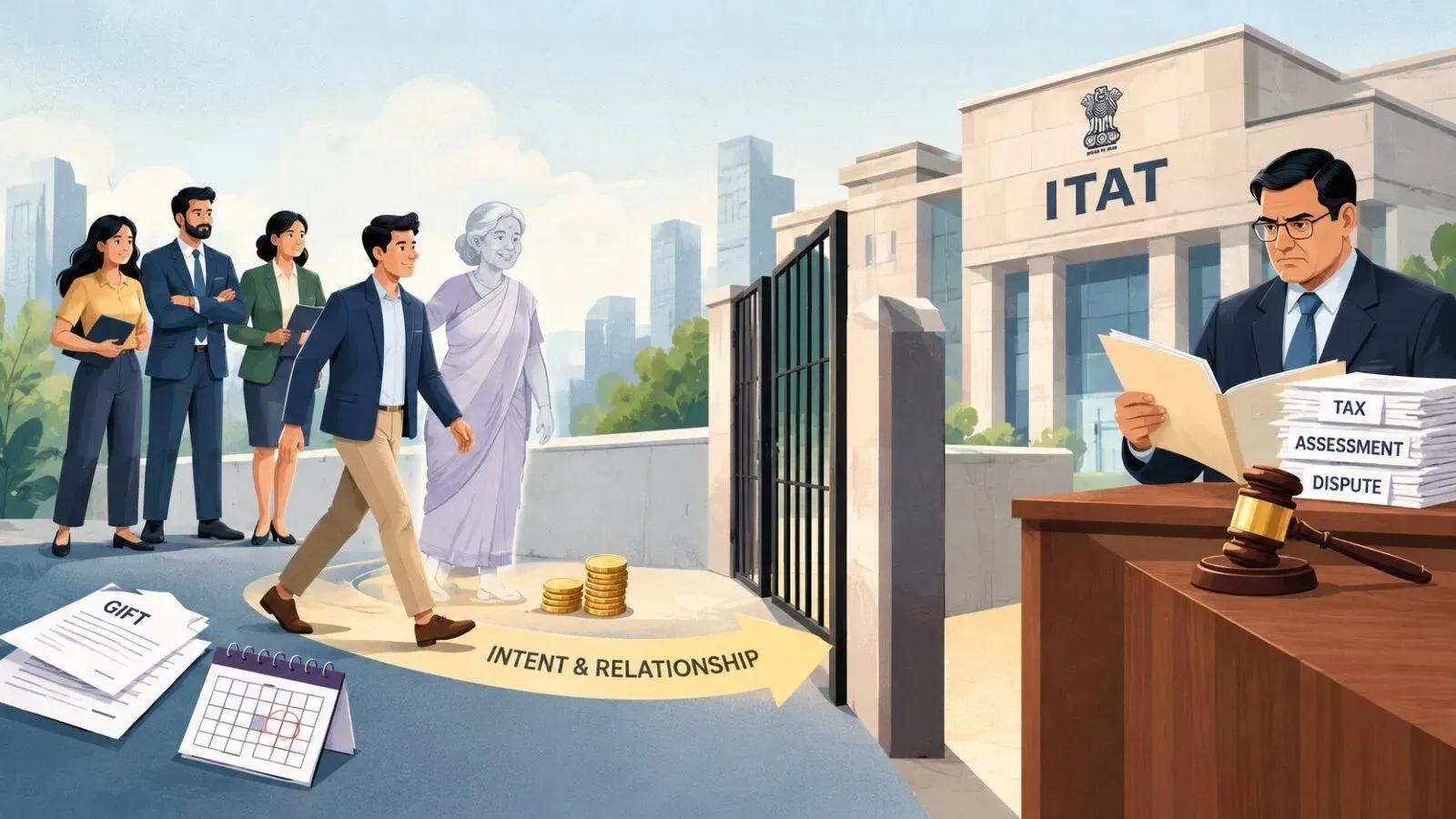
The case shows a gift from a grandparent does not need a deed. Representational image/AI generated
Anil Sharma, a contractor in Bharatpur, told the tax department that his late grandmother had gifted him ₹24,06,121. He backed it with his uncle's sworn affidavit and records showing where his grandmother's money came from. However, the department treated the entire amount as unexplained income and added it to his taxable income. The first appellate authority agreed with the department, faulting him for having no gift deed, no dates of the gift, and no money trail.
Based on the ITAT Jaipur's order dated October 26, 2026, this article explains the case history and takeaways for taxpayers.
Case history
Sharma's assessment under section 143(3) was completed on November 22, 2018, making additions of ₹3,91,61,175, comprising unexplained gifts of ₹24,06,121, unexplained expenses of ₹74,36,425 and unexplained sundry creditors of ₹2,93,18,629. His income was assessed at ₹4,45,77,740, against the returned income of ₹54,16,560.
The CIT(A) confirmed all the additions except that on sundry creditors, where relief of ₹1,88,24,970 was given and the balance addition of ₹1,04,93,659 was confirmed.
The Revenue appealed against that relief, and the assessee filed a cross objection, which was delayed by three days but condoned by the tribunal.
On the gift, Sharma's explanation was that his grandmother had given him the money, and that her own sources were three: agricultural income of ₹9,27,121, a loan of ₹5,54,000 returned to her by R.P. Sharma Contractors, a partnership firm, and sale proceeds of plots of ₹9,25,000.
In support, he filed the affidavit of his uncle, the younger son of his grandmother, confirming the gift and its sources.
However, the CIT(A) was unimpressed with his document. It noted that the affidavit lacked the basic details of how the gift was made, that no date of gifting was mentioned, and it was unclear why the grandmother would gift an odd sum of ₹9,27,121 out of agricultural income of ₹19,26,290, and that the tax audit reports did not show any repayment of the loan during the year, with no bank statements of either party to show a money trail.
CIT(A) also observed that no gift deed had been prepared, that it was unclear whether the amount came in cash or through bank transfers, and that "oral gifts cannot be considered valid except Hiba under Muslim Law without any supporting evidence"
The tribunal took a very different view. It noted that the assessee had set out the sources of his grandmother's money and had substantiated each with documents.
"None of the documents have been found to false," the bench said.
The findings of the CIT(A), it said, "only raise doubts regarding the gift given".
On the absence of a gift deed, the tribunal said, "Surely there is no requirement of gift being given only by way of a gift deed." The uncle had stated on oath that his mother had given the money to his nephew and had explained where she got it from, and "there is no requirement for the mode of giving gift also to be stated by the uncle," the tribune noted
"In the light of the above, we are of the view that the source of gifts stands adequately explained with evidence and the addition made on this account is therefore not sustainable," the bench held while directing to delete the addition of ₹24,06,121 to Sharma's total income.
The tribunal also dealt with the assessee's contention that, once a best judgment assessment is made, no separate additions can follow. It rejected that argument, holding that credits in the books can be assessed separately even where income is estimated, relying on the Supreme Court's decision in Kale Khan Mohannad Hanif v. CIT.
But it found the 25% ad hoc disallowance of expenses arbitrary, since neither the assessing officer nor the CIT(A) gave any basis for it, and restored that issue to the assessing officer to adopt a reasonable basis
It also found no infirmity in the CIT(A) excluding a bank overdraft of ₹2,41,97,454 from sundry creditors, since an overdraft is not a trade creditor, and restored the working of the remaining credits to the officer.
Takeaways
The ITAT ruling is relevant to every taxpayer who receives money from a parent or grandparent and is later asked to prove it. It sets out what a family gift actually needs: a credible account of the giver's capacity to give, supported by documents, and a witness who can confirm the giving even when there is no formal gift deed or a bank trail for an oral gift within the family.
The case shows a gift from a grandparent does not need a deed, but it does need an explanation of where the giver's money came from, documents to back that explanation, and, ideally, a witness who can confirm the giving.
However, tax experts advise to always get a gift deed done, especially when big amounts are involved, as that would serve as an additional proof during tax scrutiny.
Related News
About The Author
Next Story

