
Personal Finance News
Taxman questioned a senior citizen's ₹1.60 crore time deposit, ₹4.11 crore foreign currency investment and Section 80TTB deduction. What ITAT held

5 min read | Updated on October 26, 2026, 13:18 IST


SUMMARY
The ITAT ruling may matter to senior citizens, to non-resident and out-of-station taxpayers, and to anyone whose case has been decided ex parte because they failed to respond to tax notices
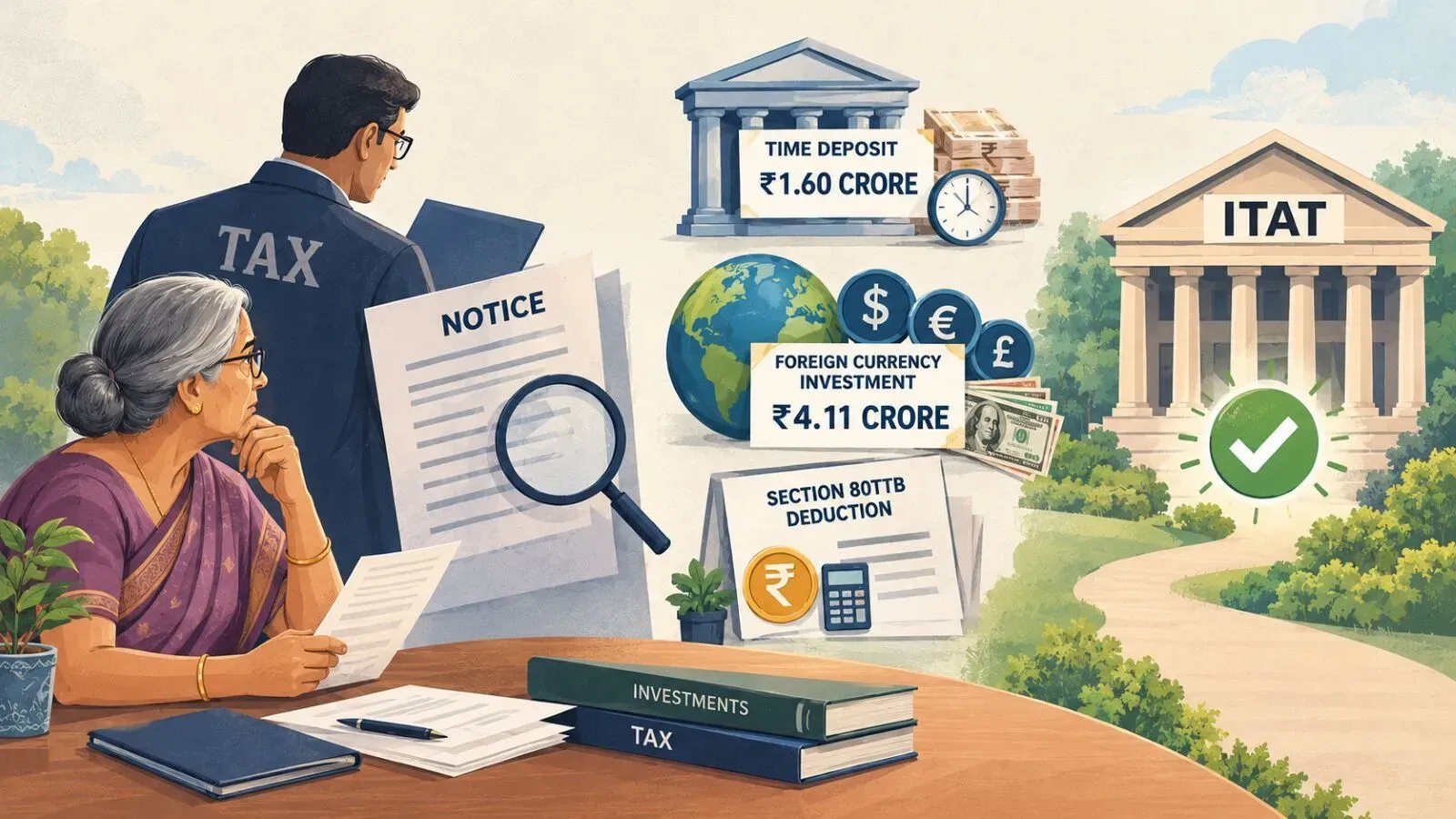
For a taxpayer living abroad or away from the address on record, unanswered notices can produce a very large ex parte demand very quickly. | Representational image/AI generated
Mangala Joshi, a senior citizen who lives outside India, had a ₹1.60 crore time deposit and ₹4.11 crore of foreign currency remittances attributed to her during assessment year 2023-24. She had filed her return declaring only ₹1,14,69,730. She also claimed a tax deduction of ₹50,000 under Chapter VI of the Income-tax Act, 1961.
When the tax department sent its notices, she could not respond. The tax officer then completed the assessment in her absence, treating the entire ₹1.60 crore time deposit as unexplained investment while adding ₹4.11 crore as well as ₹50,000 deduction to her total income for additional tax.
Based on the tribunal's order dated October 12, 2026, this article explains the case history and takeaways for readers, especially senior citizen taxpayers living abroad.
Case history
Joshi filed her return for AY 2023-24 on July 31, 2023, declaring a total income of ₹1,14,69,730. The case was picked for scrutiny under Computer-Assisted Scrutiny Selection (CASS) for verification of "large investment in purchase of foreign currency as compared to returned income".
Tax notices under sections 143(2) and 142(1), and a show cause notice under section 144, were also issued, but the department received no response from her.
From the information available with the Department, the assessing officer observed that she had made a large investment in the purchase of foreign currency of ₹4.11 crore, a time deposit of ₹1.60 crore, and a deduction claim of ₹50,000 under Chapter VI-A.
The ITAT order noted that "owing to failure on the part of assessee to respond to various notices and submit the requisite documents", the officer completed the assessment , determining the total income at ₹6.86 crore. This included an addition of ₹4.11 crore towards the foreign currency investment, ₹1.60 crore towards the time deposit, and ₹50,000 towards the Chapter VI-A deduction.
When Joshi appealed, she again could not participate, and the CIT(A) dismissed her appeal in limine. She then approached the tribunal.
Before the ITAT, her counsel said she is a senior citizen residing outside India. The investment in foreign currency, the time deposit and the deduction were all out of explained sources. And reasons beyond her control had prevented her from responding with the documents. However, he said she could substantiate her case if given an opportunity. The counsel then asked that the matter be restored to the CIT(A) for a fresh adjudication.
In her grounds of appeal, the assessee also made the broader legal point that "mere non-filing of explanations cannot automatically lead to addition under section 69 of the Act.". She said that the sums in question came out of the sale proceeds of a residential house property sold in December 2020, which had already been offered to tax in the relevant assessment years. She also challenged the disallowance of her section 80TTB deduction available to a senior citizen on interest income from bank deposits, which the officer had refused merely for want of documents.
The departmental representative, however, opposed her plea, submitting that despite ample opportunity the assessee had remained "recalcitrant" and furnished nothing, so the CIT(A) had rightly dismissed her appeal.
The tribunal weighed the two arguments and allowed a fresh hearing. Noting that the assessee had participated neither before the assessing officer nor before the first appellate authority, it recorded her counsel's submission that she is a senior citizen residing outside India and that, if given an opportunity, "the assessee is in a position to explain the source of investment which is made out of the sale of residential house and paid due taxes".
The tribunal did not decide whether the ₹1.60 crore time deposit, the ₹4.11 crore of foreign currency remittances or the ₹50,000 deduction were rightly or wrongly treated. Instead, "in the larger interest of justice," it set aside the CIT(A)'s order and remitted the matter for a fresh hearing.
However, the relief came with conditions. She has been directed to cooperate with the department, to update her registered email id and contact details on the ITBA portal. She would also need to appear on the appointed date of hearing without seeking adjournment unless otherwise required.
Takeaways
The ITAT ruling may matter to senior citizens, to non-resident and out-of-station taxpayers, and to anyone whose case has been decided ex parte because they failed to respond to tax notices. It shows that non-response, by itself, need not be fatal. In stead, one can get a fresh hearing to reopen the question of whether an investment is really unexplained.
Further, for a taxpayer living abroad or away from the address on record, unanswered notices can produce a very large ex parte demand very quickly. But this order confirms that where the non-appearance is explained and the sources are capable of being proved, the appellate tribunal may restore the case for a fresh hearing. However, the taxpayer must then actually turn up, update her contact details, and produce the documents.
Related News

About The Author
Next Story

