
Personal Finance News
He took ₹11 lakh cash advance for selling his house and was hit with an equal penalty; how 'ignorance of law' helped him win at ITAT

5 min read | Updated on November 15, 2026, 11:38 IST

SUMMARY
The ITAT ruling in this farmer's case is relevant for property sellers in areas where cash still changes hands in land deals, and where the 2015 amendment to section 269SS is not widely understood.
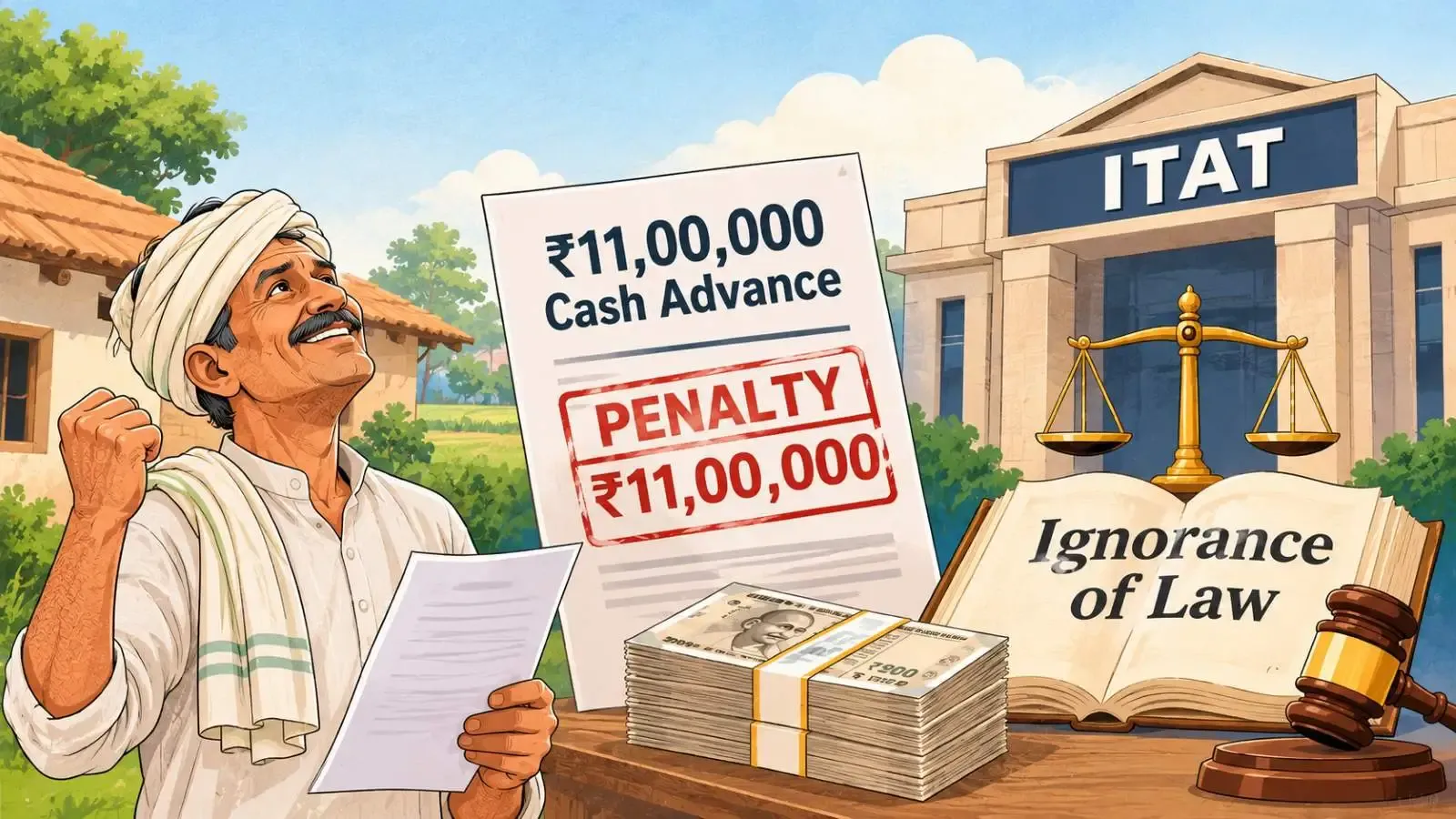
He was a farmer and a non-filer who had never been assessed to income tax before. | Representational image/Shutterstock
Omprakash Saloniya, a farmer from a remote village in Kota district, sold his house for ₹22,50,000. Of that, he received ₹11,00,000 in cash as advance, and the rest through banking channels. The cash receipt, however, breached section 269SS of the Income-tax Act, which bars anyone from accepting more than ₹20,000 in cash as advance or consideration for the sale of immovable property.
As a result, the Income Tax Department levied a penalty of ₹11,00,000 under section 271D, which is equal to the amount received in cash. The first appellate authority confirmed the penalty, holding that ignorance of the law is no defence.
Based on the ITAT order, this article explains the case history and takeaways for taxpayers in a similar situation like Saloniya.
Case history
Saloniya sold his house for a consideration of ₹22,50,000, and received ₹11,00,000 of it in cash from the buyer. The cash receipt was held as a violation of section 269SS of the Income-tax Act, 1961 by the assessing officer. He imposed a penalty of ₹11,00,000 under section 271D as it provides for levying a penalty equal to the amount accepted in breach in case of cash transactions above ₹20,000. The CIT(A) also agreed with the assessing officer.
Saloniya gave three reasons in his defence:
Saloniya also said he was willing to take the entire amount through banking channels but yielded to the buyer, who insisted on paying in cash.
He further pointed out that the department had also scrutinised the transaction and no addition was made on account of any unaccounted money.
However, the CIT(A) was not persuaded. It held that ignorance of law could not be regarded as reasonable cause under section 273B
What the ITAT held
The tribunal disagreed with CIT(A). It noted that the assessee's factual claim that he was a villager, an agriculturalist in a remote village, a non-filer who had nothing to do with income tax proceedings in the past, was not "controverted by the Revenue."
His plea of ignorance of the law could therefore "be reasonably believed to be true," the ITAT said.
The bench also found that he had acted bona fide, having executed the sale agreement at the full transaction value including the cash, even though the stamp duty value was far lower.
The fact that the department itself found no unaccounted money in the transaction added strength to his case that he never intended to evade tax.
On the legal point, the tribunal relied on the Supreme Court's decision in Motilal Padampat Sugar Mills Co. Ltd. v. State of UP, which held that "there is no presumption that every person knows the law. It is often said that everyone is presumed to know the law but that is not a correct statement. There is no such maxim known to law."
"The finding of the Ld. CIT(A) therefore that ignorance of law cannot be a valid defense from the levy of penalty, we hold is incorrect," the ITAT observed.
The tribunal further said, "The breach of the assessee therefore of the provisions of Section 269SS of the Act, we agree with the Ld. Counsel for the assessee can be reasonably said to flow from a bona fide belief that the assessee had not acted in any violation of law."
"And therefore we hold that the reasons adduced by the assessee for violating the provisions of Section 269SS of the Act constitute reasonable cause," it added.
The ITAT set aside the order of the Ld.CIT(A), saying, "No penalty, we hold , is leviable on the assessee u/s 271D of the Act and the penalty levied of ₹11,00,000/- is directed to be deleted."
Takeaways
The ruling is relevant for property sellers in areas where cash still changes hands in land deals, and where the 2015 amendment to section 269SS is not widely understood.
The practical takeaways from the case cut both ways. Under Section 269SS, a cash advance above ₹20,000 on a property sale can attract a penalty equal to the entire amount. However, the penalty is not inevitable in every case as this one shows.
Where the taxpayer is credible, the transaction is fully disclosed in a registered deed, and the department itself finds no unaccounted money, a reasonable cause under section 273B may still save the taxpayer.
However, the safer course, of course, is to take the money through banking channels and not test the proposition.
Related News
About The Author
Next Story

