
Personal Finance News
8th Pay Commission: Pensioners renew a demand rejected by 7th CPC; how it will impact pension, family pension and gratuity

5 min read | Updated on November 18, 2026, 07:21 IST

SUMMARY
It remains to be seen whether 8th CPC makes a choice between a rate that rewards long service proportionally and a floor or fixed minimum pension that protects the shortest and lowest-paid careers, or both at once.
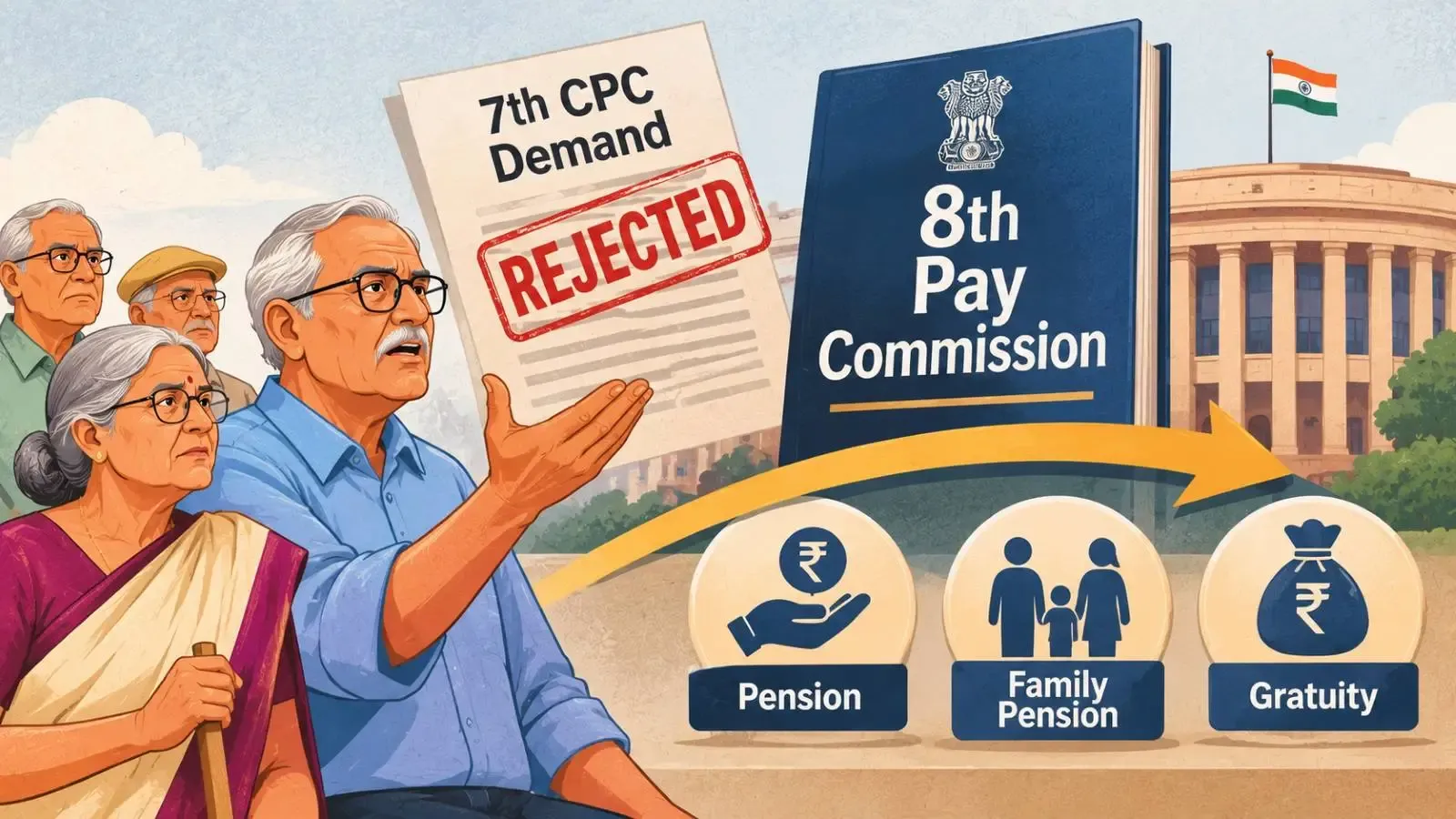
A higher pension rate does not increase gratuity, because gratuity is not calculated on pension. | Representational image/AI generated
The 7th CPC noted, “A number of entities have, while seeking a raise in pension from the existing level of 50 percent of last pay drawn, questioned the basis for determination of pension at 50 percent of last pay drawn. Similarly representations for increasing family pension from existing 30 percent to 50 percent of the last pay drawn have been received by the Commission.”
The 7th CPC’s reasoning is worth revisiting, because it is the argument the 8th CPC is likely to hear. The VI CPC had fixed pension at “50 percent of last pay or the average emoluments (for last 10 months) whichever is more beneficial,” and delinked it from the 33-year qualifying service requirement.
So “effectively the dispensation on pension has already been liberalized,” the 7th CPC said, adding its own pay recommendations would lift the last pay itself, and therefore the pension. “Therefore the Commission does not recommend any further increase in the rate of pension and family pension from the existing levels,” 7th CPC said. What the Bharat Pensioners Samaj )BPS) now seeks is a package of three linked numbers. “Minimum pension of ₹45,000, pension at 67% of last pay drawn and family pension at 50% of last pay drawn,” BPS said in its memorandum to the 8th CPC.
What 67% would actually pay
For example, take a Level 6 employee under the current 7th CPC pay matrix retiring on a last basic pay of ₹44,900. Holding everything else constant, at 50% the monthly pension is ₹22,450. At 67% it becomes ₹30,083, which is an increase of ₹7,633 a month, or ₹91,596 over a year.
| Measure | At 50% of last pay | At 67% of last pay | Difference |
|---|---|---|---|
| Monthly pension (₹44,900 last pay) | ₹22,450 | ₹30,083 | +₹7,633 |
| Annual pension | ₹2,69,400 | ₹3,60,996 | +₹91,596 |
| Family pension at 30% / 50% | ₹13,470 | ₹22,450 | +₹8,980 |
| Illustration on a last basic pay of ₹44,900 (Level 6 entry pay), excluding dearness relief and other allowances |
67% is 34% more than 50%. If the BPS’ recommendation is accepted, the percentage change will be the same for every pensioner, but the rupee difference will scale with last pay. For instance, a Level 1 retiree on ₹18,000 would gain ₹3,060 a month; a Level 12 retiree on ₹78,800 would gain ₹13,396. That is why the BPS has paired its rate demand with a minimum pension of ₹45,000, as a percentage increase alone would not do much for the lowest pensions.
How it flows into family pension
The family pension demand follows the same logic. The 7th CPC left the rate at 30% of last pay drawn after having received representations to raise it to 50. On a last pay of ₹44,900, 30% is ₹13,470 a month; 50% would be ₹22,450, which is a difference of ₹8,980 a month for a widow or dependent. If both demands are expected by the 8th CPC, a family pensioner payout would move up by two-thirds.
The 7th CPC recorded that enhanced family pension is payable, for death in service, “for a period of ten years from the date of death of a government servant, without any upper age limit,” and for death after retirement “for a period of seven years or up to the date on which he would have attained 67 years had he survived, whichever is less.” It, however, declined to extend the second period to ten years.
What it does not flow into: gratuity
One assumption that circulates widely needs correcting ahead of the 8th CPC report. A higher pension rate does not increase gratuity, because gratuity is not calculated on pension. Under the rules the 7th CPC set out, retirement gratuity is “one-fourth of his emoluments for each completed six monthly period of qualifying service subject to a maximum of 16.5 times of the last emoluments,” with the ceiling raised from ₹10 lakh to ₹20 lakh and indexed to rise “by 25 percent whenever DA rises by 50 percent.” The ceiling has now been already increased to ₹25 lakh.
On a last basic pay of ₹44,900 with DA at 63%, 16.5 times the emoluments is about ₹12.08 lakh, which is well below the ceiling. A pensioner at this level gains nothing on gratuity from a change in the pension rate. Only a pay revision, which lifts emoluments, can move that figure.
What the 8th CPC has to weigh
The cost of higher pension is easy to state and hard to absorb: A 34% hike in pension of every civil pensioner, at a time when the government's pension bill is among its largest revenue commitments. The 7th CPC's counter was that pensioners gain through pay revision, since pension is a percentage of last pay and last pay rises with each commission. The BPS’ answer is the ₹45,000 floor, which no percentage increase can deliver on its own.
It remains to be seen whether 8th CPC makes a choice between a rate that rewards long service proportionally and a floor or fixed minimum pension that protects the shortest and lowest-paid careers, or, as the BPS proposes, both at once.
Related News
About The Author
Next Story

