
Personal Finance News
Do you pay tax when switching mutual fund schemes within the same fund house?

4 min read | Updated on August 14, 2026, 12:31 IST


SUMMARY
While the decision to switch is entirely personal, mutual fund investors should understand that switching from one scheme to another is treated as a redemption for tax purposes.

So, before switching between mutual fund schemes, investors should check both the tax impact and any applicable exit load. | Image: Shutterstock.
An investor can switch schemes in two ways. One option is to redeem the units from the existing scheme and invest the proceeds in another fund. The second is to place a switch request with the fund house, instructing it to redeem units from one scheme and invest the proceeds in another.
In both cases, the switch is treated as a redemption from the original scheme, and any taxable capital gains arising from that redemption are subject to tax. The tax treatment depends on factors such as the type of mutual fund and the period for which the investment was held.
In this article, we explain how switching between mutual fund schemes works, when it triggers capital gains tax, and how much tax an investor may have to pay when moving from one scheme to another.
"Even if you switch from one mutual fund scheme to another within the same fund house (AMC), it is treated as a redemption (sale) of your existing units and a fresh investment in the new scheme. This means any capital gains earned on the original investment are taxable in the year you make the switch," said CA Abhishek Soni, CEO & Co-founder, Tax2win.
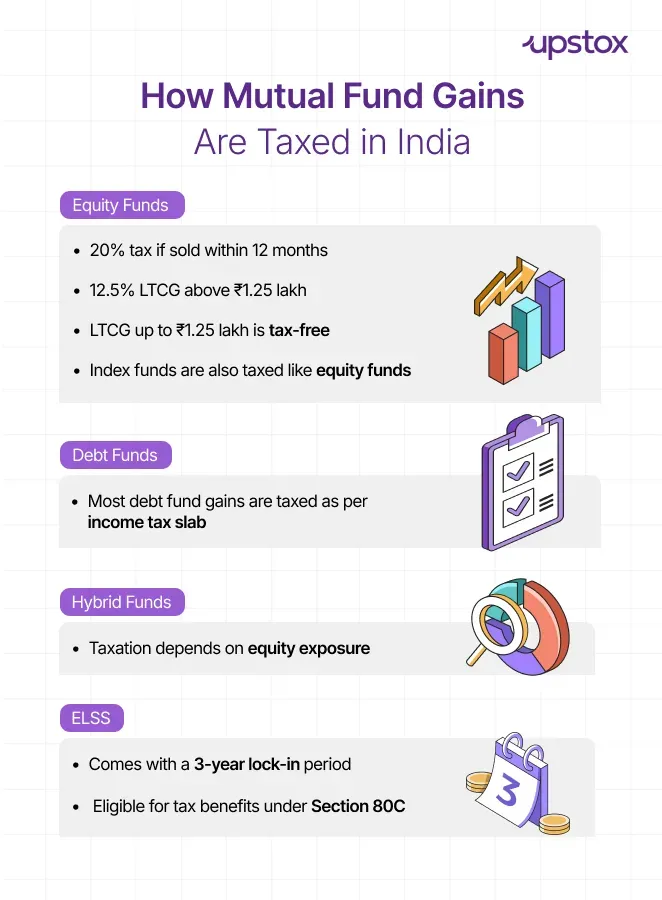
How much tax you pay depends mainly on two things: the type of mutual fund you choose (equity, debt, or hybrid) and how long you stay invested. Different types of funds follow different tax rules, so equity, debt, and hybrid funds are not treated the same.
Equity mutual funds taxation
-
Short-term capital gains (held for 12 months or less): 20%
-
Long-term capital gains (held for more than 12 months): 12.5% on gains above ₹1.25 lakh in a financial year
-
Long-term gains up to ₹1.25 lakh: Tax-free
Index mutual funds taxation
Index funds are also treated as equity-oriented mutual funds for taxation purposes.
Debt mutual funds taxation
Tax rules for debt mutual funds have changed significantly in recent years. For investments made on or after April 1, 2023, gains from most debt mutual funds are generally taxed at the investor's applicable tax slab rate.
Some investments made before April 1, 2023, may continue to receive different tax treatment depending on the holding period and the applicable rules.
Hybrid mutual funds taxation
Hybrid mutual funds tax treatment depends largely on how much of the portfolio is invested in equities.
If a hybrid fund invests 65% or more in equity, it is generally treated as an equity-oriented fund for tax purposes. In that case:
-
Short-term capital gains: 20%
-
Long-term capital gains: 12.5% on gains above ₹1.25 lakh in a financial year
-
Long-term gains up to ₹1.25 lakh: Tax-free
Funds that do not meet the equity threshold can have different tax treatment, depending on their classification and the applicable tax rules.
ELSS taxation
Equity Linked Savings Schemes (ELSS) are equity mutual funds that come with a three-year lock-in period.
Once the lock-in period ends, gains from ELSS are treated as long-term capital gains. These gains are taxed at 12.5% on the amount exceeding ₹1.25 lakh in a financial year.
ELSS investments can also qualify for a deduction of up to ₹1.5 lakh under Section 80C, but this benefit is available only to taxpayers who opt for the old tax regime.
So, before switching between mutual fund schemes, investors should check both the tax impact and any applicable exit load.
Related News



About The Author
Next Story

