
Personal Finance News
These govt employees were denied July 1 annual increment for retiring on June 30; SC grants relief
4 min read | Updated on October 14, 2026, 16:13 IST

SUMMARY
The case highlights a calendar quirk affecting a number of government retirees. Employees who complete a year of service earn an increment. When the increment date falls a day after retirement, states have often used the gap to deny both the increment and the pension built on it.
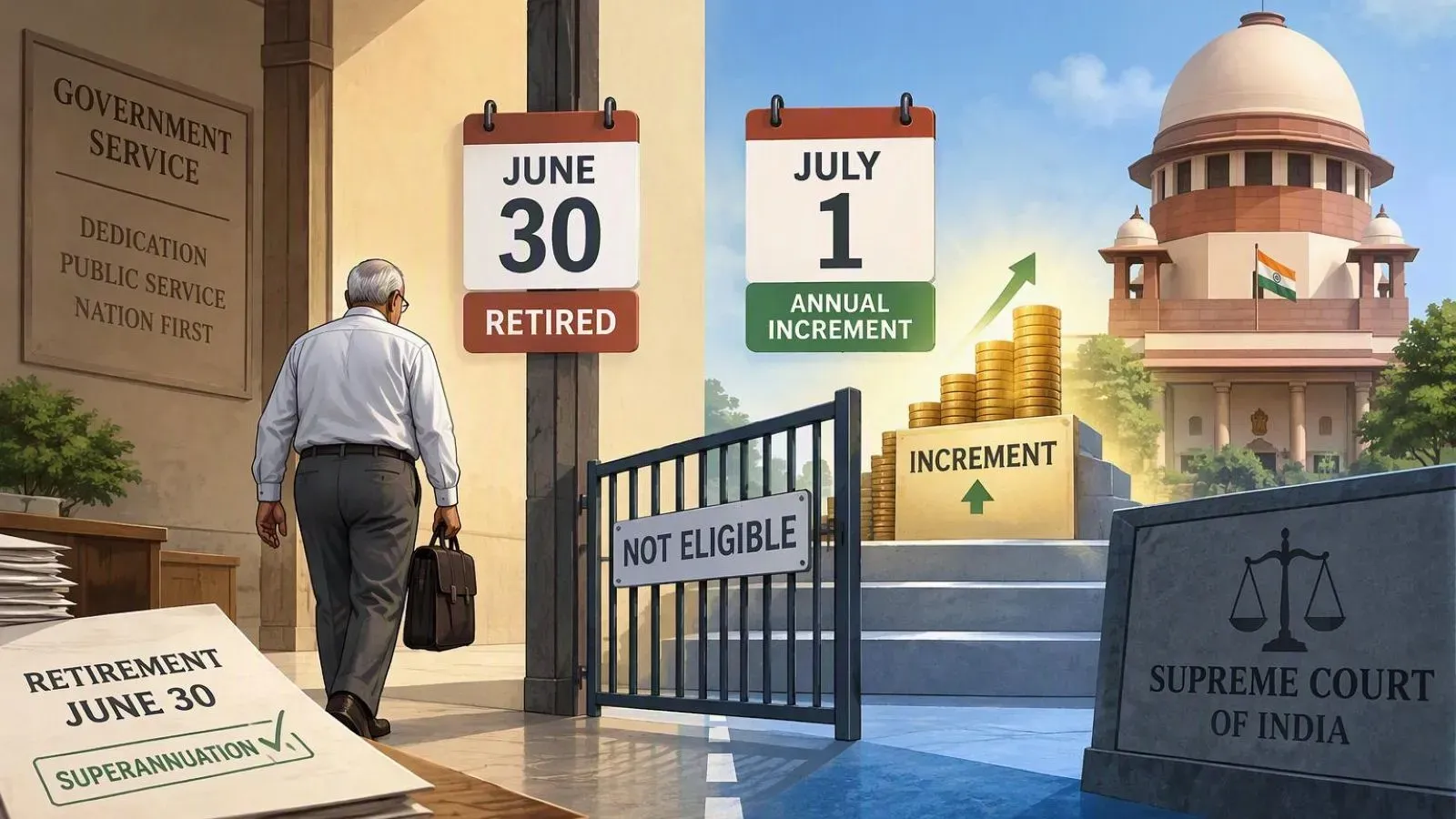
All the appellants had served in the Irrigation Department for over 30 years. | Representational image/AI Generated
A government employee's annual increment fell due on July 1 but he had retired the previous day, on June 30. Due to the one-day gap, the Gujarat government refused the increment, along with the higher pension built on it, to him and several others who had retired like him. However, the Supreme Court recently restored the benefit to these employees and asked the government to release their dues within 30 days.
The case highlights a calendar quirk affecting a number of government retirees. Employees who complete a year of service earn an increment. When the increment date falls a day after retirement, states have often used the gap to deny both the increment and the pension built on it.
Based on the SC judgement dated October 6, 2026, this article explains key details of the case.
The order
The judgment was delivered by a bench of Justices Sanjay Kumar and Sanjeev Sachdeva in Chhaganbhai Kohyabhai Pateliya and others v. The State of Gujarat and others.
The appellants had retired on June 30 of various years from the Irrigation Department of the state but were denied the benefit of the increment which fell due on the July 1 of those years.
When the State argued that arrears should not follow, the judge pointed to Pravinbhai Khemabhai Patel v. State of Gujarat judgement, where a co-ordinate bench had ordered payment along with arrears.
Holding that the right to be paid an increment was the legitimate right of an employee upon successful completion of a year of employment, the apex court in the present case directed arrears too while setting a 30-day timeframe for the exercise, failing which interest at 6% would be payable.
Why the case reached the Supreme Court
What the Supreme Court said
The top court noted that all the appellants had served in the Irrigation Department for over 30 years. Also, as per the Government Resolution dated October 17, 1988, daily-wage skilled workers who had completed 10 years of service as on October 1, 1988 were to be treated as permanent with running payscale of the cadre concerned and the salary, dearness allowance, house rent allowance, pension, gratuity and provident fund, etc. The age of superannuation of such workers was fixed at 60 years. The Additional Solicitor General appearing for the state did not dispute that all the petitioners fell in that category.
The court declined to go into individual facts. It applied its own order of February 20, 2025, which modified clause (d) of an earlier direction, saying: "In case any retired employee has filed an application for intervention/impleadment/writ petition/original application before the Central Administrative Tribunal/High Courts/this Court, the enhanced pension by including one increment will be payable for the period of three years prior to the month in which the application for intervention/impleadment/writ petition/original application was filed."
As the appellants had filed their writ petition in 2022, they fell within this modified clause (d).
"As it is an admitted fact that the appellants filed their writ petition in the year 2022 itself, they would be covered by the modified clause (d), which provided that enhanced pension, by including one increment, would be payable for the period of 3 years prior to the month in which the writ petition was filed," SC said.
"Therefore, the appellants would be entitled to the benefit of the increment and the pension payable, taking into account the said increment, in terms of the modified clause (d).," it added.
Related News
About The Author
Next Story

