
Personal Finance News
8th Pay Commission matrix: What 3 fitment factor demands mean for Levels 1, 6, and 18 salaries

5 min read | Updated on November 11, 2026, 18:25 IST

SUMMARY
The 8th Pay Commission has not indicated any preference yet. What the memorandums have done is set out three internally consistent packages, each with a factor, a minimum wage and an argument behind it.
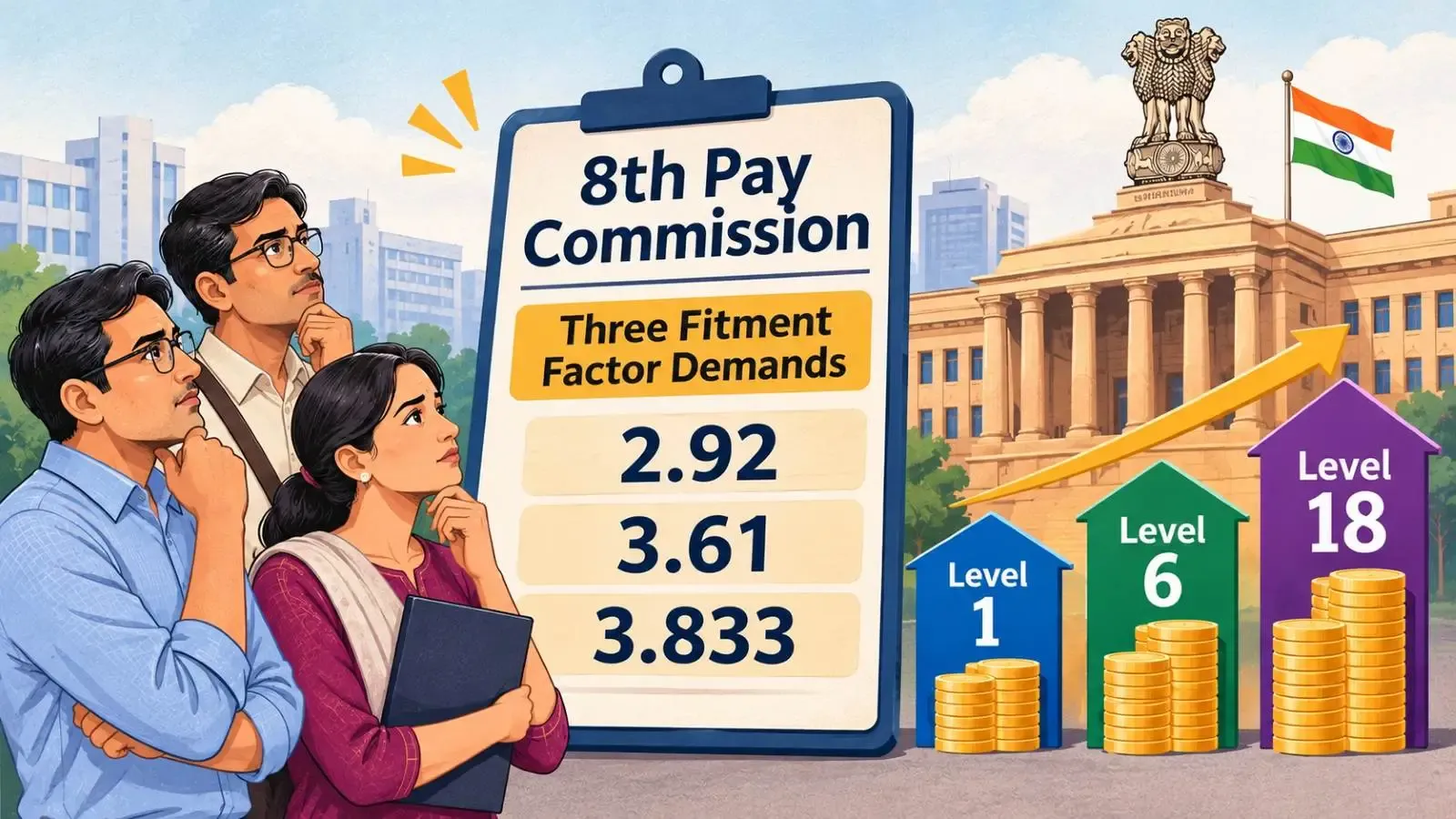
IRTSA argued that one multiplier or fitment cannot serve every level. | Representational image/AI generated
The fitment factor, or the multiplier applied to existing basic pay to arrive at the revised figure, sits at the centre of almost every memorandum filed by staff bodies with the 8th CPC. Here is what each one is, who is asking for it, and what it would actually pay at the bottom, middle and top of the 8th CPC matrix.
But first, let's understand the 2.57 fitment currently offered under the 7th CPC. No staff union has asked the 8th CPC to repeat the 7th CPC's fitment factor of 2.57. Assuming it remains same under the 8th CPC, the minimum salary at Level 1 can jump to ₹46,300, arrived at by multiplying the 7th CPC minimum salary of ₹18,000 by a factor of 2.57.
Here, 2.57 fitment factor needs one clarity before any comparison: it was not a flat raise under the 7th CPC. “Of this multiple, 2.25 provides for merging of basic pay with DA, assumed at 125 percent on 01.01.2016, while the balance is the real increase being recommended by the Commission,” the 7th CPC report said, putting the real increase at 14.2%.
However, with DA at 63% today, rather than 125%, a factor of 2.57 applied now would do considerably more than neutralise prices. This is why the number the 8th CPC picks will not be directly comparable to its predecessor.
3.833 fitment
The highest fitment demand has come from the National Council-JCM staff side. It has proposed the fitment formula for the existing employees and pensioners at 3.833. If approved, this fitment will take the minimum salary to ₹69,000.
The Bharat Pensioners Samaj and FNPO have also proposed minimum pay of ₹69,000 with a fitment factor of 3.83.
The Ministerial Staff Association (MSA) has proposed a fitment of 3.61.
“A factor of 3.61 should be applied to the existing basic pay to compensate for inflation and bridge the PSU/private sector parity gap,” MSA said in its memorandum, pairing it with a minimum wage of ₹65,000.
The Indian Railways Technical Supervisors Association (IRTSA) argued that one multiplier or fitment cannot serve every level. Its proposed factor starts at 2.92 for Level 1, rises to 3.50 for Levels 4 to 8 and 3.80 for Levels 9 to 13, then 4.09 for Levels 14 to 16 and 4.38 for Levels 17 and 18.
“Multiple fitment factors have to be adopted for different level,” it argued, because the pay structure must reflect “the substantial difference in duties and responsibilities of various posts.” IRTSA's minimum proposed pay works out to ₹52,600, which is 2.92 times of 7th CPC minimum pay.
| Proposal | Factor | Level 1 (₹18,000) | Level 6 (₹35,400) | Level 18 (₹2,50,000) |
|---|---|---|---|---|
| 7th CPC (reference) | 2.57 | ₹46,300 | ₹91,000 | ₹6,42,500 |
| IRTSA (graded) | 2.92 / 3.50 / 4.38 | ₹52,600 | ₹1,23,900 | ₹10,95,000 |
| MSA | 3.61 | ₹65,000 | ₹1,27,800 | ₹9,02,500 |
| NCJCM, BPS, FNPO | 3.833 | ₹69,000 | ₹1,35,700 | ₹9,58,300 |
In the table above, the spread is wide reading down the columns. At Level 1, the entry pay ranges from ₹46,300 under the 7th CPC's own factor to ₹69,000 under the NCJCM and BPS proposals. At Level 6, the range is ₹91,000 to ₹1,35,700. At Level 18, it runs from ₹6,42,500 to ₹10,95,000, with the IRTSA's graded approach producing the highest figure of all at the top even though it produces the second-lowest at the bottom.
Here, one pattern is worth pausing on because it explains what the argument is really about. Multiply ₹18,000 by each proposal's factor for Level 1 and the results are ₹52,560, ₹64,980 and ₹68,994. After rounding off, these are precisely the minimum pay figures of ₹52,600, ₹65,000 and ₹69,000 that these staff bodies have proposed. Therefore, the fitment factor and the minimum wage are not two demands but one, stated in two ways. To accept a union's minimum pay is to accept its factor, and vice versa.
Please note, none of these numbers has been accepted. The 8th Pay Commission has not indicated any preference yet. What the memorandums have done is set out three internally consistent packages, each with a factor, a minimum wage and an argument behind it. When the final 8th CPC report arrives sometime in 2027, one of them, or something close to it, may become the number every pay slip is calculated from.
Related News

About The Author
Next Story

