
Personal Finance News
8th Pay Commission: Two pay compression ratio proposals compared; how salaries could differ across levels

4 min read | Updated on November 13, 2026, 21:25 IST

SUMMARY
The 7th Pay Commission was on the side of a modest ratio, and defended it with the like-to-like measure. The 8th Pay Commission may also face the same argument.
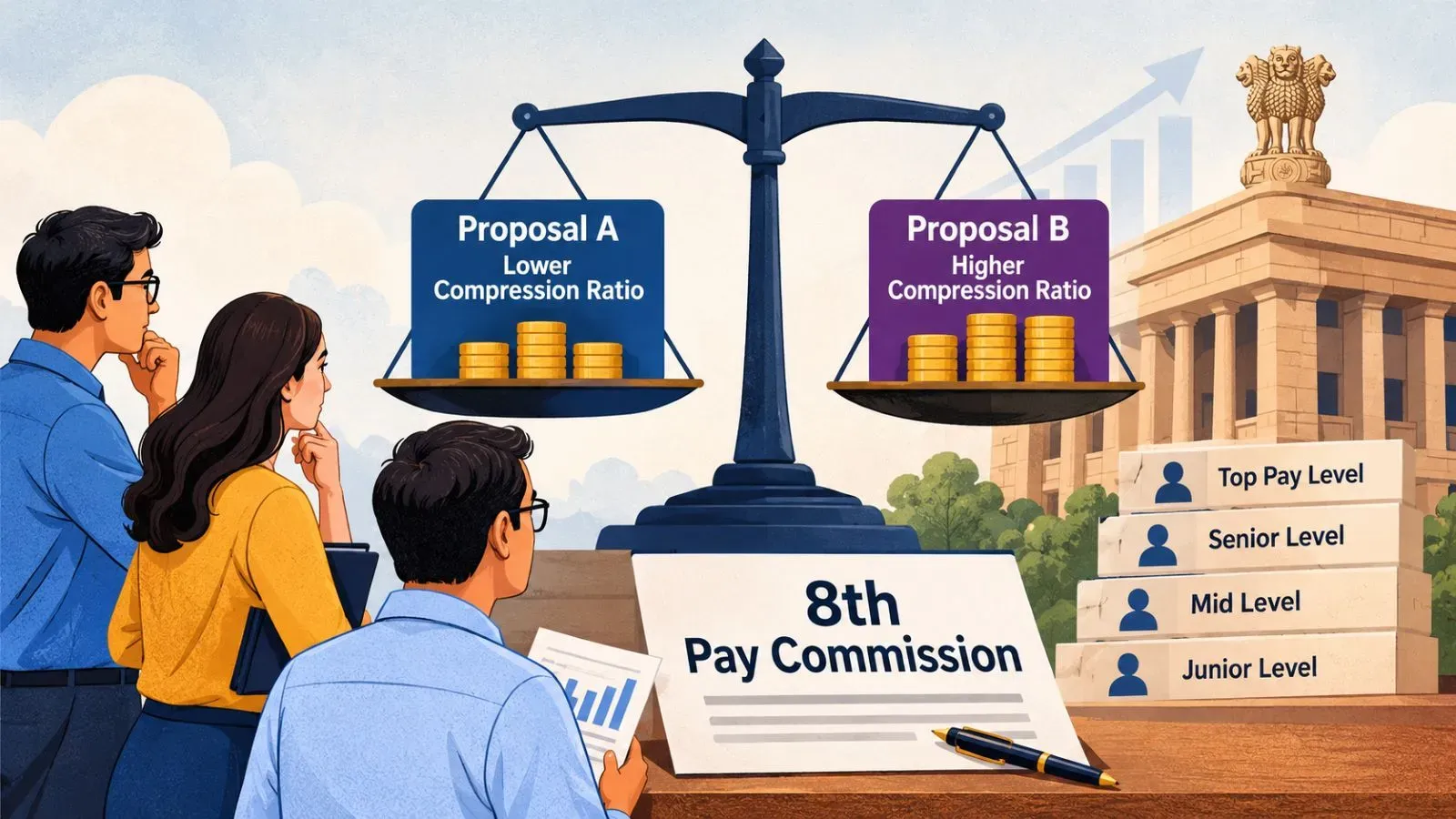
Under the IRTSA's graded factors proposal, the Level 1 employee gains less than the average. | Representational image/AI generated
But before proceeding, let's have a look at what the 7th CPC said.
The 7th Pay Commission measured the compression ratio in two ways and was clear about which it preferred.
“Comparison of entry pay of the lowest functionary in the government with the highest pay drawn by the Secretary to Government of India is not appropriate. The comparison should be like to like,” it held, before settling on Group C entry pay against Group A entry pay: ₹18,000 against ₹56,100, giving “a compression ratio… arrived at 1: 3.12,” the 7th CPC report said.
The 7th CPC offered a second measure for completeness, saying the maximum pay of someone who joined at Level 1, served 35 years and progressed only through MACP (₹56,800), against the apex-level maximum of ₹2,25,000, which gives 1:3.96. However, it concluded that “the minimum pay at entry level is considered a better comparator.”
In the lead up to the 8th CPC report in 2027, the measure most staff unions have demanded is a third one: minimum against maximum, ₹18,000 against the ₹2,50,000 entry pay of Level 18. That ratio is 1:13.9. It is not the ratio the 7th CPC used to justify its structure, but it is the one that many employees’ bodies have been demanding.
The Ministerial Staff Association proposed a ratio of 1:13 between the minimum and maximum pay, setting the Secretary-level pay at ₹9,00,000, against a minimum of ₹65,000. However, a quick calculation based on these two figures show something unexpected: ₹65,000 to ₹9,00,000 is a ratio of 1:13.85, which is almost exactly the 1:13.9 that the present matrix already produces.
The above shows that the MSA is not proposing to widen the ratio at all. Instead, it has proposed to raise both minimum and maximum salaries by a fitment factor of roughly 3.6 times.
A uniform fitment factor multiplies every level by the same amount. So it cannot change a ratio between any two of them. Applying 3.61 across the matrix takes Level 1 minimum pay rfrom ₹18,000 to ₹65,000, while Level 18 rises from ₹2,50,000 to ₹9,02,500. And the ratio between them stays at 1:13.9 to the second decimal.
Graded fitment factor can change the compression ratio
Only a graded factor can change the ratio. The Indian Railways Technical Supervisors Association (IRTSA) has proposed fitment factors running from 2.92 at Level 1 to 4.38 at Levels 17 and 18. Runing these numbers through the current 7th CPC matrix shows minimum pay rising to ₹52,600 while the top level pay becomes ₹10,95,000, giving a ratio of 1:20.8.
| Level | 7th CPC Entry Pay | Uniform Factor 3.61 | IRTSA Graded Factor | IRTSA Pay |
|---|---|---|---|---|
| 1 | ₹18,000 | ₹65,000 | 2.92 | ₹52,600 |
| 6 | ₹35,400 | ₹1,27,800 | 3.50 | ₹1,23,900 |
| 12 | ₹78,800 | ₹2,84,500 | 3.80 | ₹2,99,500 |
| 18 | ₹2,50,000 | ₹9,02,500 | 4.38 | ₹10,95,000 |
| Minimum-to-maximum ratio | 1 : 13.9 | 1 : 13.9 (unchanged) | — | 1 : 20.8 |
Under a uniform fitment factor, a Level 1 employee and a Level 18 officer both would gain about 3.6 times in absolute terms. However, the distance between them in proportional terms would be unchanged.
Under the IRTSA's graded factors proposal, the Level 1 employee gains less than the average while the officer at the top gains more. The salary ladder in this case steepens, and the reward for reaching higher levels grows relative to the reward for staying at the bottom.
For an employee, this raises two practical questions.
First, is the floor being raised enough? A wider ratio achieved by holding the bottom down is not a gain for a majority of employees, who, say, are sitting in Levels 1 to 6.
Second, is a promotion worth the additional responsibility? A very narrow ratio would make seniority and promotion financially pointless. This is also one of the complaint that has driven the MACP demands.
The 7th CPC was on the side of a modest ratio, and defended it with the like-to-like measure. The 8th CPC may also face the same argument, with one addition: several unions have now proposed graded factors that, if accepted, would widen the ratio sharply.
Related News


About The Author
Next Story

