
Personal Finance News
8th Pay Commission: How much 12-month arrears could you get if the fitment factor matches the 7th CPC?

4 min read | Updated on November 08, 2026, 15:53 IST

SUMMARY
8th Pay Commission: Actual pay fixation, fitment factor, DA rates, allowances and arrears eligibility will all be settled by government orders issued after the Commission reports.
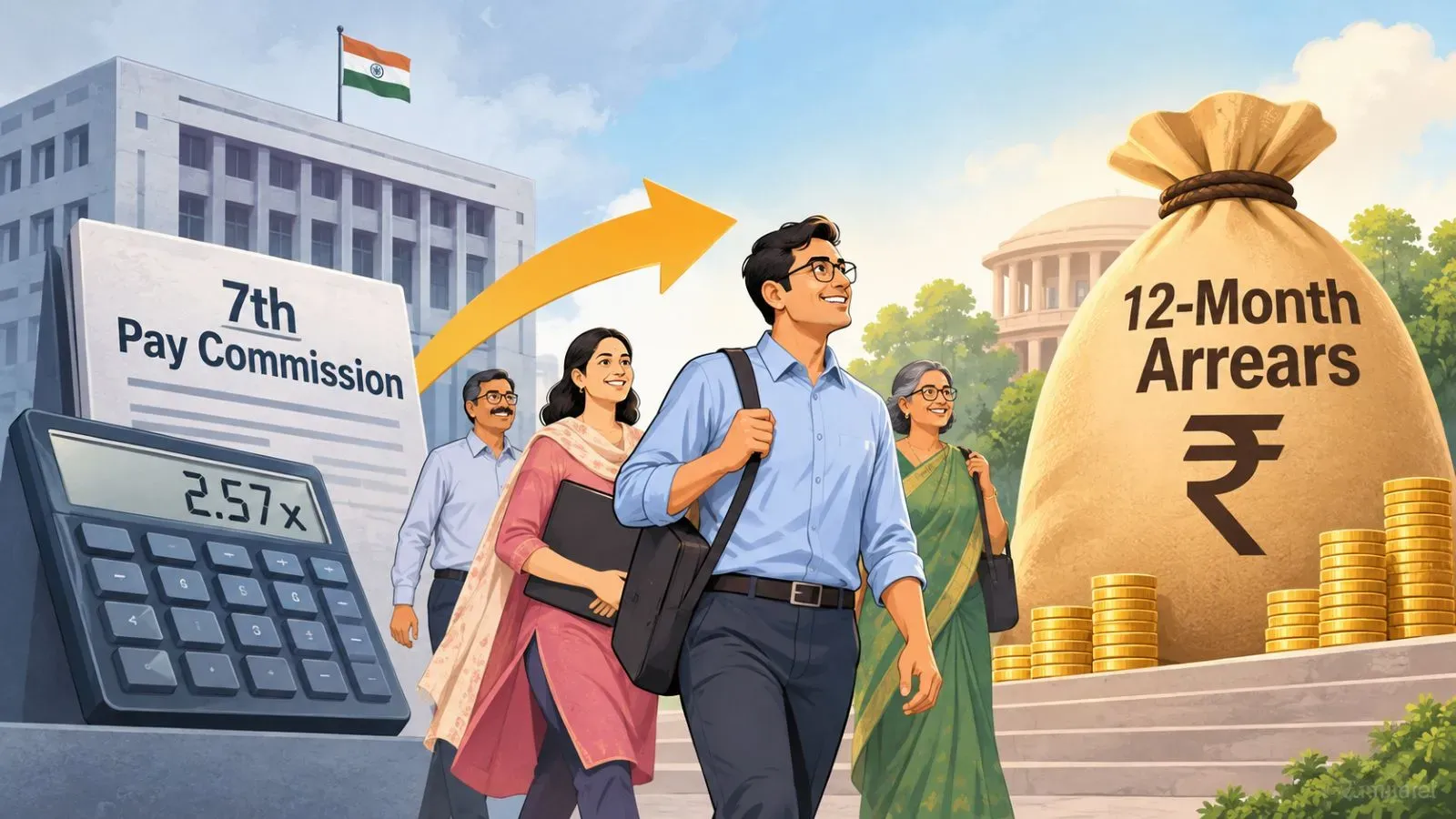
The 8th CPC is due for implementation from January 1, 2026. Representational image/AI generated
Yet, many employees are eager to estimate the potential hike in their salaries, the fitment factor and even the arrears they may receive due to delayed implementation of the 8th CPC. This article attempts to provide an indicative estimate through an illustrative calculation of what 12 months of arrears up to the end of 2026 end could look like, based on five assumptions:
-
One, the effective date. This calculation assumes revised pay takes effect from January 1, 2026, the date the 8th CPC is expected to be implemented from.
-
Two, the fitment factor. This is the most tricky part as no one can be sure about the fitment factor the 8th CPC may recommend. The 7th CPC used a fitment factor of 2.57, while 2.92, 3.61 and 3.83 are demands made by several staff bodies. For this article, let's assume the 7th CPC fitment remains unchanged.
-
Three, dearness allowance in the new pay structure under the 8th CPC is expected to start at zero, just like the previous pay commission. This is because the accumulated DA is absorbed into the revised basic pay.
-
Four, house rent allowance and transport allowance are left at 7th CPC rates, so no arrears are counted on them.
-
Five, deductions like income tax, CGHS, CGEGIS and NPS are all excluded from the calculation
Calculation
For understanding, let's take an example of a Level 6 employee drawing basic pay of ₹44,900.
₹44,900 × 2.57 = ₹1,15,393, rounded up to the next ₹100, which gives ₹1,15,400. This is the projected basic pay in this example if the fitment factor remains same as the 7th CPC.
In 2026, the 7th CPC DA rate changed mid-year: 60% until June, and 63% from July. So for January to June, the monthly figure is ₹44,900 plus 60% (₹26,940), or ₹71,840. For July to December, it is ₹44,900 plus 63% (₹28,287), or ₹73,187.
Here, step 3 cannot be skipped. While it would be tempting to multiply only the basic pay difference by 12, but that figure can be way too high. For example: ₹1,15,400-₹44,900 is ₹70,500 a month, or ₹8,46,000 for the year. This figure is far too high because it ignores the dearness allowance the employee is already drawing.
The correct comparison will be between two total monthly amounts, not two basic pays.
What the number does not include
The ₹5,14,638 is a gross estimate of the pay difference for 12 months. It does not include any arrears on house rent allowance or transport allowance, which would arise only if the 8th CPC raises those rates. It does not net off income tax, CGHS, CGEGIS or NPS contributions. And it assumes your basic pay and level stay unchanged through the year. Any increment in July, a promotion or an MACP would change the calculation.
Any change in the fitment factor would also change the arrears estimate. For instance, at 2.92 fitment factor, the projected basic pay becomes ₹1,31,200 rather than ₹1,15,400, and the twelve-month arrears would widens accordingly. At 3.83, the basic pay will widen further.
Please note that none of the above are a forecast. They are scenarios, and the point of doing the sum is to see how much the answer moves when the one unknown number moves.
Actual pay fixation, fitment factor, DA rates, allowances and arrears eligibility will all be settled by government orders issued after the Commission reports.
Any figure produced the way explained in this article is just an illustrative estimate, which will be useful for planning, and for understanding what is at stake, but not a promise of payment.
The 8th CPC is due for implementation from January 1, 2026 itself as the tenure of the 7th Pay Commission got over by December 31, 2025.
Related News
About The Author
Next Story

