Personal Finance News
8th Pay Commission: Full list of 73 demands covering salary, pension, bonus, promotion by BPMS

14 min read | Updated on November 23, 2026, 14:15 IST

SUMMARY
The list of demands runs well beyond pay, covering minimum pay and the fitment factor, the merger of dearness allowance, restoration of the Old Pension Scheme, bonus and insurance and more.
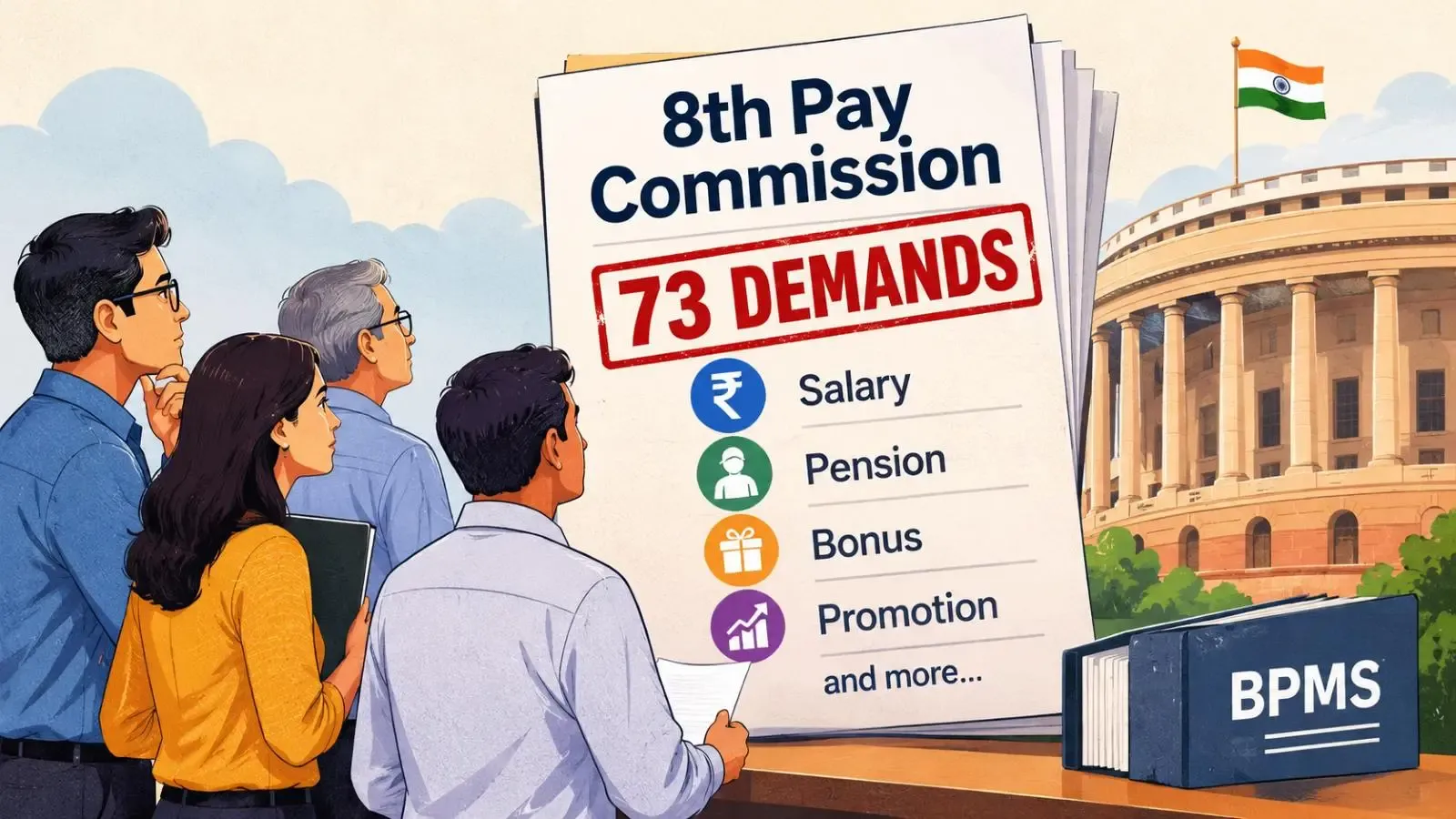
The BPMS submitted this demand to the 8th Pay Commission on November 19, 2026. | Representational image/Shutterstock
These demands were placed in a submission dated November 18, 2026, filed for its second-round of interaction with the Commission.
The BPMS’ submission followed the federation's comprehensive memorandum emailed to the Commission in April 2026, and is described as supplementary to it, with a particular focus on defence civilian employees.
The list of demands runs well beyond pay, covering minimum pay and the fitment factor, the merger of dearness allowance, restoration of the Old Pension Scheme, bonus and insurance, a long block of allowances from risk pay to CGHS subscriptions, leave and leave encashment, MACP and promotion reform, and separate cadre demands for workshop staff, fire-fighting staff, stenographers, pharmacists, dressers, security staff, canteen employees and the Rajbhasha cadre.
Following is the complete list 73 demands made by the BPMS.
Minimum pay should be determined based on actual family consumption requirements, accepted Indian Labour Conference (ILC) norms, and the Aykroyd formula, factoring in prevailing market prices of essential commodities to ensure a dignified standard of living.
An appropriate fitment factor should be recommended to offset inflation and the erosion of purchasing power. Reasonable differentials between successive pay levels must be maintained, ensuring the maximum-to-minimum pay ratio does not exceed 1:10.
The existing annual increment rate of 3% should be enhanced to 6% of Basic Pay to ensure meaningful financial progression and counteract rising living costs.
The National Pension System (NPS) and Unified Pension Scheme (UPS) should be discontinued for Central Government Employees, and the defined-benefit Old Pension Scheme (OPS) should be restored to guarantee adequate post-retirement social security.
Ad-hoc Bonus and Productivity Linked Bonus (PLB) should be extended to all Central Government Employees without exclusions, including those at the highest levels. Bonus should be calculated on the minimum pay of the respective Pay Level, with a minimum entitlement equivalent to 30 days' pay plus DA.
Insurance coverage under the Central Government Employees Group Insurance Scheme (CGEGIS) should be enhanced from the existing ₹30,000 to at least ₹15 lakh to provide substantial financial protection to employees' families.
The Deposit Linked Insurance benefit should be enhanced to ₹10 lakh to ensure adequate financial security for the family of a deceased employee.
The rate of interest on the General Provident Fund (GPF) should not fall below the rate applicable to the Employees' Provident Fund (EPF) to maintain parity and protect employee savings.
Discontinued or restricted interest-free advances should be restored to assist employees in meeting essential personal and family obligations.
Employees acquiring higher professional or educational qualifications relevant to their duties should be granted two additional increments—on par with Nursing Staff—rather than a one-time lump-sum monetary incentive.
Risk Allowance should be substantially enhanced up to ₹10,000 per month for employees performing hazardous, dangerous, or high-risk duties, commensurate with their occupational exposure.
The existing ceiling on the number of increments admissible to meritorious sportspersons should be removed to adequately recognize outstanding sporting achievements.
Uniform Allowance should be increased to three times the existing rate, plus applicable DA, to offset the rising costs of uniforms and their maintenance.
Hospital Patient Care Allowance (HPCA) and Patient Care Allowance (PCA) should be enhanced to three times the existing rates, plus applicable DA, reflecting the demanding nature of patient care and associated occupational hazards.
Children Education Allowance (CEA) should be extended up to the Post-Graduation level, subject to prescribed conditions, to support the higher education of employees' children.
Fixed Medical Allowance (FMA) should be substantially increased for serving employees and pensioners who do not have access to equivalent medical facilities under CGHS or other Government healthcare schemes.
NPA should be extended to other eligible employee categories whose professional qualifications, specialized knowledge, and service conditions justify such compensation.
Central Government Employees and Pensioners should be exempted from paying CGHS subscriptions, with the scheme fully funded by the Government as an essential healthcare and social-security measure.
Ex-gratia compensation payable to the family of an employee who suffers a fatal accident while performing official duties should be enhanced to ₹1 crore.
Applicable leave provisions governing Central Government Employees and Defence Civilian Employees should be harmonized and consolidated to eliminate inconsistencies and ensure uniform benefits.
Increase Casual Leave to 12 days per calendar year.
Permit leave encashment of 20 days on each admissible Leave Travel Concession (LTC) occasion, subject to prescribed conditions.
Reintroduce the LTC Special Cash Package on the lines of the facility extended during the COVID-19 period.
Enhance Paternity Leave to 45 days and extend the benefit to cases of child adoption.
Grant Child Care Leave (CCL) for up to two years with full wages, subject to prescribed conditions.
27)Leave encashment for re-employed ex-servicemen
Extend leave encashment up to 300 days without deducting leave encashment already availed during prior military service.
28)Menstrual leave
Grant one day of menstrual leave per month to female employees.
Enhance Special Casual Leave to 60 days per year for Office Bearers and 30 days per year for Executive Committee Members of recognized associations/unions.
Grant WRIL to employees incapacitated by accidents arising out of or in the course of employment, alongside compensation under the Employees' Compensation Act in addition to full leave salary during absence.
Introduce a Dynamic Promotion Scheme for all employees to replace the existing vacancy-based system, linking career advancement to length of service, merit, competence, and experience rather than vacancy availability.
Ensure every employee receives at least five financial up-gradations over a 30-year service span to guarantee reasonable financial progression and eliminate stagnation.
When a Departmental Promotion Committee (DPC) is not convened regularly despite available vacancies and eligible candidates, its recommendations must take retrospective effect from the date the earliest DPC was due, subject to eligibility rules.
Where promotion depends on a prescribed Trade Test assessing technical knowledge and practical skills, separate APAR assessments should not be mandated, as the Trade Test provides an objective measure of suitability.
Cap the prescribed residency period between a feeder post and its promotional post at five years to prevent prolonged career stagnation.
The Department of Personnel and Training (DoPT) should frame Common Model Recruitment Rules for all applicable cadres to ensure uniformity in qualifications, eligibility, promotion channels, and service conditions across Ministries and Departments.
Group 'C' employees should ordinarily be rotated among suitable posts within the same station, wherever administratively feasible, to broaden work exposure, enhance efficiency, and prevent transfers that cause undue hardship and expenditure.
Sensitive posts in Government establishments should be identified in consultation with Staff Side representatives of the Departmental Council (JCM) to ensure transparency, objectivity, and mutual trust in transfer policies.
Workshop Staff recruited with Matriculation and a three-year NCVT certificate should receive appropriate recognition for their technical training. Their entry-level pay must reflect the duration, skill, and technical responsibilities of the role rather than placing them at the lowest Pay Level.
Inter-grade ratios for Skilled, Highly Skilled Grade-II, Highly Skilled Grade-I, and Master Craftsman in Defence establishments should be brought on par with corresponding technical cadres in the Indian Railways to eliminate existing disparities.
Master Craftsmen (MCM), who possess extensive shop-floor experience and technical expertise, should be granted Selection Grade in Pay Level-7 (GP ₹4,600) along with Non-Functional Upgradation to Pay Level-8 (GP ₹4,800), subject to prescribed conditions. This will offer a dedicated technical career path without forcing experienced craftsmen into supervisory roles for financial growth.
Civilian Dressers in Naval Hospitals should be granted Pay Level-3 on par with Railway Dressers and Medical Assistants in Ordnance Factory Hospitals. Their redesignation as Multi-Tasking Staff (MTS) during the 6th CPC should not deprive them of pay benefits granted to comparable medical-support categories.
The current transportation entitlement for personal effects is inadequate and discriminatory, particularly for employees in Pay Level-4 and below. The permissible weight limit should be raised from 1,500 kg to at least 3,000 kg, and transportation rates should be rationalized based on realistic market principles rather than arbitrary Pay Level linkages.
Existing Grant-in-Aid allocations should be substantially increased and periodically revised to keep pace with inflation and actual needs, ensuring robust support for employee welfare, emergency assistance, sports, and recreation.
DoPT should develop a centralized digital portal to facilitate transparent, time-bound inter-Ministry and inter-Department transfers for Group 'B' and Group 'C' employees on compassionate grounds, enabling staff facing genuine family or medical hardships to view vacancies and apply uniformly.
There must be no discrimination between employees retiring before and on or after 01.01.2026 regarding pension revisions arising from the 8th CPC. Pensioners in both categories must receive equitable pensionary benefits.
Personnel Below Officer Rank (PBOR) retiring from the Armed Forces and subsequently re-employed in Central Government establishments should receive pay fixation benefits that account for their last pay drawn in military service, governed by a uniform and equitable policy.
When an establishment is disbanded, closed, or reorganized and its staff are redeployed elsewhere, their existing pay, Pay Level, and service-related financial benefits must be fully protected so no employee suffers financial loss due to administrative restructuring.
There should be no discrimination in granting special allowances between civilian employees and uniformed personnel when both perform identical or substantially similar duties at the same posting under comparable working conditions and risk exposure. Allowances should be governed by the nature of duties and risks rather than civilian or uniformed status.
The JCM framework should be made more effective and authoritative in all service-related matters. Issues raised by the Staff Side must receive timely consideration, with decisions communicated within a fixed timeframe to strengthen industrial relations and minimize avoidable litigation.
The ministerial hierarchy should be rationalised by granting appropriate replacement Pay Levels and restoring historical pay parity with corresponding Central Secretariat Service (CSS) posts, including provision for a 50% promotional quota in relevant lower formations. Employees performing identical administrative duties with comparable qualifications should receive equitable pay structures and career progression, irrespective of their place of posting.
50% of promotional vacancies in Lower Division Clerk (LDC), Store Staff, Stenographer and Rajbhasha cadres should be reserved for eligible and qualified MTS employees. This will provide structured career progression, recognise institutional experience and practical knowledge, and eliminate stagnation at the entry level.
Uniform Model Recruitment Rules should be formulated for Fire-Fighting Staff across all Defence establishments, covering recruitment, designations, pay structures, promotional avenues and service conditions. This will eliminate disparities among employees performing identical and high-risk emergency duties.
Full pay parity with the Central Secretariat Stenographers' Service (CSSS) should be restored, along with appropriate replacement Pay Levels and Non-Functional Upgradation (NFU) for eligible personnel, considering their identical stenographic responsibilities, secretarial functions and professional skill requirements.
Three-year NCVT technical qualifications should be recognised with an appropriately upgraded entry Pay Level.
The promotional hierarchy from Skilled Grade to Highly Skilled Grade, Master Craftsman (MCM) and MCM (Selection Grade) should be rationalised.
Non-Functional Upgradation (NFU) should be introduced on completion of four years of prescribed service.
Separate technical and supervisory career progression channels should be established.
The entry-level pay of Security Staff should be rationalised and their promotional hierarchy streamlined by creating structured supervisory promotional avenues. Uniformity in pay and assured career progression are essential for maintaining the morale of personnel responsible for safeguarding vital Defence installations.
CMD/AMD Fire-Engine Drivers should be granted an upgraded entry Pay Level, with a structured promotional hierarchy providing career progression from Level-3 to Level-6 of the proposed Pay Matrix, considering their specialised heavy-vehicle driving skills, operational hazards and critical emergency-response responsibilities.
Suitable entry Pay Levels and appropriate replacement pay scales should be provided to Canteen and Catering Staff, including Vendors, Cooks, Halwais and Supervisory Staff. A well-defined promotional hierarchy leading to higher supervisory grades should also be established in recognition of their essential operational and supervisory responsibilities.
Pharmacists should be granted entry-level pay at Level-6 of the proposed Pay Matrix, with promotional avenues and Non-Functional Upgradation strictly at par with corresponding categories under the Central Government Health Scheme (CGHS), considering their statutory registration requirements, professional qualifications, technical responsibilities and direct patient-care duties.
Ward Masters should be granted appropriate replacement pay scales commensurate with their administrative and ward-management responsibilities.
The pay structure and promotional hierarchy of Medical Assistants and Ward Masters should be suitably upgraded.
Paramedical status and Pay Level-3 should be restored to Dressers in Naval Hospitals, at par with similarly placed employees in Indian Railways and Ordnance Factory Hospitals.
Pay anomalies arising merely due to redesignation of posts without any corresponding change in actual duties and responsibilities should be rectified.
Employees performing comparable medical and paramedical functions across Central Government hospitals should receive equal pay and status irrespective of their departmental placement.
Suitable replacement pay scales under the 8th CPC Pay Matrix should be granted to Supervisory Staff and Telephone Operators, recognising their supervisory accountability, technical operations and comparable duties performed across various Defence establishments.
The Rajbhasha cadre should be granted replacement pay scales at par with equivalent posts in the Central Secretariat Official Language Service (CSOLS), along with well-defined promotional avenues, ensuring uniform pay treatment for employees performing identical statutory translation and Official Language implementation responsibilities.
Kindly permit the Federation to elaborate upon and discuss the above demands during the second-round interaction scheduled for 18th November 2026.
Accord special consideration to the genuine grievances of Defence Civilian Employees, recognizing their technical responsibilities, specialized skills, hazardous working conditions, and vital contribution to the operational readiness of the Armed Forces.
Recommend decisive measures to eliminate existing disparities in pay, allowances, career progression, cadre structure, and service conditions.
Treat this representation as supplementary to the comprehensive memorandum submitted by BPMS in April 2026, incorporating all demands herein while formulating the Commission's final recommendations.
Related News
About The Author
Next Story