
Personal Finance News
8th Pay Commission: Fitment factor alone may not decide revised pay; a third step could matter too

4 min read | Updated on November 20, 2026, 21:43 IST

SUMMARY
If the 8th Pay Commission follows the method adopted by the 7th CPC, the fitment factor will be only the first step in a three-step pay-fixation process.
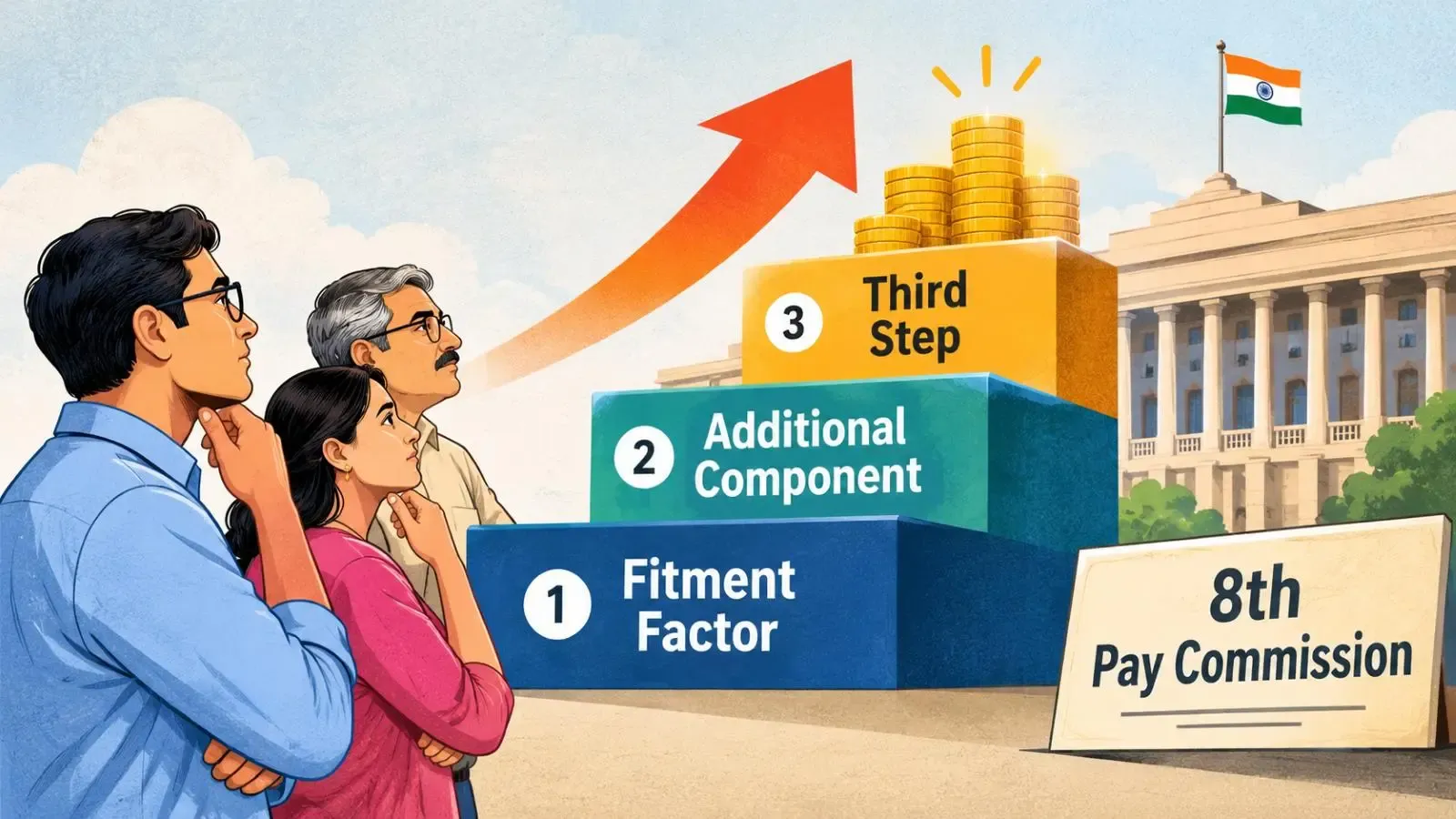
8th CPC has completed one year since notification. | Representational image/AI generated
However, whenever the 8th CPC is discussed, the conversation almost always revolves around the expected fitment factor. Employees use several fitment-factor assumptions to estimate their revised pay. Most online calculators also stop there. However, this shortcut can understate the final pay that an employee may receive if the Pay Matrix placement results in a higher figure.
But if the 8th CPC follows the method adopted by the 7th CPC, the fitment factor will be only the first step in a three-step pay-fixation process. In fact, the figure obtained after applying the fitment factor is not necessarily the final basic pay. A third step involving placement in the Pay Matrix ultimately determines how much revised salary an employee draws.
This article explains how the 7th CPC process worked and why it matters for estimating salaries under the 8th Pay Commission.
Many employees assume revised pay is calculated simply by multiplying current basic pay by the fitment factor. Under the 7th CPC, that was not the final step. After multiplication and rounding, the employee's pay was placed in a Pay Matrix cell equal to or immediately higher than the calculated amount. Depending on the level and matrix structure, this could increase the final salary beyond the multiplication result.
The three steps were the following:
The 7th CPC shared an example of an employee having basic pay of ₹12,560 in the 6th CPC Grade Pay 2400 to explain the three steps.
Basic pay ₹12,560 was first multiplied by the fitment factor of 2.57. Nothing else was included at this stage, not even dearness allowance, house rent allowance, or transport allowance.
The number derived from multiplying basic pay by the fitment factor was then rounded off to nearest rupee. Note that this was rounding to the nearest rupee, not to the nearest hundred. In this example, the figure came to ₹32,279.
The rounded figure was not the new basic pay. Instead, it served as a benchmark for locating the employee in the Pay Matrix. The employee was placed in the relevant level at a cell equal to or immediately higher than ₹32,279. Since the nearest higher cell in Level 4 was ₹32,300, the employee's revised basic pay was fixed at ₹32,300.
Two more examples
The 7th CPC report shared two more situations that could change the revised pay.
The first situation involves an upgrade in grade pay.
Suppose an employee drawing ₹12,560 in GP 2400 (₹10,160 plus ₹2,400) is upgraded to GP 2800. “The new basic pay will be computed using the upgraded grade pay. The pay arrived will be as follows: Basic Pay: 10160+2800=12,960.” Only then is the factor applied: ₹12,960 × 2.57 = ₹33,307.20, rounded to ₹33,307, and placed in Level 5 at ₹33,900.
The second situation involves promotion or financial upgradation under the Modified Assured Career Progression (MACP) scheme.
Suppose an employee drawing ₹28,700 in Level 4 is upgraded to Level 5 by giving one increment in her current Level 4 (to ₹29,600 in this case). She is then placed in the Level 5 at a Level equal to or next higher compared to ₹29,600, which comes to ₹30,100.
The second example shows that promotion does not involve the fitment factor. It is an increment in the old level, and then a placement in the new one.
What this means for the 8th CPC report
The fitment factor may grab the headlines when the 8th CPC submits its recommendations. However, employees should remember that the factor alone may not determine their final pay.
Under the 7th CPC model, revised salary depended on three steps: applying the fitment factor, rounding the result, and then placing the employee in the appropriate Pay Matrix cell. Until the new Pay Matrix is announced, any 8th CPC salary estimate based only on a fitment factor remains an approximation.
Related News


About The Author
Next Story

