
Personal Finance News
EPFO SWP calculation: How much basic salary and PF corpus are needed for ₹50,000 or ₹1 lakh a month?
8 min read | Updated on November 20, 2026, 15:29 IST

SUMMARY
SWP feature under EPF will ensure that the unspent balance keeps earning. But what may it take to draw a monthly amount out of your own PF account? This article explains assuming 8.25% interest.
Finder details of SWP under EPFO are yet to be notified. | Representational image/Shutterstock
“The Board approved a proposal to introduce Systematic Withdrawal Plan, which will enable retiring EPF members to receive their accumulated provident fund savings in periodic instalments instead of withdrawing the entire amount in one go,” the Labour Ministry said in a release after the meeting chaired by Union Minister Mansukh Mandaviya.
The payout under SWP can be monthly, quarterly or half-yearly and members will be able to opt for this facility voluntarily.
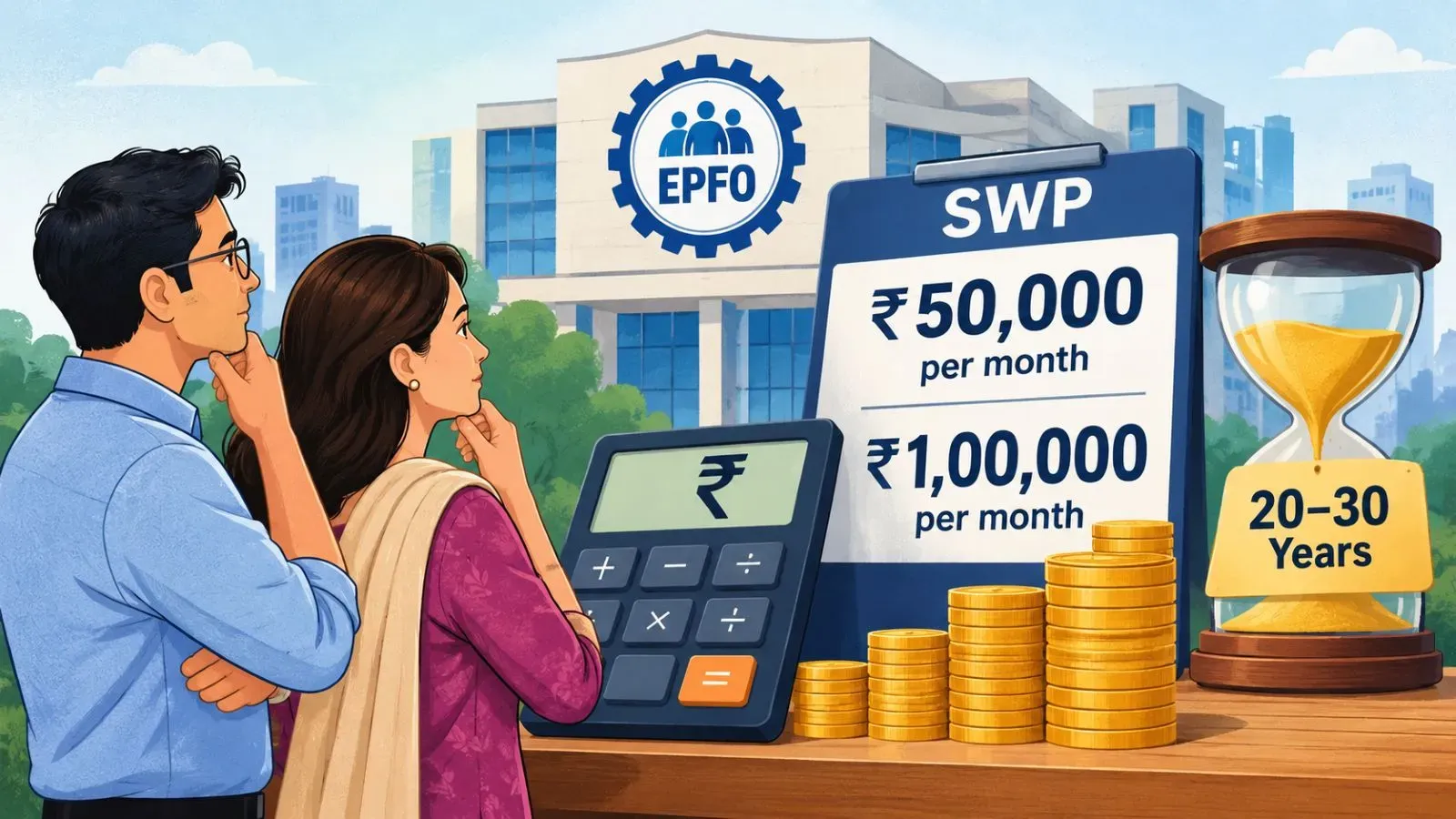
This feature under EPF will ensure that the unspent balance keeps earning. But what may it take to draw a monthly amount out of your own PF account? While the EPFO is yet to come out with official rules and processes to be followed for SWP, this article explains the calculation for ₹50,000 and ₹1 lakh a month over 20, 25 and 30 years under existing rules, assuming an 8.25% annual interest. This interest is calculated every month on the running balance and credited once at the end of the year. In other words, the interest is compounded annually, not monthly.
How much corpus will be required?
For understanding, think of the retirement corpus as a water tank and the monthly withdrawal via SWP as a tap. The tank earns 8.25% a year and the tap runs every month. This tank, however, needs to be sufficiently big to let you draw a monthly payout while ensuring that the tank does not run dry before the period ends.
The following table gives an estimate of the required corpus for 20 years, 25 years and 30 years.
| Monthly withdrawal | Corpus required for 20 years | Corpus required for 25 years | Corpus required for 30 years |
|---|---|---|---|
| ₹50,000 | ₹60.5 lakh | ₹65.5 lakh | ₹69.0 lakh |
| ₹1,00,000 | ₹1.21 crore | ₹1.31 crore | ₹1.38 crore |
Read the above table this way: to draw ₹50,000 a month for 20 years, you need about ₹60.5 lakh at retirement. For stretching the same withdrawal to 30 years, you may need ₹69 lakh. A higher amount is required because the corpus must keep earning for a decade longer. For ₹1 lakh a month, the requirement roughly doubles, to between ₹1.21 crore and ₹1.38 crore.
How much basic salary will be required to build such corpus?
A PF balance is built from two streams of contributions: 12% of basic wages from the employee and 12% from the employer.
For members within the ₹25,000 wage ceiling, 8.33% of wages goes from the employer's share to the pension scheme, leaving about 15.67% of wages in the PF account.
Above the ceiling, that pension contribution is capped at ₹2,082.50 a month.
For example, assuming a 30-year working career, corpus in the above table has been calculated like this: to reach ₹60.5 lakh, a member needs about ₹4,070 in the PF account every month, which is possible from a basic wage of ₹25,600 (₹3,072 from the employee and ₹989 from the employer). The same corpus built over 20 years instead would need about ₹10,250 a month, or a basic pay of roughly ₹51,400.
| Corpus needed | Monthly PF contribution (30-year career) | Basic wage needed |
|---|---|---|
| ₹60.5 lakh | ₹4,070 | ₹25,600 |
| ₹65.5 lakh | ₹4,410 | ₹27,000 |
| ₹69.0 lakh | ₹4,640 | ₹28,000 |
| ₹1.21 crore | ₹8,130 | ₹42,600 |
| ₹1.31 crore | ₹8,820 | ₹45,400 |
| ₹1.38 crore | ₹9,280 | ₹47,300 |
Please note that the flat-salary assumption flatters the above figures slightly. More so because, most careers begin at a lower wage and rise over the service period. So a person who starts at ₹15,000 basic pay, may end at ₹40,000 or higher and have a better final corpus than someone on a fixed basic pay throughout his career.
What lands in the EPF account each month
Above ₹25,000, every extra rupee of basic would add around 24 paise to the PF account and nothing to the pension.
| Monthly basic wage | Employee's 12% | Employer's 12% | To EPS (8.33%, capped) | Employer's share to PF | Total credited to PF account |
|---|---|---|---|---|---|
| ₹20,000 | ₹2,400 | ₹2,400 | ₹1,666 | ₹734 | ₹3,134 |
| ₹25,000 | ₹3,000 | ₹3,000 | ₹2,083 | ₹917 | ₹3,917 |
| ₹25,600 | ₹3,072 | ₹3,072 | ₹2,083 | ₹989 | ₹4,061 |
| ₹27,000 | ₹3,240 | ₹3,240 | ₹2,083 | ₹1,157 | ₹4,397 |
| ₹28,000 | ₹3,360 | ₹3,360 | ₹2,083 | ₹1,277 | ₹4,637 |
| ₹42,600 | ₹5,112 | ₹5,112 | ₹2,083 | ₹3,029 | ₹8,141 |
| ₹45,400 | ₹5,448 | ₹5,448 | ₹2,083 | ₹3,365 | ₹8,813 |
| ₹47,300 | ₹5,676 | ₹5,676 | ₹2,083 | ₹3,593 | ₹9,269 |
EDLI at 0.5% and administrative charges at 0.5% are paid by the employer outside these amounts and do not enter the member's account. (All figures are rounded, so the monthly contribution needed for a corpus and the split shown against the nearest wage can differ by a few rupees).
How long will the corpus last?
₹60.5 lakh is the sum that can pay ₹50,000 a month for 20 years at 8.25%. However, if the rate falls below 8.25%, or the monthly withdrawal is raised, the same corpus will run dry before 20 years. However, this can be taken care of by accumulating a higher corpus during service years. In such case, the interest alone will keep pace with a ₹50,000 withdrawal while ensuring that the principal remains intact.
The government expects the first users of SWP to be the 6.32 lakh EPF members aged above 55 whose accumulations exceed ₹5 lakh. However, this threshold is modest against the sums above. At ₹50,000 a month, a ₹5 lakh corpus can exhaust in about 10 months, and even ₹25 lakh can last only 4.9 years.
| Corpus at retirement | ₹50,000 a month lasts | ₹1,00,000 a month lasts |
|---|---|---|
| ₹25 lakh | 4.9 years | 2.2 years |
| ₹50 lakh | 13.5 years | 4.9 years |
| ₹75 lakh | 54.8 years | 8.5 years |
| ₹1 crore | Does not deplete | 13.5 years |
Calculation shows that at 8.25%, a corpus of ₹1 crore can earn over ₹68,000 in interest in the first month, against a ₹50,000 withdrawal. In such case, the principal will hold while the balance will grow. The corpus that can sustain ₹50,000 a month indefinitely would be about about ₹76 lakh, and for ₹1 lakh a month, about ₹1.52 crore.
How the plan may work
The plan details are not yet fully clear. As of now, all we know is that the SWP under EPFO would allow a member to choose the amount and the interval; the payout will repeat while the balance stays invested.
If the member dies during the payout period, the nominee or dependent will be able to withdraw the remaining balance or continue receiving periodic payments, the release said.
The option may also be extended to eligible family members/beneficiaries.
Three points to note
First, what the EPFO's Board has approved is a proposal, not a live scheme. “The necessary amendments to the EPF scheme will be notified accordingly after approval from the Ministry,” the release stated. This means the SWP facility will begin only after that notification.
Second, the SWP feature would also need to be in sync with a separate relaxation approved by the Board. Now, the minimum balance a member must retain has been reduced from 25% to 10%, and the waiting period for final withdrawal from 12 months to 2 months.
Third, for a member weighing the SWP choice, it is advisable to wait for finer details through official notifications in the coming weeks.
Related News


About The Author
Next Story

