
Personal Finance News
8th Pay Commission: 3 pending dearness allowance changes are back on the table after 20 years

4 min read | Updated on October 27, 2026, 16:15 IST

SUMMARY
Two decades on, the stakes have grown heavier. DA crossed the 100% mark in January 2014 on the 6th CPC's base; on the 7th CPC's 2016 base it stood at 60% from January 2026.

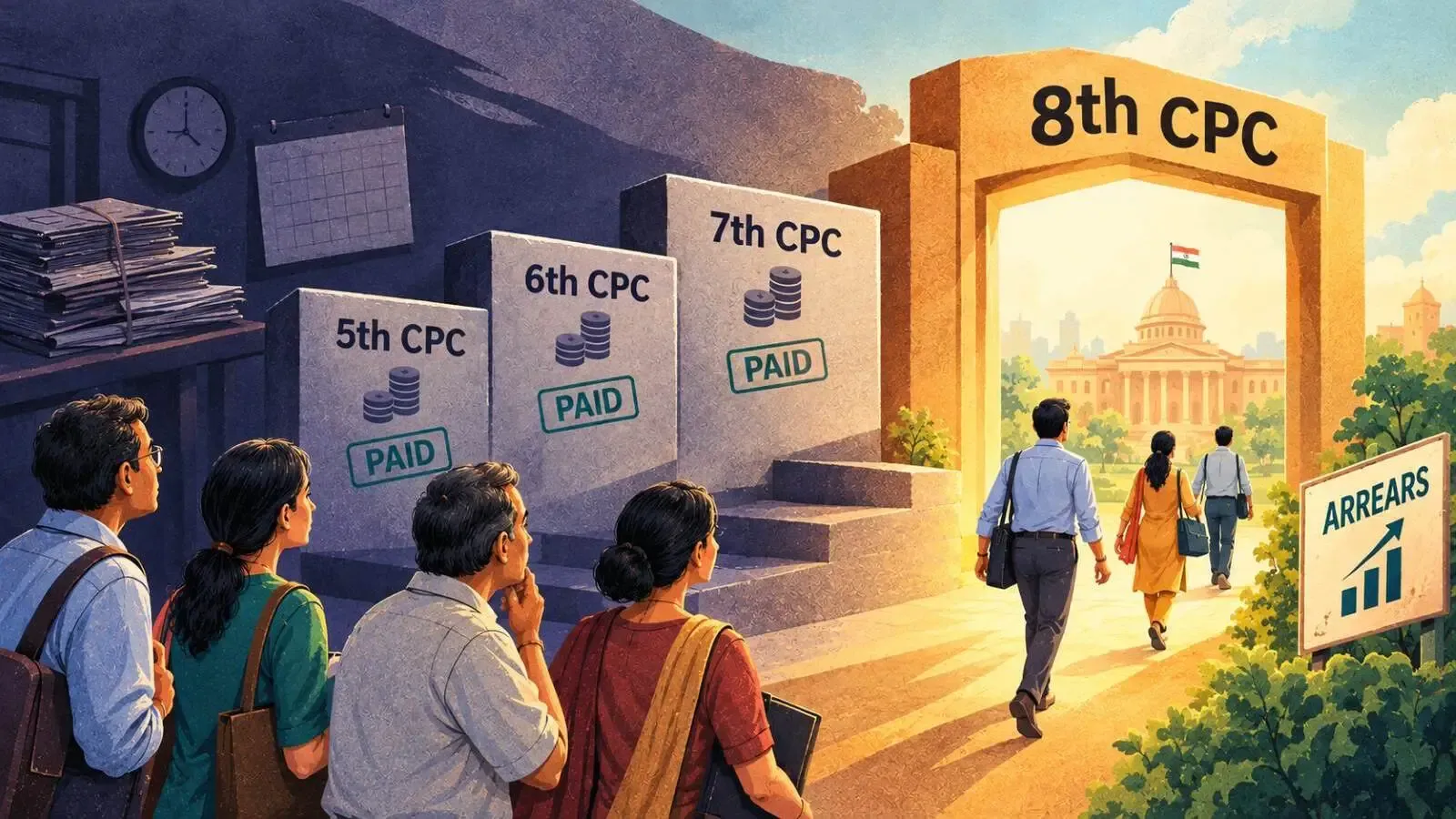
The three demands have reappeared after 20 years. | Representational image/AI generated
However, all three demands have now reappeared in the memorandums filed by employees' bodies with the 8th CPC.
The 6th CPC listed these plainly in Chapter 4.1, under the heading ‘Demands made’.
-
First: “Instead of revising the DA once in six months, it should be revised once in three months.”
-
Second: “The principle laid down by the 5th CPC for merger of 50% of DA with the Pay as DP should be modified to 25% to remove distortions in the pay structures.”
-
Third: “DA should be paid net of taxes on the same line as recommended by the 5th CPC to make the concept of 100% neutralization somewhat meaningful.”
However, the 6th Pay Commission’s verdict on the merger demand was categorical. It said, “The Commission is, therefore, not recommending merger of dearness allowance with basic pay at any stage." The 6th CPC's gave a reasoning that a merger ought logically to be accompanied by a revision of the base index, and that such conversion was unnecessary in the structure it was recommending. The 6th CPC's pay structure provided for payment of increments as a percentage of pay in the pay band and grade pay,
On the issue of DA payment frequency, the 6th CPC held firm, saying, “No real justification exists for revising DA once in 3 months.” “Accordingly, DA may continue to be sanctioned twice a year as on 1st January and 1st July payable with the salary of March and September respectively for administrative convenience with inflation neutralization being maintained at 100% at all levels,” it added.
On the tax demand, the 6th CPC offered no recommendation at all.
The 7th CPC did not pick any of the three demands. Its report, running to nearly 900 pages, contains no discussion of quarterly DA revision, no proposal to merge DA with basic pay at a 25% trigger, and no reference to tax-free DA. The nearest echo is a recorded argument from the staff side, in the section on the date of effect, that wages had eroded “owing to non-merger of DA, which has crossed the 100 percent mark in January 2014”. But that was a plea made by the staff side for an earlier implementation date, not for a merger rule.
As the 8th Pay Commission prepares its report, all three are now back. Multiple employees' bodies have submitted memorandums to the 8th CPC seeking these changes related to DA.
The Bharat Pensioners Samaj (BPS) has revived the first demand in its memorandum, almost word for word, seeking “quarterly revision of DA/DR on the basis of the three-month average, with point-to-point compensation, and examination of the merger of DR with basic pension after it exceeds 25%.”.
The second demand returned in the FNPO’s memorandum, which asked that “the 8th CPC may recommend merger of DA/DR with Basic Pay whenever it crosses 25%.” It also said that “Point-to-Point DA without rounding-off should be provided.”.
The third demand also found a mention in the FNPO’s chapter on income tax reform, where its reasoning was sharper than the 6th CPC version. “Allowances such as DA, HRA, and Transport Allowance are compensatory — intended to offset rising living costs, not to represent wealth growth. Taxing these creates a circular logic: the Government provides inflation relief only to reclaim a portion via the tax code. These allowances must be fully exempted from Income Tax,” it said.
The FNPO's first recommendation was very specific: “Exemption of DA from Taxable Income: DA, being an inflation-neutralisation tool, should be treated as non-taxable reimbursement.”
What joins the three demands of employees is a single premise, that dearness allowance is a reimbursement of cost, not a component of income. It should therefore be measured more often, merged at a lower threshold and taxed not at all. The 6th CPC accepted the premise for its own formula, maintaining “inflation neutralization at 100% at all levels” but declined the changes that would have followed from it.
Two decades on, the stakes have grown heavier. DA crossed the 100% mark in January 2014 on the 6th CPC's base; on the 7th CPC's 2016 base it stood at 60% from January 2026. Whether the 8th CPC treats the three demands as unfinished business or as settled questions this time remains to be seen
Related News
About The Author
Next Story

