
Personal Finance News
8th Pay Commission: Dearness allowance merger - what the 5th, 6th and 7th CPCs did; what's expected now

5 min read | Updated on October 23, 2026, 17:51 IST


SUMMARY
Any change in the AICPI-IW calculation methodology could impact DA calculation if the 8th Pay Commission continues to follow the 7th CPC's way of maintaining status quo with respect to dearness allowance.
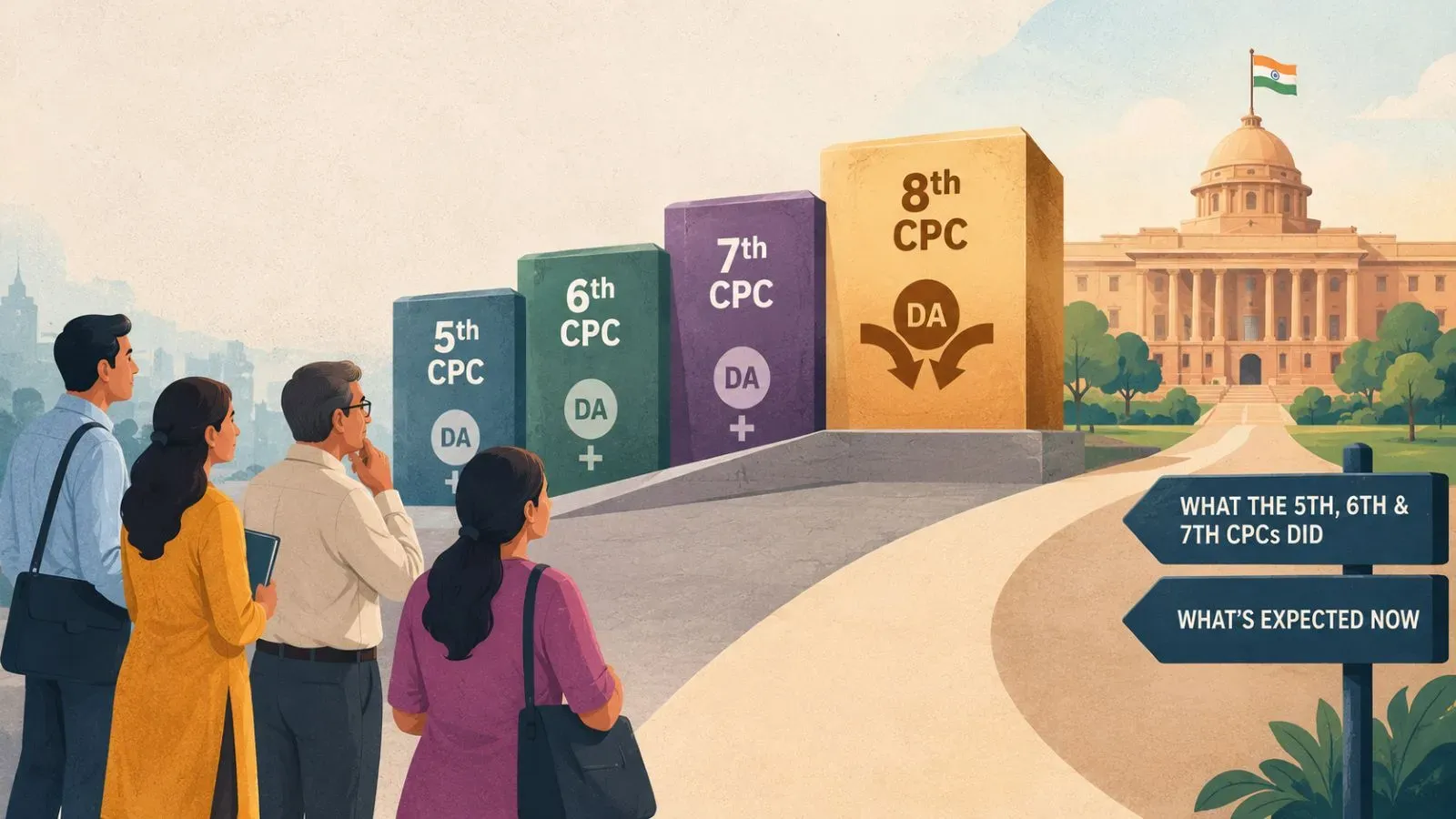
Merging DA with Basic Pay is an old demand. | Representational image/AI Generated
Uniform neutralisation of DA at 100% under 5th CPC
The 5th CPC recommended,
-
Uniform neutralization of DA at 100% to employees at all levels
-
Conversion of DA into Dearness Pay each time the CPI increases by 50% over the base index with Dearness Pay counting for all purposes including retirement benefits
-
Dearness Allowance including Dearness Pay being paid net of tax.
The 5th CPC did not favor the option of employing separate indices for each category of employee because of the sheer impracticality of the task and, therefore, recommended using the 12 monthly average of All India CPI (IW) with base 1982 for calculating DA.
The 6th CPC report noted the above decisions of the 5th CPC in its report.
What the 6th CPC said
The 6th CPC only recommended revising the base year for calculating AICPI-IW data. However, it found no relevant reason to allow merger of DA with Basic Pay at any stage.
"Logically, therefore, conversion of dearness allowance as dearness pay should invariably be accompanied with simultaneous revision of the base index. This conversion, however, is not necessary in the revised structure being recommended where increments are payable as a percentage of the pay in the pay band and grade pay thereon and provision has been made for all allowances/benefits to be revised periodically linked to the increase in the price index. The Commission is, therefore, not recommending merger of dearness allowance with basic pay at any stage," the 6th CPC said.
It also rejected the demand for revising DA once in every three months.
"No real justification exists for revising DA once in 3 months. Accordingly, DA may continue to be sanctioned twice a year as on 1st January and 1st July payable with the salary of March and September respectively for administrative convenience with inflation neutralization being maintained at 100% at all levels," the 6th CPC said.
What the 7th CPC said
The 7th CPC found no reason to make any change to the DA calculation method continuing since the previous pay commission. "Keeping in mind that the present formulation of DA has worked well over the years, and there are no demands for its alteration, the Commission recommends continuance of the existing formula and methodology for calculating the Dearness Allowance," the 7th CPC said.
What is expected from 8th CPC?
The Bharat Pensioners Samaj has sought “quarterly revision of DA/DR on the basis of the three-month average, with point-to-point compensation, and examination of the merger of DR with basic pension after it exceeds 25%."
Several other organisations have called for revising the AICPI-IW formula by considering a family unit of five instead of three.
The IRTSA pointed out that the index's definition of a “Working Class Family” does not cover government employees, and that the shift to geometric averaging in the 2016 series “will reduce the average price.” It has reminded the Commission that the 6th CPC had recommended a separate index built on a survey of government employees, and argues that with 37% of central staff in ‘X’ cities, 25.5% in ‘Y’ and 37.5% in ‘Z’, the formula ought to reconcile with “the prices and consumption pattern in these cities.”
The Ministerial Staff Association contended that “the existing Dearness Allowance (DA) mechanism does not fully capture the ‘Need-Based’ requirements for a modern family unit.” The Railway Senior Citizens Welfare Society (RSCWS) framed the same worry from the pensioners' side, saying, DA offers only “partial protection against inflation,” and the gap between periodic revisions and rising costs “results in erosion of real wages and pensions.”.
Any change in the AICPI-IW calculation methodology could impact DA calculation if the 8th CPC continues to follow the 7th CPC's way of maintaining status quo with respect to DA.
Related News


About The Author
Next Story

