
Market News
H1 2026 review : NIFTY50 top loser, Microcap index soars 11%, FII selling rises 2.5x and more

4 min read | Updated on July 01, 2026, 14:30 IST


SUMMARY
The H1 of 2026 has remained eventful, with the world engaging in a global war-like situation in the Middle East. At the global level, India stands amongst the top losers with the benchmark NIFTY50 delivering -8% returns. At the domestic level, the small and microcaps turned out to be the top gainers.

NIFTY50 among the top losers at global level, delivering -8.4% returns in H1 of 2026. Image: Shutterstock.
Indian stock markets are hovering around the same levels as they were in March 2026. The past six months have been eventful for Indian markets, by witnessing strong rally in the first half of H1 2026 and a sharp downfall in the second half of H1 2026. Investors have largely left dry with no major returns at index level. The first half witnessed near global war like situation in the Middle East, with aggravated FII selling and currency depriciation crisis. Owing to these issues, the Indian markets saw a dull period. Lets take a deeper look at how the markets performed in H1 2026 vs H1 2025 across different categories.
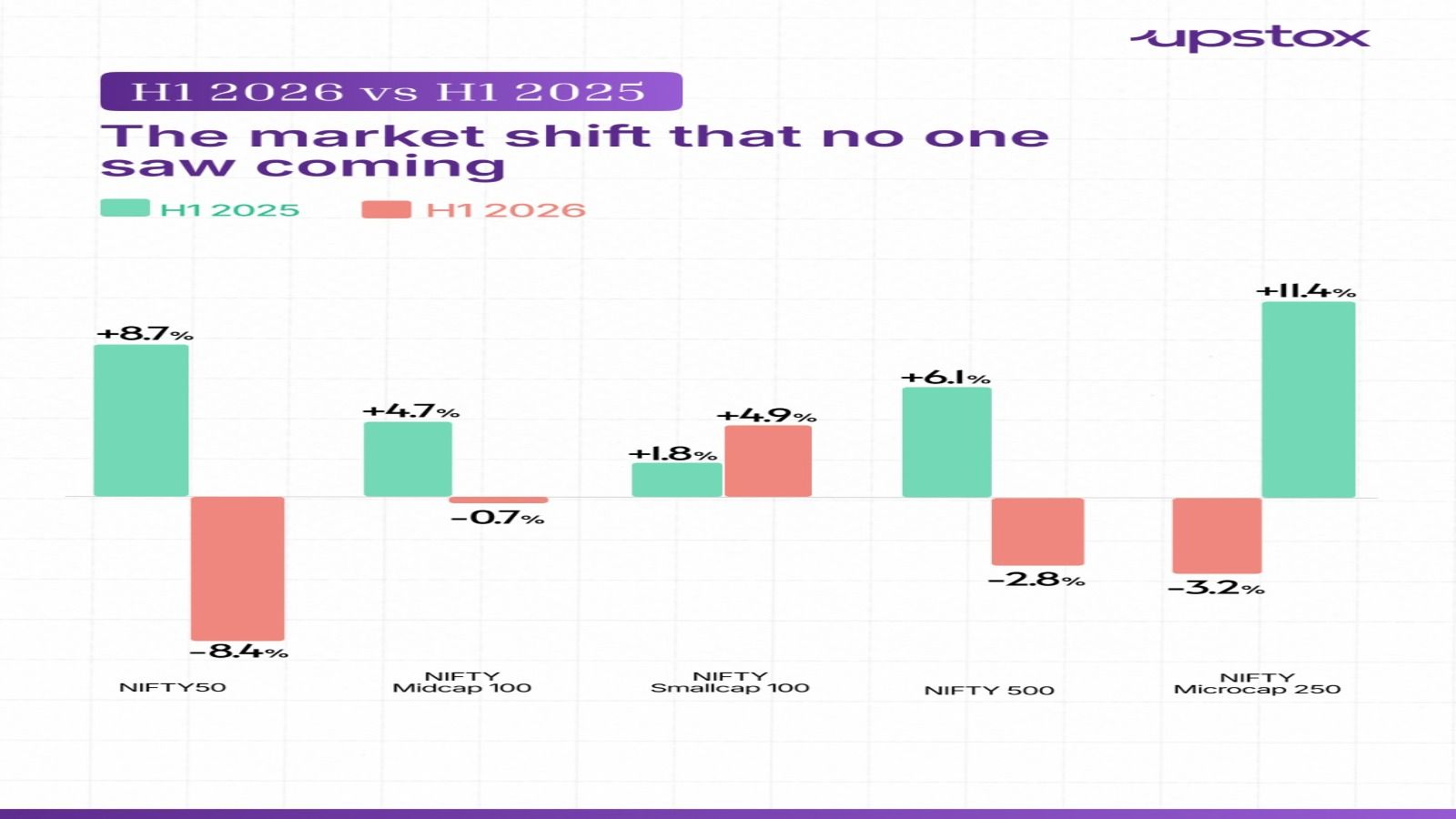
(Note: H1 FY26 performance as of 12:00 pm, 30th June 2026)
Largecap laggards
The above table is evident of the fact that the large-cap category has been the top-most laggard in H1 2026 with NIFTY50 delivering -8.4% returns. On the contrary, the broader-market category of NIFTY Midcap 100 and Smallcap 100 index delivered better performance compared to the big companies. The performance looks improved as we move downward in market capitalization. The underperformance by largecaps was largely driven by excessive FII selling in that particular category. NSE’s data shows, excluding the selling in the largecaps, the FII ownership in Indian equities have inched marginally higher.
Aggravated FII selling
The FII selling has only aggravated in the calender year 2026 as compared to previous year. According to the NSDL’s data, the FII’s sold Indian equities worth ₹77,901 crore. However, FIIs were net buyers for three out of first six months in 2025. On the contrary, FIIs remained net sellers for all six months in H1 2026, selling close to ₹2.75 lakh crore nearly 3x more selling in the H1 of 2026. Global rebalancing, sharp depreciation in the currency, high constitution of non-trending sectors like IT, Banking and Finance in the benchmark index and non-affordable valuations remained key triggers for aggravated FII selling in the Indian equities.
India, the non-AI trade
Much of the FII selling was also triggered partly due to non-participation of India in the global AI-led rally. Over 10% of the benchmark indices constituted Information Technology stocks, which were argued as a major casualty of the AI advancements. Since no major company in India from the largecap category was seen amongst the AI supplychain ecosystem, which got rewarded globally. Countries like South Korea, Japan and Taiwan, where there is a high concentration of chip-making companies, in their benchmark indices, delivered magnificent returns as high as 100% in the H1 of 2026.
Microcaps the clear leader
Contrary to the larger belief and the performance metrics, the microcap index has outperformed all the other categories by huge margin. The NIFTY Microcap 250 index has delivered over 11% returns H1 2026 compared to -3.2% returns in H1 2025. The index breadth also remained largely positive with nearly 120 stocks delivered positive returns in the six months.
Companies like Sterlite Technologies, Mtar Technologies, Garware Hi Tech, Rubicon Research, Avalon Technologies and Atlanta Electric have delivered more than 100% returns in past six months. On the other hand, FII’s consistently increased their stake in 17 companies from the index for the past four quarters.
What lies ahead?
With improving geopolitical tensions and crude oil prices back to pre-war levels, Indian markets are expected to deliver better performance. The overcrowded AI trade could find its peak or a stagnation point, where India could stand as a better alternative with affordable valuations, bringing back the foreign investors. Moreover, inflation worries could abate the investor concerns, keeping the global interest rate expectations benign. Collectively, the above key factors bode well for Indian markets as well; whether they will outperform or underperform needs to be seen.
About The Author
Next Story

