
Market News
Why LIC, Adani Power, NSE, DMart and HAL are not in the NIFTY50 index despite their large market caps

8 min read | Updated on November 20, 2026, 10:43 IST

SUMMARY
Adani Power, LIC, Divi’s Laboratories, Hindustan Aeronautics, Adani Green Energy and others have high market capitalisation compared to the NIFTY50 bottom five stocks. But despite this, the stock is not part of the NIFTY50 index. Here’s why
Stock list
NIFTY50 picks its constituents from the NIFTY100 index using average free-float market cap.
NIFTY50 and SENSEX are two of India’s major benchmark indices that track the performance of the largest, most liquid, and actively traded Indian companies. NIFTY50 index is the yardstick many investors use to judge their returns. If the index rose 15% in a year and your fund gave 12%, your fund trailed it by 3 percentage points. That is one reason many investors now skip stock-picking and buy funds that simply copy the index.
In May 2026, 47 NIFTY50 ETFs and index funds managed ₹4.98 lakh crore. These passive funds do not pick stocks. When a company enters the index, they have to add it to its portfolio in line with its weight. That is why a stock entering the NIFTY50 gets passive inflow of new investment.
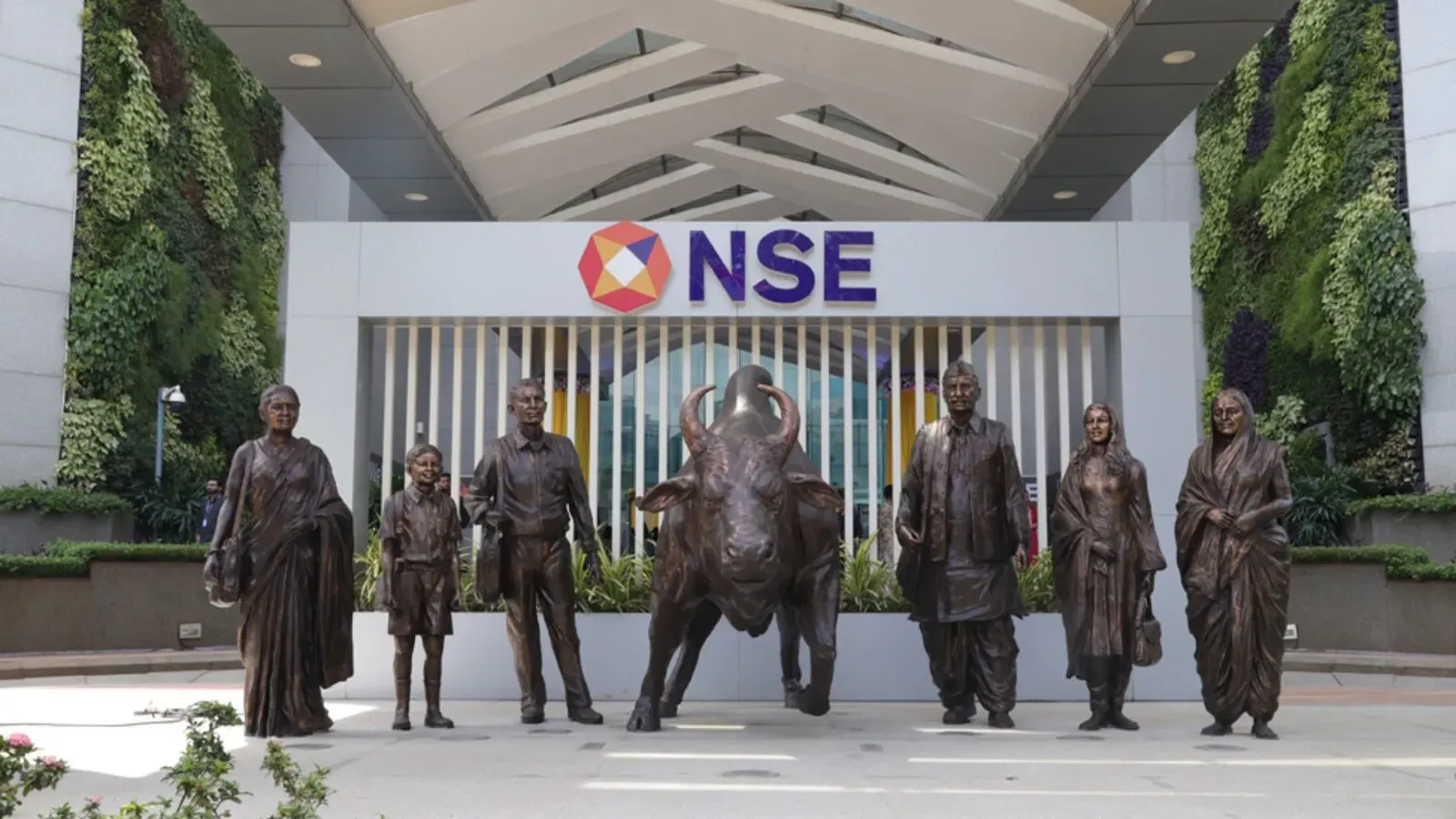
On September 24, NSE finally became a listed company. But NSE's shares did not start trading on NSE. They listed on its old rival, BSE, because current rules do not allow an exchange to list on its own platform. In the same month, BSE, which is listed only on NSE, entered the benchmark NIFTY50.
NSE shares, which trade around ₹2,210 apiece on BSE, have a market cap of around ₹5.47 lakh crore, roughly equal to the bottom five NIFTY50 stocks put together. Yet NSE stock has no place in an index run by its own subsidiary. And NSE is not alone. LIC, Adani Power, Hindustan Aeronautics, Divi's Laboratories, Adani Green Energy, DMart and Hindustan Zinc are each worth more than twice the smallest NIFTY50 stock. So why don't they make the cut? Here’s the complete breakdown
High market cap stocks outside the NIFTY50 index
| Company | Market cap (₹ crore) | Free-float market cap (₹ crore) | Free float (%) |
|---|---|---|---|
| NSE | 5,41,604 | 55,689 | 10.3 |
| LIC | 5,11,186 | 51,122 | 10.0 |
| Adani Power | 4,05,171 | 87,139 | 21.5 |
| Hindustan Aeronautics | 3,18,003 | 89,921 | 28.3 |
| Divi's Laboratories | 2,96,741 | 1,41,420 | 47.7 |
| Adani Green Energy | 2,34,393 | 47,570 | 20.3 |
| DMart (Avenue Supermarts) | 2,28,309 | 56,496 | 24.7 |
| Hindustan Zinc | 2,23,498 | 25,355 | 11.3 |
NIFTY50 bottom five stocks
| Company | Market cap (₹ crore) | Free-float market cap (₹ crore) | Free float (%) |
|---|---|---|---|
| Dr Reddy's Laboratories | 1,16,766 | 85,096 | 72.9 |
| Cipla | 1,14,397 | 80,257 | 70.2 |
| Tata Consumer Products | 1,12,974 | 73,914 | 65.4 |
| Max Healthcare Institute | 1,01,061 | 76,446 | 75.6 |
| Tata Motors Passenger Vehicles | 96,975 | 55,346 | 57.1 |
| Total | 5,42,173 |
As seen in the table above, NSE's total market cap of ₹5.41 lakh crore is roughly the same as the bottom five NIFTY50 stocks. Life Insurance Corporation of India (LIC )'s market cap is more than five times that of Tata Motors Passenger Vehicles, the smallest NIFTY50 stock by market cap. But look at the free-float column, and the order flips.
Only free-float market cap counts
NIFTY50 picks its constituents from the NIFTY100 index using average free-float market cap, and weighs them by free-float market cap. Free float is the value of shares that are actually available for public trading. Shares held by promoters and stakes the index provider treats as strategic, such as some government or partner holdings, rarely come up for sale, so they are left out.
Take LIC and Tata Consumer Products. LIC has a market cap of ₹5,11,186 crore, but the government holds 90% of it. That cuts LIC's free float to just ₹51,122 crore. Tata Consumer's total market cap is only ₹1,12,974 crore, less than a quarter of LIC's. But about 65% of its shares, worth ₹73,914 crore, are freely available for trading for investors. On the basis of free-float market cap, Tata Consumer is the bigger company.
If LIC become part of the NIFTY50 index in the current scenario, it would be difficult for passive funds and ETFs to buy LIC shares, as a single owner holds 90 of every 100 shares?
In fact, LIC shares were recently removed from the NIFTY100, the parent index of the NIFTY50, in March 2026, when the public held only 3.5%. In August 2026, the government sold 6.5% in an offer worth ₹31,552 crore, which raised public holding to 10%. Even so, LIC's free float is still below that of Tata Motors Passenger Vehicles.
- Hindustan Zinc: Vedanta holds 60.71% and the government 27.92%. Its free float is only ₹25,355 crore.
- Adani Green Energy: The promoters hold 62.43%, while TotalEnergies holds 17.25% via two public non-promoter subsidiaries. Its free float is ₹47,570 crore.
- DMart: The promoters hold 74.48%. Its free float is ₹56,496 crore.
Each of the four is close to or below Tata Motors Passenger Vehicles, whose free float is ₹55,346 crore.
Average six-month free-float market cap should be 1.5 times
Hindustan Aeronautics, Adani Power and Divi’s Laboratories face a different hurdle. Their free floats now range from ₹87,139 crore to ₹1.41 lakh crore, higher than that of any of the five smallest NIFTY50 stocks. So why are they still not part of the NIFTY50 index?
First, the index does not go by one day's price. NSE Indices, the NSE arm that runs the NIFTY50, reviews it twice a year using six-month averages. Data from February to July decides the changes to be made in September, and data from August to January decides the changes made in March.
Second, a newcomer must clear a higher bar. Its average free float must be at least 1.5 times that of the smallest member. This buffer stops stocks from moving in and out of the index too often. The index can also add at most five companies in a calendar year in its regular reviews.
In the September 2026 review, Divi's Laboratories six-month average free float was ₹82,930 crore, against ₹65,666 crore for the smallest member, HDFC Life. It needed about ₹98,500 crore, so it fell short. TVS Motor, at ₹84,566 crore, also missed. Divi's shares have nearly doubled from their 52-week low, and its free float now stands at ₹1,41,420 crore. In early October, research firm Quiddity Leaderboard named Divi's and TVS Motor as possible entrants in the March 2027 review.
So a short-term rally does not guarantee a stock will be added to the NIFTY50 index, as a one-month jump gets diluted by the other five months, and that average still has to clear the 1.5-times bar.
Stock must trade on NSE and F&O
A NIFTY50 stock must first be part of the NIFTY100 index, trade on NSE and be available in NSE's futures and options (F&O) segment. Except for NSE shares, all other seven stocks actively trade in the F&O segment.
That rules out NSE. Its shares are listed only on BSE, so they do not trade on NSE and have no F&O contracts there. NSE is part of BSE's BSE 200 index, yet it cannot enter the NIFTY50, which is run by its own subsidiary.
NSE has explored a route under which its shares could be "permitted to trade" on its own platform while staying listed on BSE, but this needs SEBI's approval. Its chairman has also asked SEBI to review the rules on self-listing. Unless its shares are allowed to trade on NSE, it stays out, however large it gets.
One more filter: easy trading
Each stock also has to be easy to buy and sell in size. NSE Indices checks this with impact cost, the extra price paid when a large order hits the market. For a ₹10 crore basket, a stock's average impact cost must be 0.50% or less in at least 90% of observations over six months. The stock must also trade on every trading day in that period.
Conclusion
So, despite having high market capitalisation, companies can not directly become part of the NIFTY50 index. What matters is the free-float market cap of the stock and F&O trading. Hindustan Zinc, LIC, Adani Green Energy, and DMart have a large part of their holdings locked with promoters. Meanwhile, NSE shares are listed on BSE and are not part of the F&O segment.
Related News
About The Author
Next Story

