
Market News
Reliance, Hindustan Zinc and other metal stocks shine in Q2FY27 earnings; while auto sector faces pressure: Check key highlights

8 min read | Updated on November 18, 2026, 07:14 IST

SUMMARY
The Q2FY27 earnings season which started in October 2026 served as one of key factors behind the broad-based market recovery. Q2 earnings performance was heavily mixed across sectors. Metals, oil and gas, and IT rebounded sharply, while Automobile sector posted lower profits due to soaring raw material costs.
Reliance Industries (RIL) shares rose over 11% after Q2 earnings, adding ₹1.83 to ₹1.84 lakh crore to its market cap.
The September quarter earnings made a lasting impression among investors, as Q2FY27 earnings were one of the key factors behind broad-based market recovery. Benchmark NIFTY50 and SENSEX recovered 12.04% and 13.57% since 1st October 2026, and one of the key tailwinds behind this recovery is recently announced Q2FY27 earnings by domestic companies. In Q2FY27, some sectors delivered robust earnings, while some sector earnings remained laggard.
For example, in the auto sector, Maruti Suzuki reported sales of 6.96 lakh units, which was highest ever for the company in a single quarter as total sales grew by 26.5% YoY. Domestic passenger-vehicle market share expanded to 40.8% with roughly 2 lakh pending customer bookings at the end of September 2026.
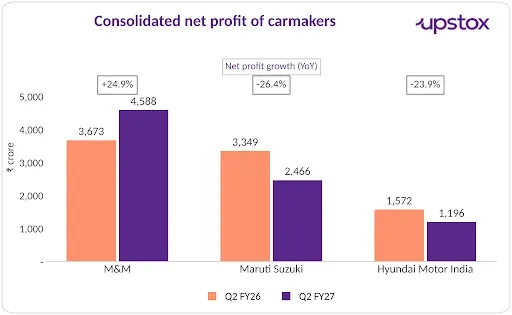
But despite the highest-ever quarterly sales volume, the consolidated net profit for the quarter fell 26.4% YoY and 28.5% QoQ to ₹2,466 crore. Other automakers like Hyundai Motor India and Tata Motors PV also reported weak Q2 profitability.
Meanwhile, metal & mining companies reported robust profitability during the quarter as surge in global metal prices aided the bottomline growth.
Reliance Industries shares surge over 11% after Q2 earnings
Reliance Industries (RIL) shares have rose over 17% since its Q2 earnings announcement. RIL announced its results on Friday, October 30 and on November 2, its shares rallied some 11.6%, the highest single-day gain since April 2020.
The company’s oil-to-chemicals (O2C) segment recorded an all-time high EBITDA of ₹25,203 crore, up 67.9% YoY, on higher margins arising out of fuel sales. That in turn boosted RIL's consolidated net profit attributable to the shareholders by 40.6% YoY to ₹25,548 crore. Meanwhile, Jio Platforms reported 13.7% YoY increase in consolidated net profit to ₹8,389 crore, while revenue from operations rose 11.4% YoY to ₹40,475 crore.
This robust earnings boosted investor sentiment towards Reliance Industries as the stock rose over 11% to close above ₹1,300 apiece on NSE and added ₹1.83 to ₹1.84 lakh crore to its market capitalisation.
Auto sector saw higher car sales but decreased profitability
Maruti Suzuki Q2FY27 net profit declined 26.4% YoY, while Hyundai Motor India also reported a 23.9% YoY decline in net profit to ₹1,196.2 crore. Meanwhile, Tata Motors PV reported a net loss of ₹5,531 crore. The profitability declined on the back of higher commodity and raw material costs linked to geopolitical tensions and adverse foreign exchange movements. However, all three automakers reported double-digit growth in revenue from operations.
Mahindra & Mahindra (M&M) was an exception. The consolidated net profit of the SUV maker was up 25% YoY to ₹4,588 crore. Revenue from operations also grew by 25% to ₹57,553 crore. The robust demand for SUVs contributed to M&M's auto business registering a 26% increase in vehicles sold in the quarter. But M&M has felt the pinch of costs, and the automotive segment margin has dropped to 8.8% from 9.3% a year ago. However, it did sell additional vehicles to offset the additional expenses.
Higher metal prices lead to record earnings for the metal sectors
Surge in global base metal prices of steel, zinc, copper and silver, along with record sales volume, helped major metal & mining companies post exceptionally strong Q2FY27 earnings with triple-digit growth in profitability. Besides this, disciplined cost control measures also aided the September quarter earnings.
Q2FY27 consolidated earnings of metal companies
| Company | Revenue from operations | % growth | Net profit | % growth | PAT margin |
|---|---|---|---|---|---|
| JSW Steel | ₹54,486 crore | 20.7% YoY | ₹5,279 crore | 225% YoY | 9.8% |
| Tata Steel | ₹65,436 crore | 11.5% YoY | ₹3,700 crore | 16.2% YoY | 5.6% |
| Hindustan Zinc | ₹15,093 crore | 76.5% YoY | ₹6,412 crore | 142% YoY | 42.5% |
| Vedanta* | ₹25,812 crore | 57% YoY | ₹6,202 crore | 151% YoY | 23.5% |
| SAIL | ₹31,997 crore | 19.8% YoY | ₹1,750 crore | 318% YoY | 5.5% |
| Lloyds Metals | ₹5,672 crore | 55% YoY | ₹1,023 crore | 86% YoY | 18.0% |
| Hindustan Copper | ₹1,175 crore | 63.7% YoY | ₹518.1 crore | 181% YoY | 44.1% |
JSW Steel's net profit shot up more than threefold to ₹5,279 crore on a record crude steel output of 7.27 million tonnes.
Hindustan Zinc posted its highest-ever quarterly revenue and profit. The company’s revenue from silver sales rose 141% to ₹4,111 crore, helping propel its net profit to ₹6,412 crore. Lower production costs, favorable LME prices, and a stronger US dollar expanded the company's EBITDA margin to 62%.
SAIL reported a 318% rise in net profit as crude steel production rose to 4.85 million tonnes and sales volumes climbed to 5.16 million tonnes.
NIFTY IT index surge 17.7% in October 2026 after Q2 earnings
For a significant portion of 2026, investors had concerns that AI would consume the business of traditional outsourcing by IT companies, on which the Indian IT industry is primarily reliant. This resulted in a significant sell-off in the IT sector through out this year.
However, in October 2026, the NIFTY IT index rose 17.7%, its best monthly performance in over six years. In the week that ended October 16 it was up 11.7%, its largest weekly increase since April 2008. This strong return came after the announcement of September quarter earnings.
In Q2FY27 earnings, TCS's consolidated net profit came in at ₹13,884 crore, marking a 15% YoY growth, while its annualised AI revenue surpassed $3 billion. HCL Tech's net profit rose 21.2% YoY to ₹5,132 crore and Tech Mahindra's 32.7% to ₹1,586 crore. Infosys' profit has increased 6.2% to ₹7,823 crore. Wipro lagged with a 1.4% decline to ₹3,200.6 crore. The market responded as the results rolled in.
Overall, top IT services companies delivered a mixed performance with steady deal wins and strong profit expansions for major companies.
Hardening bond yields hit PSU Bank treasury incomes in Q2FY27
During the September quarter, public sector (PSU) banks experienced pressure on non-interest or other income due to lower treasury gains as bond yields hardened, although headline net profits and net interest income (NII) remained resilient.
Domestic 10-year government bonds breached the 7% mark during the second quarter. When bond yields go up, bond values go down, and that's bad for the banks that hold these bonds. That translates to mark-to-market losses and reduced opportunities to capitalise on profits on bond sales. The Indian banks' treasury income decreased by 61.6% YoY, while the PSU banks' treasury income dropped by 59.4% YoY in Q2 FY27.
At the bank level, leaving out insurance and other subsidiaries, SBI's other income fell 23.8% YoY to ₹11,777 crore. The other income of Canara Bank declined 18.2% to ₹5,771.8 crore while treasury income took a beating as it dipped 68.5%. The non-interest income of Union Bank of India also dropped 6.9% to ₹4,651 crore. Meanwhile, Bank of Baroda’s other income nearly doubled to ₹6,881 crore. This was primarily because of gains on the bank's stake in NSE. However, the picture is not so rosy when these gains are excluded.
So how did PSU banks keep growing profits? Most of them held or improved their net interest margins (NIMs). SBI's domestic NIM was at 3.11%, Union Bank's global NIM was at 2.86% against 2.67% a year ago and Canara Bank's NIM stood at 2.55% against 2.50% a year ago. Bank of Baroda's NIM fell to 2.74% from 2.96%. The reduction of provisions for bad loans also proved to be a positive. SBI's consolidated net profit rose to ₹25,361 crore, an improvement of 20% YoY helped by gains from a stake sale, while Union Bank's net profit improved 31% YoY to ₹5,781 crore.
Conclusion
Overall, September quarter earnings were a mixed bag, with some sectors like metals & mining, oil & gas and others outperforming, while some like auto and the banking sector witnessed some challenges like rising input costs and lower treasury income.
About The Author
Next Story

