
Market News
Hindustan Aeronautics, Bharat Electronics and BDL: Q2 revenue rises across defence PSUs, but profit growth varies

4 min read | Updated on November 16, 2026, 13:18 IST

SUMMARY
Three major listed defence manufacturers: Hindustan Aeronautics (HAL), Bharat Electronics (BEL) and Bharat Dynamics (BDL) reported contrasting performances in the September quarter. Revenue from operations rose at HAL, BEL and Bharat Dynamics, while net profit grew at HAL and BEL but declined at Bharat Dynamics.
Bharat Dynamics, which recorded the highest Q2 revenue growth, reported a fall in net profit.
Hindustan Aeronautics (HAL), Bharat Electronics (BEL) and Bharat Dynamics (BDL), three of India’s leading defence manufacturers, reported contrasting business performances in the September quarter.
All three companies recorded revenue growth on a yearly basis, but their profit trends and operating margins varied considerably. HAL and BEL sustained solid double-digit expansions in both revenue and net profit, fueled by strong domestic indigenisation demand. Meanwhile, Bharat Dynamics recorded the fastest revenue growth, up 45.1% YoY to ₹1,664 crore, but its net profit declined 15% YoY to ₹183 crore as expenses rose sharply and operating margins contracted.
For a defence company, an order for a fighter jet may be newsworthy, but it takes longer to build the aircraft and collect the payment. The order book does not tell us how profitable future work will be. The September quarter earnings of Hindustan Aeronautics, Bharat Electronics (BEL) and Bharat Dynamics show this exact gap.
Revenue from operations increased at all three companies. However, Bharat Dynamics, which recorded the highest revenue growth in percentage terms, reported a fall in net profit. Here’s a brief Q2 earnings overview of leading defence PSUs.
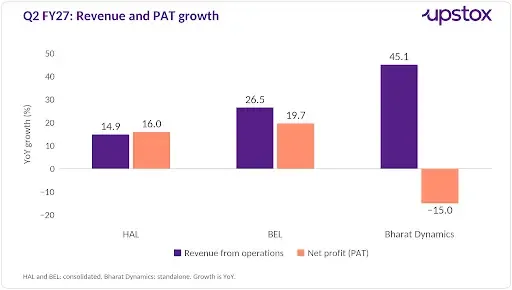
Hindustan Aeronautics' revenue from operations rose 14.9% YoY, while net profit grew by 16.0% YoY. Bharat Electronics recorded revenue growth of 26.5% YoY, while net profit rose 19.7% YoY. Bharat Dynamics revenue from operations increased 45.1%, but PAT fell 15% on a yearly basis.
Defence PSUs Q2FY27 earnings breakdown:
| Stock | Total order book* | Revenue from operations | Net profit (PAT) | YTD return | Trailing P/E (x) |
|---|---|---|---|---|---|
| Hindustan Aeronautics | ₹2.54 lakh crore | ₹7,613 crore | ₹1,936 crore | +8.6% | 33.6 |
| Bharat Electronics | ₹68,717 crore | ₹7,328 crore | ₹1,540 crore | +1.3% | 45.7 |
| Bharat Dynamics | ₹26,176 crore | ₹1,664 crore | ₹183 crore | −30.1% | 77.3 |
*Order-book dates: HAL and BDL: 31 March 2026; BEL: 1 October 2026. P/E as on 12 November and reported EPS for the TTM ended September 2026. HAL and BEL financials consolidated; BDL financials standalone.
PAT margins see considerable difference
Hindustan Aeronautics (HAL) net profit margin improved from 25.18% to 25.42% YoY, while Bharat Electronics (BEL) margin fell from 22.22% to 21.02%, and Bharat Dynamics (BDL) declined from 18.82% to 11.03%.
HAL’s operating EBITDA margin fell from 23.50% to 22.85% YoY. Material costs, after purchases and inventory adjustments, absorbed a larger share of revenue. Other income rose from ₹887.67 crore to ₹988.30 crore, and its share of joint venture profit increased from ₹7.34 crore to ₹96.52 crore. These helped PAT grow even as the operating margin weakened.
BEL’s net profit rose, but saw lower percentage growth compared to revenue from operations. Materials, traded goods and inventory adjustments absorbed a larger share of revenue, impacting the benefit of higher sales. Its operating margin was lower YoY but improved QoQ.
BDL’s costs rose faster. Total expenses increased 61.7% YoY, outpacing revenue growth. The cost of materials consumed fell. But changes in finished goods and work in progress added a large expense this quarter, although expenses reduced in Q2FY26. Other income helped cushion BDL’s results, growing to ₹167.07 crore from ₹120.57 crore.
Tracking order book
The order books represent work spread across several years. Higher revenue shows more business being recognised, but does not mean every programme is running on schedule. For HAL, engine availability, flight testing and customer acceptance remain key to Tejas Mk1A handovers. An aircraft without an engine cannot be delivered, even if an order exists.
Bharat Electronics' existing programmes include radars, electronic warfare systems and other defence electronics. At its Q2 earnings call, management was still awaiting approval for the Quick Reaction Surface-to-Air Missile (QRSAM) order. Expected contracts and confirmed orders need to be kept separate.
Bharat Dynamics order announced in October 2026, worth ₹1,307 crore plus taxes, highlights the lag between an order and revenue. Its execution period is 42 months. The work will be spread across the delivery schedule. Component availability, production and customer acceptance will affect how it progresses.
Conclusion
Bharat Dynamics recorded the fastest revenue growth despite a fall in Q2 profit. The focus will now be on production and deliveries. The fighter jet that grabbed headlines is yet to reach its customer. How much profit and cash will the signed contract leave behind is the question the next set of results will help answer.
Related News

About The Author
Next Story

