Market News
Mazagon Dock falls over 4%, GRSE down 3%: Here’s how defence stocks are faring after DAC meeting

3 min read | Updated on December 30, 2025, 12:15 IST


SUMMARY
The Nifty India Defence, which constitutes 18 stocks, fell as much as 1.4% to an intraday low of 7,619.95. Except for Mishra Dhatu Nigam (2.54%) and Bhart Forge (1.33%), all the other 16 stocks on the index were trading in red

Mazagon Dock was the biggest laggard on the Nifty India Defence index, falling 4.19%.
Defence stocks slipped up to 4% on Tuesday, December 30, even after the Defence Acquisition Council (DAC), chaired by Defence Minister Rajnath Singh, cleared capital acquisition proposals worth about ₹79,000 crore to boost the operational capabilities of the country’s armed forces on Monday.
The Nifty India Defence, which constitutes 18 stocks, fell as much as 1.4% to an intraday low of 7,619.95. Except for Mishra Dhatu Nigam (2.54%) and Bhart Forge (1.33%), all the other 16 stocks on the index were trading in red.
Mazagon Dock was the biggest laggard on the Nifty India Defence index, falling 4.19%, followed by Solar Industries (-4.01%), Garden Reach Shipbuilders & Engineers (-3.27%), Bharat Dynamics (-2.9%), Zen Technologies (-2.52%) and Data Patterns (-2.24%).
Further, shares of Mtar Technologies (-2.03%), BEML (-2.01%), Astra Microwave Products (-1.97%), Cochin Shipyard (-1.98%), Paras Defence (-1.8%) and Dynamatic Technologies (-0.98%) were also trading lower. Unimech Aerospace and Manufacturing (-0.88%), Bharat Electronics (-0.79%), Hindustan Aeronautics (-0.72%) and Cyient DLM (-0.14%) were down as well.
All you need to know from the DAC meeting
The Council accorded “acceptance of necessity”, the first formal step in India’s defence procurement process, for a range of weapons, platforms and systems for the army, navy and air force at a meeting held on December 29, the defence ministry said.
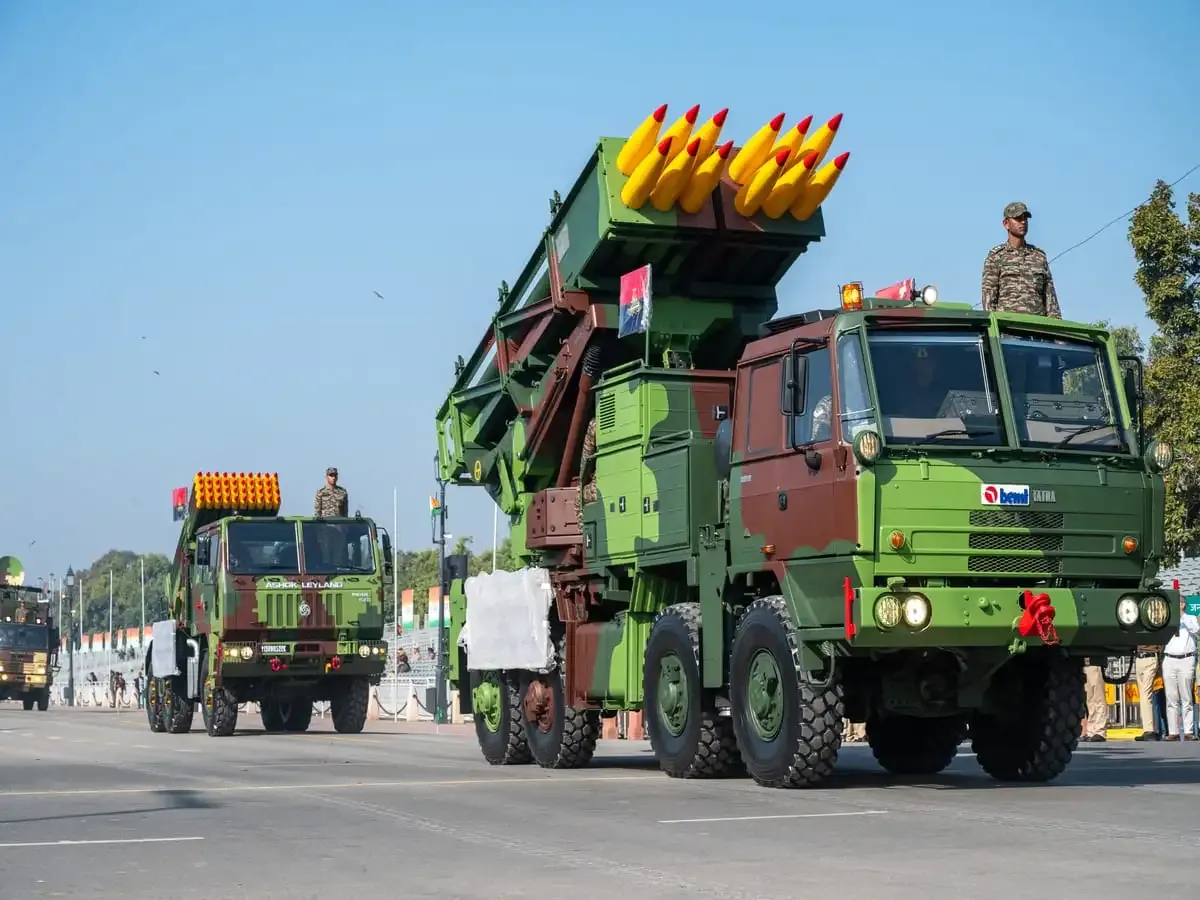
For the Army, the DAC cleared proposals for loiter munition systems for artillery regiments, low-level lightweight radars, long-range guided rocket ammunition for the Pinaka Multiple Launch Rocket System (MRLS), and an upgraded integrated drone detection and interdiction system.
The loitering munitions would allow precision strikes against tactical targets, while the radars would improve detection and tracking of small, low-flying unmanned aerial systems. The guided rockets are expected to enhance both the range and accuracy of the Pinaka system for effective engagement of high-value targets.
The upgraded drone detection and interdiction system will help protect vital assets in both tactical battle areas and hinterland locations, the defence ministry said.
For the Indian Navy, the DAC granted approvals for the procurement of bollard pull tugs, high-frequency software-defined radios in manpack configuration, and the leasing of high-altitude long-endurance (HALE) remotely piloted aircraft systems (RPAS).
According to the ministry, the tugs will assist naval ships and submarines in berthing and manoeuvring in confined harbour areas.
The HF SDR manpacks will improve long-range secure communications during boarding and landing operations, while the HALE RPAS will provide persistent intelligence, surveillance and reconnaissance, bolstering maritime domain awareness over the Indian Ocean Region.
The Indian Air Force will procure automatic take-off and landing recording systems, Astra Mk-II air-to-air missiles, full mission simulators and SPICE-1000 long-range guidance kits under the approvals.
The automatic take-off and landing recording system will help plug gaps in the aerospace safety environment by providing high-definition, all-weather recording of aircraft operations.
The Astra Mk-II missiles, with an extended engagement range, are expected to enhance the air force’s ability to engage enemy aircraft from greater stand-off distances.
The full mission simulator for the Light Combat Aircraft Tejas will augment pilot training capacity in a cost-effective manner, while the SPICE-1000 kits will strengthen long-range precision strike capability, the ministry added.
Related News

About The Author
Next Story