Market News
IndiGo, SpiceJet: Airline stocks rise after ATF cap move; Morgan Stanley, Goldman Sachs analysts weigh impact on margins, cash flows

4 min read | Updated on June 04, 2026, 12:04 IST


SUMMARY
Analysts at Morgan Stanley observed that InterGlobe Aviation may face near-term margin pressure driven by rising crude prices, moderation in demand, and currency depreciation
Stock list
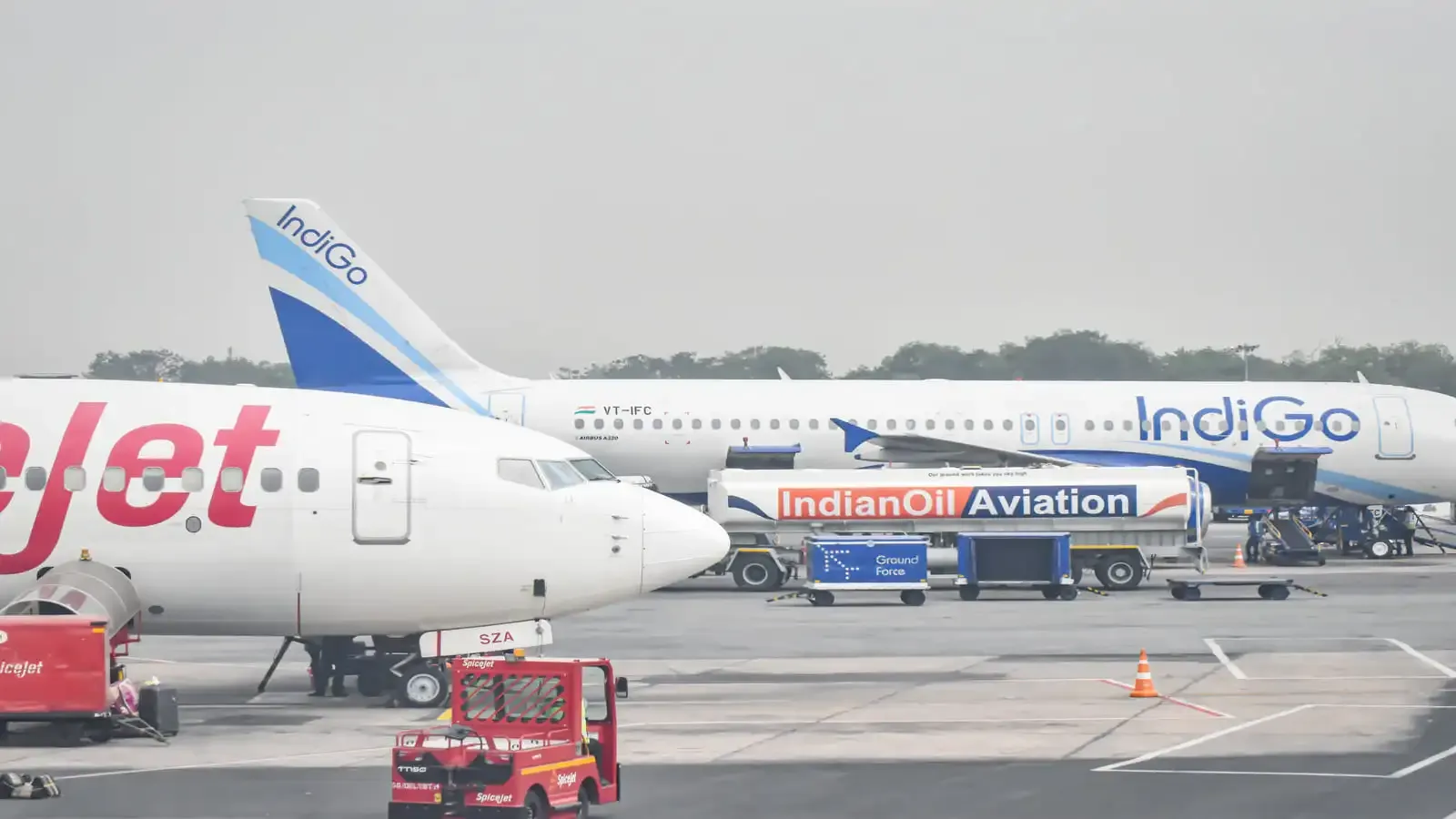
Since the beginning of the year, IndiGo's shares have declined over 11%, and its market capitalisation stands at ₹1.75 lakh crore. Image: Shutterstock
Shares of airline companies like InterGlobe Aviation and SpiceJet were trading in green on Thursday, June 4, a day after the government capped ATF prices for domestic airlines and approved a ₹10,000 crore jet fuel stabilisation fund to ease airline cost pressures.
The Union Cabinet has approved a ₹10,000 crore Aviation Turbine Fuel (ATF) Price Stabilisation Fund to protect airlines and passengers from the impact of a sharp rise in global jet fuel prices triggered by the ongoing crisis in West Asia.
The decision comes amid a nearly 2.5-fold increase in international ATF prices, which rose from ₹60.5 per litre in March 2026 to ₹142 per litre in May 2026, according to the government.
The government, however, capped ATF prices for domestic operations at ₹75.6 per litre to shield carriers and passengers from the full impact of the surge.
“While this measure helped stabilise domestic airline operations, the prolonged crisis began to have a significant negative impact on oil marketing companies (OMCs),” Information and Broadcasting Minister Ashwini Vaishnaw said at a Cabinet briefing.
“The challenge, therefore, was to find a win-win-win solution, one that benefits airlines, OMCs, and citizens alike,” he added.
The one-time budgetary support of up to ₹10,000 crore to oil marketing companies (OMCs) will help stabilise ATF prices for scheduled Indian airlines. ATF accounts for around 40% of airlines’ operating costs, making fuel prices a critical determinant of the sector's financial health.
IndiGo and SpiceJet shares price trends on Thursday
Opening at ₹4,500 apiece, shares of IndiGo operator InterGlobe Aviation climbed 0.55% to its intraday high of ₹4,537 apiece on Thursday. At 11:35 AM, the stock was trading at ₹4,524.60 per share on the National Stock Exchange, gaining 0.28%.
SpiceJet shares: after opening at ₹12.79 apiece on BSE, the stock has jumped 4.4% to today's high of ₹12.97. At 11:40 AM, the scrip was trading 2.09% higher at ₹12.68 per share.
Since the beginning of the year, IndiGo's shares have declined over 11%, and its market capitalisation stands at ₹1.75 lakh crore.
SpiceJet, with a market capitalisation of ₹1,935.09 crore, has tanked 57.5% so far since the beginning of 2026.
Here’s what analysts said
Goldman Sachs analysts noted that the proposed ATF price cap mechanism is designed to support airlines by facilitating interest-free advances to oil marketing companies (OMCs), enabling them to absorb losses when global aviation turbine fuel (ATF) prices exceed predefined benchmarks. They added that the framework aims to enhance price predictability and protect airlines, like IndiGo, from sharp fuel cost volatility stemming from the ongoing West Asia crisis.
The analysts highlighted that their scenario analysis suggests the support mechanism could help cover fuel price volatility for a period of around 2–5 months, depending on prevailing price levels. However, they stated that no changes have been made to their estimates at this stage, as further clarity is awaited on the structure and implementation of the proposed fuel price cap.
Furthermore, analysts at Morgan Stanley observed that InterGlobe Aviation may face near-term margin pressure driven by rising crude prices, moderation in demand, and currency depreciation. They expect the first half of FY27 to remain weak, with a gradual recovery anticipated in the second half as operating conditions improve.
The analysts noted that the proposed support mechanism is temporary and self-sustaining in nature, with advances to be recovered from OMCs once global fuel prices moderate. They added that the measure is positive for airline cash flows and helps stabilise operating costs, which currently account for around 40–60% of overall airline expenditure.
IndiGo’s Q4 FY26 earnings
InterGlobe Aviation reported a net loss of ₹2,536 crore for the quarter ended March 31, 2026 (Q4 FY26) as compared to a net profit of ₹3,068 crore seen in the same period of the last financial year. However, excluding the impact of foreign exchange and exceptional items, the company said it has reported a net profit of ₹1,920.6 crore.
The airline’s revenue increased just 1% at ₹22,438 crore in the reporting quarter as against ₹22,152 crore year-on-year (YoY).
IndiGo witnessed a 6% decline in EBITDAR to ₹6,396 crore in Q4, compared to ₹6,817 crore in the year-ago period. The airline’s EBITDAR margin stood at 28.5%, down from 30.8% YoY, while its EBITDA margin was reported at 3.6% versus 27.5% in the corresponding quarter.
However, despite continuing external disruptions, during the year ended March 2026, IndiGo said it has expanded its operations, with capacity increasing by 9.5% YoY and total income growing by 6.4% to ₹89,513.4 crore.
Related News


About The Author
Next Story