Market News
FMCG stocks struggle: NIFTY FMCG index down 18% in 2026; why a margin recovery looks elusive

5 min read | Updated on October 19, 2026, 13:05 IST


SUMMARY
Latest industry reports said that FMCG companies face sustained margin pressure in the second half of the current fiscal year (H2 FY27) as rising input costs squeeze profitability, with firms weighing post-Diwali price hikes against the risk of hurting consumer demand, particularly in price-sensitive mass-market and rural categories.
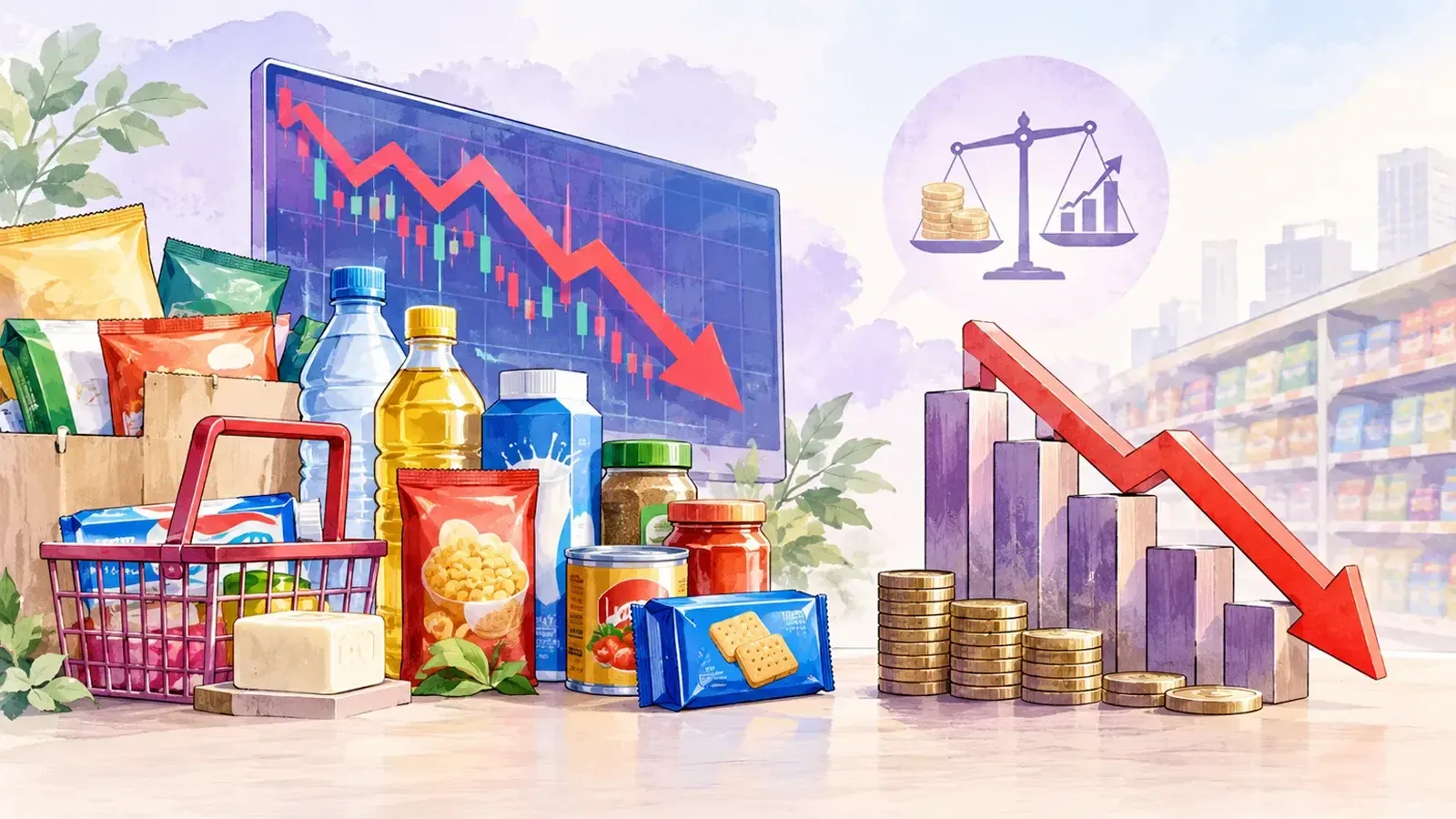
At 12:33 PM, the FMCG index was down 1.26% at 44,054.20, with 13 stocks declining and 2 advancing.
Shares of fast moving consumer goods (FMCG) companies were trading with notable losses in the early trade on Monday, October 19. The NIFTY FMCG index slipped up to 1.37% to the day's low of 44,004.80.
At 12:33 PM, the FMCG index was down 1.26% at 44,054.20, with 13 stocks declining and 2 advancing.
The fall in FMCG stocks could be attributed to margin pressure.
Latest industry reports said that FMCG companies face sustained margin pressure in the second half of the current fiscal year (H2 FY27) as rising input costs squeeze profitability, with firms weighing post-Diwali price hikes against the risk of hurting consumer demand, particularly in price-sensitive mass-market and rural categories.
Input-cost pressures intensified in the September quarter, reversing some of the moderation seen in the preceding quarter, which squeezed margins even as companies absorbed part of it to protect consumer demand during the festive season.
The increase has been uneven across commodities, with crude-linked derivatives, packaging materials, palm oil and sugar emerging as key pressure points, said Naveen Malpani, Partner and Consumer Industry Leader at Grant Thornton Bharat.
"In rupee terms, palm oil prices were approximately 21% higher year-on-year in September, while sugar prices remained around 18% higher year-on-year despite correcting 8 per cent month-on-month," Malpani said.
Higher costs have not been fully offset by price increases and operational efficiencies, putting pressure on operating margins, Malpani added.
"Pre-results analyst estimates projected operating-margin compression of approximately 45 basis points year-on-year across a group of major consumer staples companies, with some estimates indicating declines of up to 150 basis points for the companies covered," Malpani said.
| Symbol | Open | High | Low | Prev. Close | LTP | Change | % Change |
|---|---|---|---|---|---|---|---|
| NIFTY FMCG | 44,548.00 | 44,579.25 | 44,004.80 | 44,616.15 | 44,077.90 | -538.25 | -1.21% |
| ITC | 262.70 | 263.90 | 259.95 | 263.50 | 261.00 | -2.50 | -0.95% |
| VBL | 430.00 | 430.45 | 419.60 | 430.50 | 421.30 | -9.20 | -2.14% |
| HINDUNILVR | 1,885.00 | 1,889.00 | 1,852.90 | 1,893.80 | 1,854.80 | -39.00 | -2.06% |
| PATANJALI | 367.00 | 367.00 | 359.45 | 367.30 | 364.45 | -2.85 | -0.78% |
| NESTLEIND | 1,264.50 | 1,264.90 | 1,247.10 | 1,265.50 | 1,249.80 | -15.70 | -1.24% |
| COLPAL | 1,772.00 | 1,776.50 | 1,734.10 | 1,770.90 | 1,741.90 | -29.00 | -1.64% |
| GODREJCP | 858.00 | 858.00 | 843.40 | 855.00 | 847.65 | -7.35 | -0.86% |
| RADICO | 4,473.40 | 4,504.00 | 4,423.10 | 4,473.40 | 4,479.40 | +6.00 | +0.13% |
| MARICO | 790.00 | 791.85 | 778.95 | 785.00 | 780.25 | -4.75 | -0.61% |
| TATACONSUM | 978.80 | 978.85 | 961.80 | 978.90 | 963.90 | -15.00 | -1.53% |
| BRITANNIA | 4,774.00 | 4,787.90 | 4,730.10 | 4,764.00 | 4,736.20 | -27.80 | -0.58% |
| UBL | 1,200.00 | 1,208.90 | 1,191.50 | 1,201.60 | 1,202.60 | +1.00 | +0.08% |
Outlook
"Outlook for H2 FY27 remains cautious," said Malpani, adding, " Companies may continue to face cost pressures, with any meaningful margin recovery dependent on commodity prices easing and earlier pricing actions flowing through.
The risk is particularly relevant for packaged foods, home and personal care products and other categories exposed to edible oils, crude derivatives and agricultural commodities.
The potential strengthening of El Niño conditions during October-December also adds uncertainty to the outlook for agricultural production and food prices. Its impact on Indian agriculture, however, will depend on broader ocean-atmosphere conditions and regional weather patterns, and higher food inflation is a risk rather than a certainty.
The impact on consumer demand will be another key factor to watch. While price increases can support value growth, they may not translate into higher underlying volumes if consumers cut purchases, shift to cheaper brands or opt for smaller packs.
“If food inflation rises or rural incomes weaken, consumers may trade down to lower-priced brands, choose smaller packs, reduce purchase frequency or defer discretionary purchases. The uneven monsoon and potential El Niño impact add uncertainty to rural purchasing power,” he said.
What Nestle India said in Q2 FY27 earnings
In its commodity outlook, Nestle India said coffee and wheat prices were expected to remain range-bound, while sugar and edible oils would stabilise at elevated levels in the December quarter.
Cocoa remained volatile because of weather-related crop concerns in key producing regions, while milk prices had strengthened seasonally but were expected to ease with the arrival of flush supplies, it said.
FMCG stocks struggle
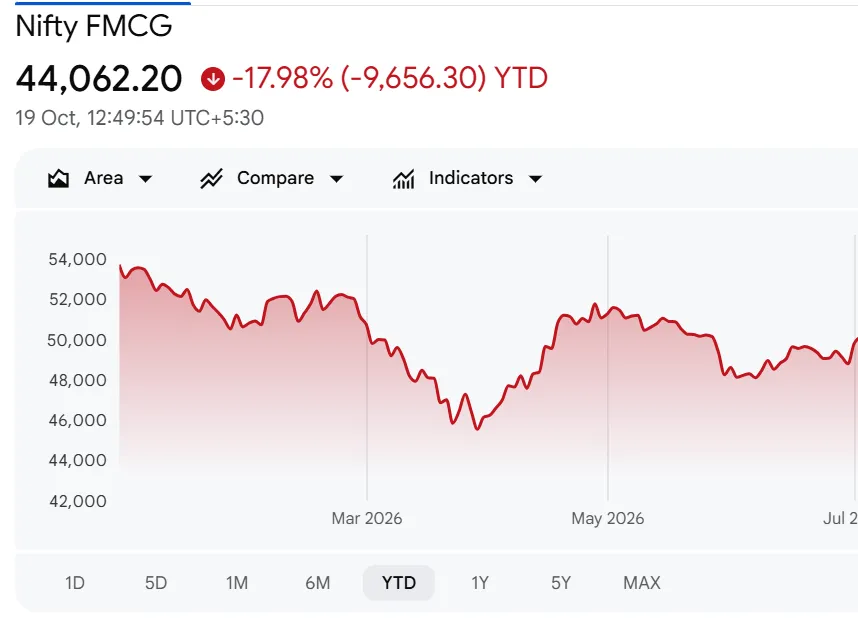
Data show that the NIFTY FMCG index has slipped 1.4% over the past five sessions, 4% in one month, over 11% in 6 months, and around 18% so far in 2026 (year-to-date).
Related News

About The Author
Next Story