
Market News
Do equity markets underperform during a rate-hike period? Here is what the data shows

4 min read | Updated on October 07, 2026, 15:09 IST


SUMMARY
RBI hiked the interest rates for the first time since February 2023, as sticky inflation and elevated global bond yields prompted the central bank to change the policy stance. Historically, markets have shown a positive response in the period of rate hikes in the last fifteen years.

In the previous rate hike cycle period in 2022-2023, NIFTY50 delivered 41% returns until next rate cut. Image: Shutterstock.
Indian benchmark indices opened in red on Wednesday ahead of the important RBI policy outcome. The NIFTY50 opened over 80 points lower and extended the fall in the early hours. Similarly, the SENSEX opened nearly 200 points lower on Wednesday. However, after the RBI announced its policy outcome, the indices regained some of the lost ground and bounced back from the intraday lows.
The RBI raised its key repo rate by 25 bps to 5.5%, for the first time since February 2023, when it began its rate-cut cycle. The hike was unanimously agreed upon by all the members of the Monetary Policy Committee (MPC) as inflationary pressures around the globe prompted a hawkish stance.
Moreover, the RBI governor explicitly mentioned that any rate cuts are off the table and that the committee will be considering rate hikes and pauses in the coming policy meeting, setting the stage for an upward interest rate trajectory.
The RBI said that increasing crude oil prices, elevated global bond yields, and sticky inflation prompted the central bank to take the policy tightening decision. The rate hike also follows the global central banks’ policy stance of slowly ending the cheap money policy, after the US Federal Reserve, Bank of Japan, ECB, and Bank of England announced their rate hikes recently.
A rate hike is largely seen as a sentiment dampener for the economy as borrowing costs increase, followed by curtailed credit growth and slower expansion in economic activity. For equity markets, it is also seen as a negative, as heightened borrowing costs impact overall margins of companies and thereafter profits. A rate hike also implies a massive rerating of stocks that hold high debt on their balance sheets.
The rate-sensitive sectors like Auto, Consumer Durables, Realty, and Metals are likely to react negatively as a rate hike affects the aggregate demand for the respective sectors. In summary, a rate hike is expected to impact the market performance adversely. But does that actually happen?
NIFTY50 returns during the rate-hike period
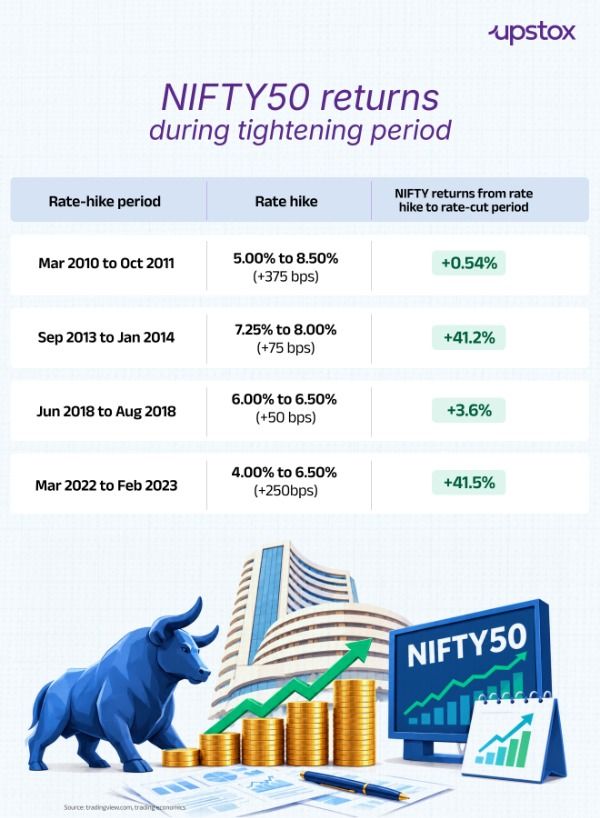
Source: tradingview.com, trading economics
Rate hikes in the past 15 years have shown that markets have reacted positively during periods of rate hikes. The rate hike following the sub-prime crisis was the most aggressive in nearly two decades, as the RBI hiked interest rates 13 consecutive times, raising it by 375 bps in total. This was the period when sticky inflation and aggressive rate hikes impacted market performance adversely, delivering muted returns.
In the 2013 to 2015 rate hike cycle, the pre-election optimism bolstered the rally in the NIFTY50, delivering more than 41% returns until the next rate cut happened in January 2015.
Similarly, during the 2022 to 2023 rate-hike period, the market absorbed the shocks of higher borrowing costs as the economy posted a V-shaped recovery from the aftermath of Covid-19. Additionally, robust domestic flows and corporate earnings helped to absorb the shock of the hawkish RBI policy stance.
Will history repeat itself this time?
The RBI governor indicated in a precise manner that the central bank will be focusing on bringing inflation to the lower end of the tolerance band of 2-6%, i.e. below 4%. Thus, rate cuts are off the table, and hikes and pauses will only be considered in coming policy meetings.
Markets may absorb the higher borrowing costs and perform well, in line with the historical trend, if the earnings growth remains intact and global uncertainty subsides in the coming months. However, historical instances may not provide a true picture for the future. It will be imperative for investors to closely monitor earnings growth and other global geopolitical and economic factors.
About The Author
Next Story

