
Market News
Maruti Suzuki Q4 results: Revenue, net profit could see double-digit growth aided by higher volumes
.png)
4 min read | Updated on April 28, 2026, 09:42 IST


SUMMARY
Maruti Suzuki India is set to announce its March quarter (Q4FY25) results on April 28, 2025, with expectations of strong double-digit growth in revenue and net profit driven by 12 to 14% YoY volume growth. Investors will closely track management commentary on demand trends, new launches, input cost pressures, and export outlook.
Stock list

Maruti Suzuki option pricing indicates a potential move of about ±7.2% for the 26 May expiry.
Automobile giant Maruti Suzuki India is set to announce its March quarter results on April 28, 2025. India’s largest carmaker is likely to report upbeat quarterly earnings with double-digit growth in revenue and net profit led by higher volumes, which could grow by 12 to 14% YoY.
According to experts, Maruti Suzuki’s standalone revenue could increase by 25 to 28% YoY in the range of ₹51,100 to ₹52,250 crore, while its net profit could see double-digit growth of 11 to 17% YoY to ₹4,150 to ₹4,350 crore. Higher profitability could come on the back of an uptick in sales volume and a shift in product mix with a higher share of SUVs/EVs models, which could improve average selling prices. Higher export volumes may also aid profitability.
Maruti Suzuki reported a standalone revenue of ₹40,674 crore in Q4FY25 and ₹49,892 crore in the previous quarter. Meanwhile, its net profit stood at ₹3,711 crore in the same quarter of the previous fiscal year and ₹3,794 crore in Q3FY26. EBITDA margin for the March quarter likely to contract by 20 to 50 bps on a sequential basis due to elevated commodity prices, high freight and production costs.
Investors will keep an eye on the management commentary on demand trends and upcoming new product launches. Ongoing pressure from input costs, export volumes and near-term outlook will also be closely monitored.
Ahead of the Q4 result announcement, Maruti Suzuki shares are trading 0.4% higher at ₹13,287 apiece on NSE. So far this year, Maruti Suzuki shares are trading over 20% lower.
Technical view
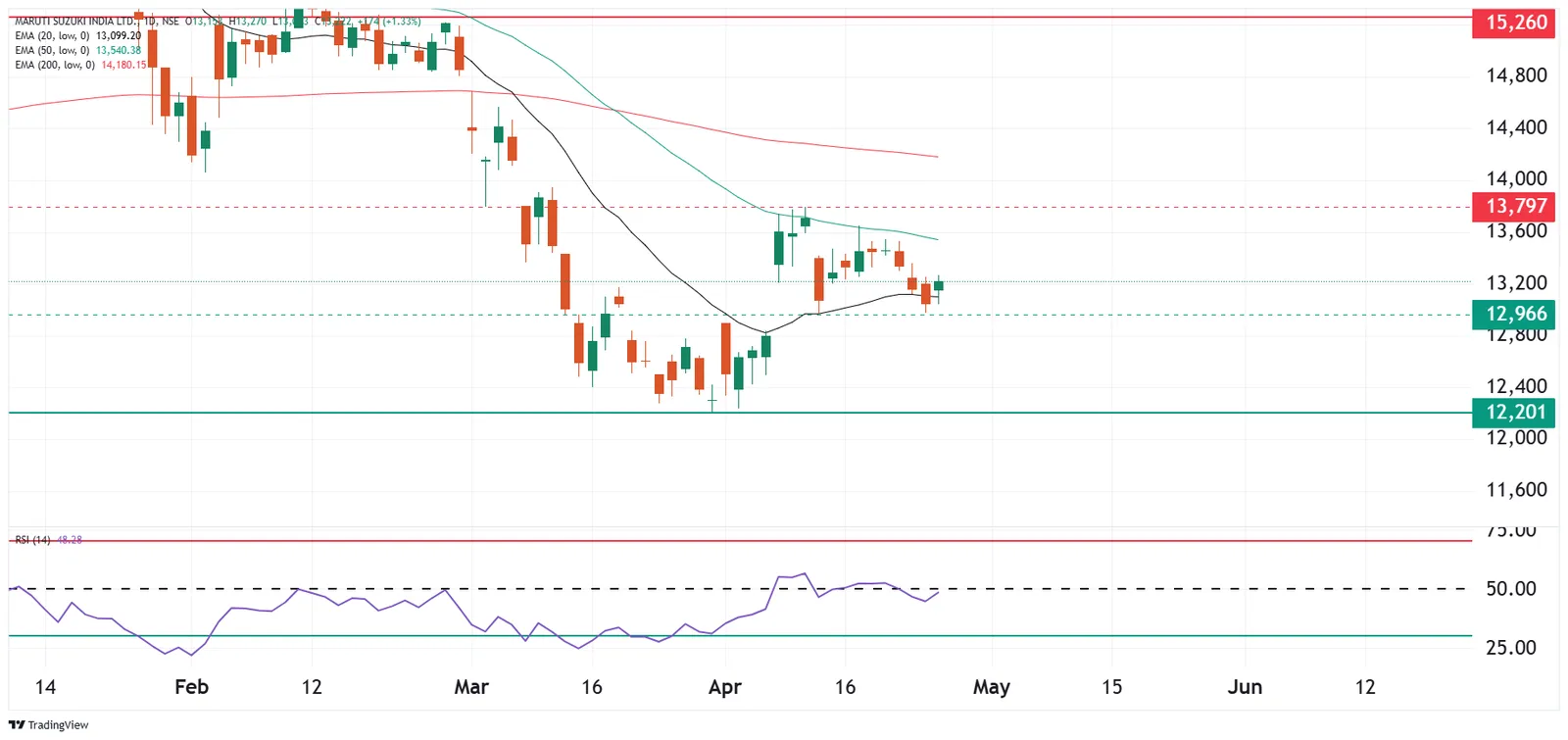
Maruti Suzuki is attempting to stabilise after a sharp correction, with prices forming a base near the 12,200 zone and now consolidating just around the 20 EMA. The broader trend remains mildly bearish as the stock continues to trade below the declining 50 EMA and well under the 200 EMA, indicating that upside momentum is still limited.
In the near term, the 13,800 zone acts as immediate resistance, and only a decisive close above this level can trigger a upside move. On the downside, 12,900 is the key support to watch, with a breakdown potentially dragging the stock back towards recent lows.
Options outlook
As of 27 April, Maruti Suzuki’s February at-the-money (ATM) strike for 26 May expiry stood at 13,300, with both call and put options priced at ₹956. This suggests an expected price move of about ±7.2%.
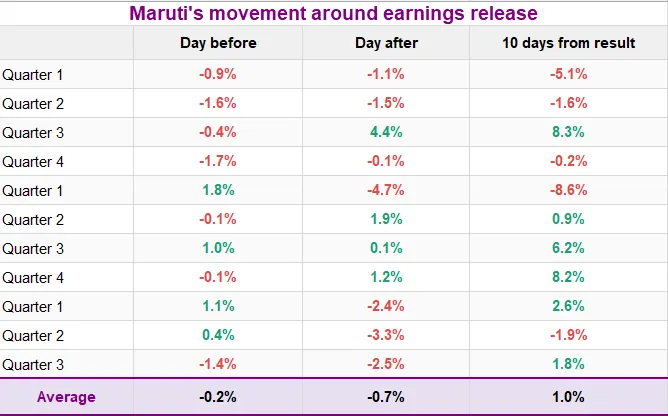
Before getting into options strategies, it helps to first review how the stock has behaved around earnings announcements over the past two years.
Options strategies for Maruti Suzuki
With the options market pricing in a potential move of about ±7.2% for the 26 May expiry, traders can look at both volatility-driven and directional setups.
For a volatility-focused approach, a long straddle involves buying an at-the-money (ATM) call and put with the same strike and expiry. This position benefits from sharp moves in either direction.
On the other hand, a short straddle means selling both an ATM call and put. This works when you expect the stock to stay relatively stable. If the move remains within the implied ±7.2% range.
For a directional view, spreads offer a more defined risk setup. A bull put spread involves selling a higher strike put and buying a lower strike put, aiming to profit if the stock stays above a certain level or moves higher. A bear call spread, in contrast, involves selling a lower strike call and buying a higher strike call, suited for a mildly bearish outlook.
Disclaimer:
Derivatives trading must be done only by traders who fully understand the risks associated with them and strictly apply risk mechanisms like stop losses. The information is only for educational purposes. We do not recommend any particular stock, securities or strategies for trading. The securities mentioned in this article are purely illustrative and not recommendations. Investors are advised to do their own research before investing.
About The Author
Next Story

