
Market News
InterGlobe Aviation Q1 results: IndiGo posts ₹237 crore net loss as jet fuel expense rises 86% YoY; check key numbers

5 min read | Updated on July 23, 2026, 16:42 IST


SUMMARY
IndiGo recorded a ₹237 crore net loss in its Q1 earnings as the airline suffered a massive hit from the rising cost of jet fuel in the market, weighing down on the company's expenses.
Stock list
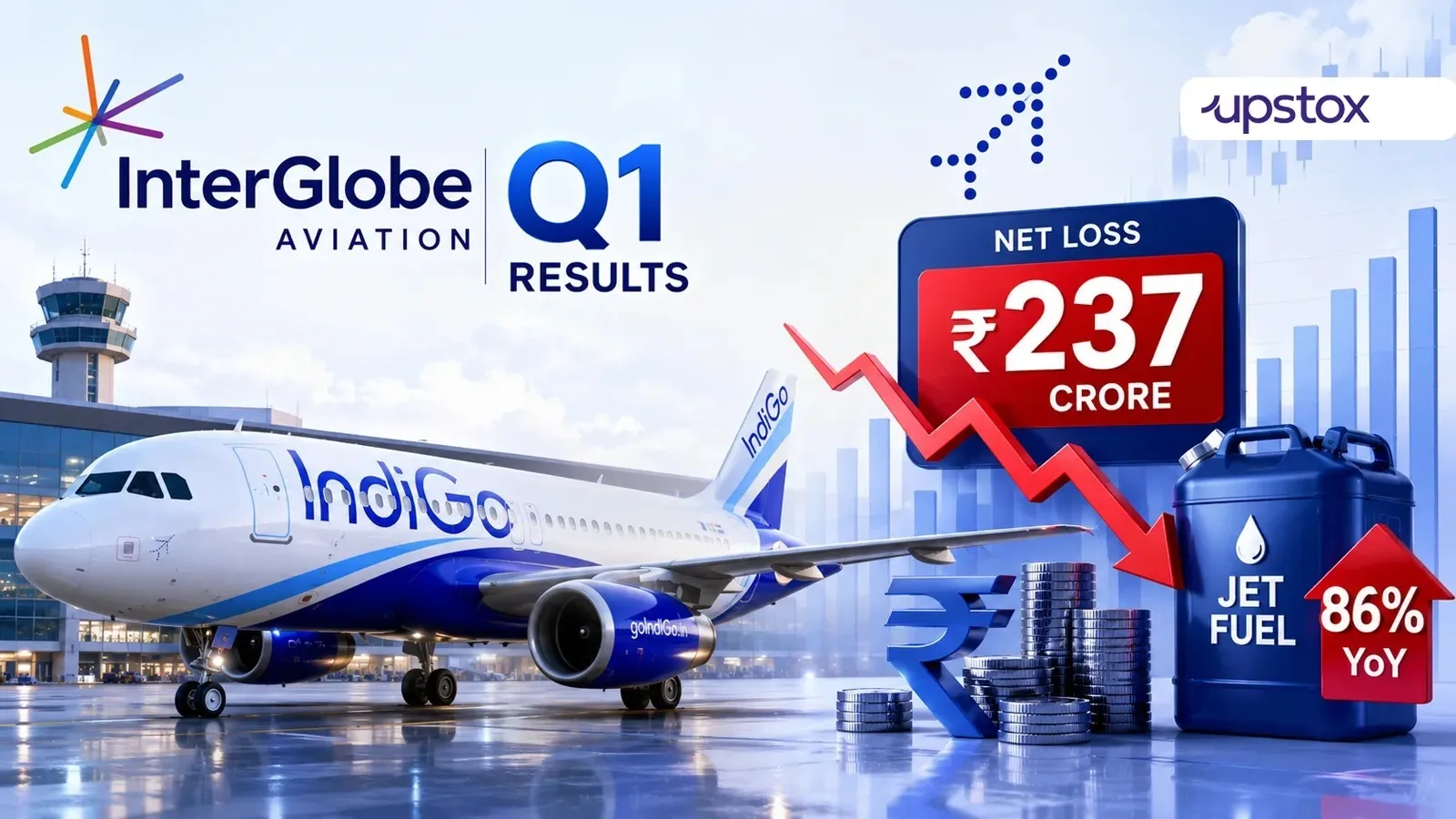
InterGlobe Aviation announced its Q1 earnings report after the market hours on Thursday, July 23. | Image: Shutterstock
NSE filings data showed that IndiGo recorded a ₹237.6 crore net loss in the first quarter of the fiscal year 2026-27, in comparison against a net profit of ₹2,176.3 crore in the same period a year ago.
Although the airline company’s revenue from core operations advanced 20% to ₹24,584 crore, from ₹20,496 crore in the same quarter of the previous year, the overall expenses in the period weighed down the margins and financial performance.
Shares of InterGlobe Aviation closed 1.8% lower at ₹5,023.50 on Thursday’s market, compared to ₹5,117 crore in the same period a year earlier, according to NSE data. The airline filed its Q1 earnings report after market hours on July 23.
Fuel costs squeeze margins thin
The airline company attribute its Q1 net loss to a combination of fuel price escalation, adverse foreign exchange movement and the West Asia conflict which in turn impacted the profitability in the period under review.
IndiGo’s consolidated financial statements also showed that IndiGo’s fuel expenses surged 86% to ₹10,832.9 crore in the June quarter, compared year-on-year with ₹5,832.6 crore in the same period a year earlier.
“The first quarter was shaped by a volatile operating environment, with elevated fuel costs and networkrelated constraints in the middle east impacting profitability. At the same time, demand remained healthy and our revenue performance improved year-on-year, supported by improved yields and continued customer preference for IndiGo,” said Rahul Bhatia, MD of InterGlobe Aviation.
IndiGo’s 86% rise in fuel cost increased the overall expenses in Q1 by 24% YoY to ₹25,852 crore in the June quarter, from ₹19,232 crore in the same period year earlier, as per the exchange filing.
For an airline a major portion of its expenses are tied up in fuel costs, or the funds which an airline spends to acquire aviation turbine fuel (ATF) and any changes in the global energy prices increases the input cost for an airline.
Latest data collected from International Air Transport Association (IATA) jet fuel monitor price data showed that ATF prices surged 17.6% to a weekly average price of $149.40 per barrel in the week ended July 17, compared to $127.06 per barrel in the previous week.
Due to the rising fuel costs, IndiGo’s EBITAR (earnings before interest, tax, depreciation, amortisation, and rent costs) margins dropped to 16.5% in the June quarter, compared YoY with 28% a year earlier.
Although the Ministry of Petroleum and Natural Gas’ price cap on jet fuel prices somewhat cushioned domestic passengers from a full impact on their ticket prices, the aircraft fuel expenses were accrued up to June 8, based on the capped prices.
Other key numbers
India’s largest airline operator, IndiGo’s official release also disclosed that its capacity increased by 2.9% YoY to 43.5 billion ASKs (Available Seat Kilometers), while the passenger traffic increased by 0.7% YoY to 31.3 million in the June quarter.
The NSE filings showed that IndiGo’s total cash balance as of the end of the June quarter was at ₹52,884.6 crore, while the company has a operating lease liability of ₹53,755.6 crore, and a total debt of ₹81,531.3 crore.
As of June 30, 2026, IndiGo has a total fleet comprising of 432 aircrafts, and the company reduced 9 passenger aircrafts in the period under review.
“ASK is expected to remain broadly flat compared to the second quarter of fiscal year 2026, reflecting lower aircraft utilization. As we move beyond this seasonally weaker quarter, we expect aircraft utilization to progressively increase,” said IndiGo’s management looking ahead in the upcoming period.
IndiGo share performance
InterGlobe Aviation or IndiGo shares delivered more than 191% returns to their investors in the last five years, and over 88% gains on their investment in the last three years, according to NSE data.
However, in the last one year period, the company stock has lost 15% in the last one year period.
On a year-to-date (YTD) basis, IndiGo shares have lost 1.5%, but the stock has gained 1.3% in the last one month period. The airline stock has lost 4.4% in the last five trading sessions on NSE.
The company’s market capitalisation (m-cap) was at over ₹1.94 lakh crore as of the stock market close on Thursday, July 23, 2026.
Related News


About The Author
Next Story

