Market News
Asian Paints Q1 results: Revenue likely to grow in double digits despite elevated oil prices

4 min read | Updated on July 29, 2026, 08:51 IST


SUMMARY
Asian Paints will announce its June quarter results on July 29, 2026. Analysts expect consolidated revenue to grow 10–14% YoY to ₹9,900–₹10,200 crore, while net profit may rise 11% to 19% to ₹1,230–₹1,310 crore. Investors will closely track volume growth, margin trends and management commentary on the demand outlook.
Stock list
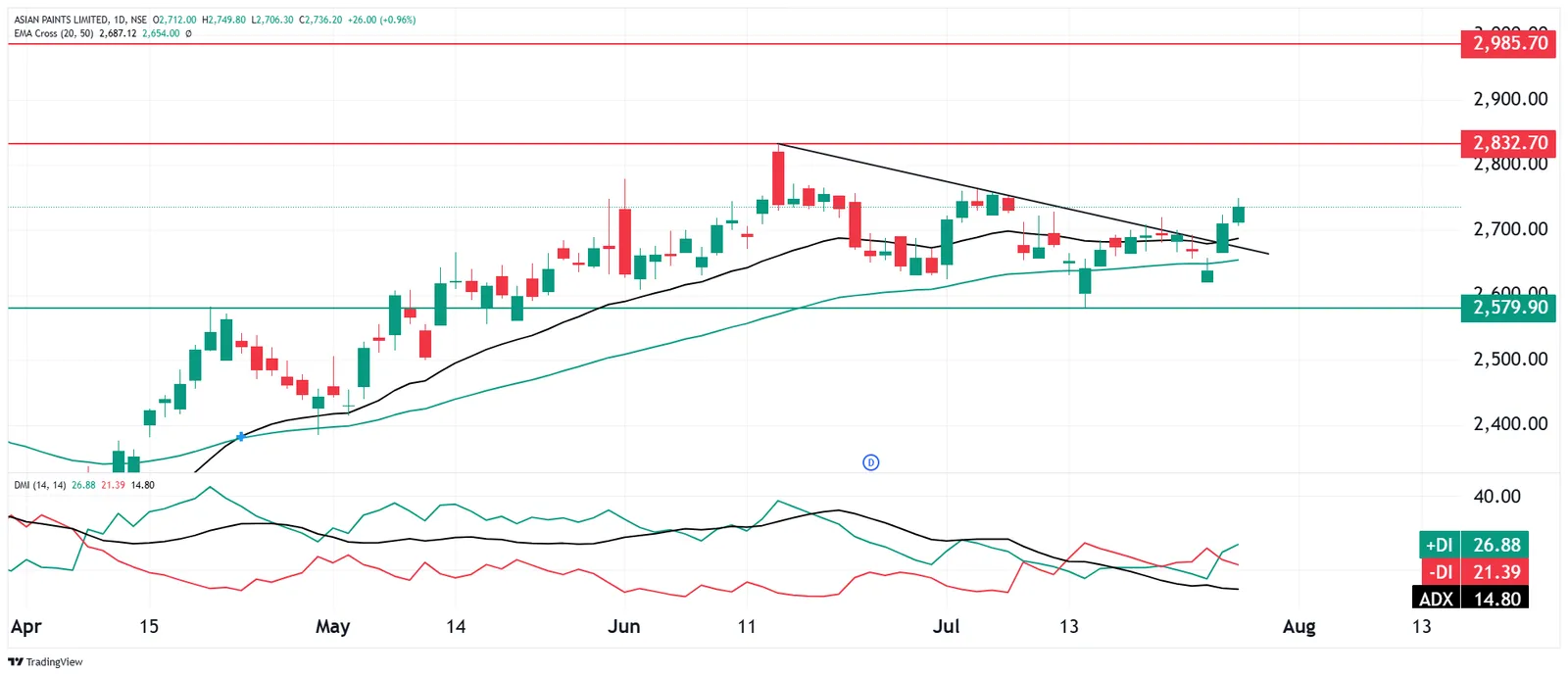
Asian Paints shares are trading above the 20-EMA and the 50-EMA.
India’s largest paint maker, Asian Paints, will announce its June quarter results on July 29, 2026. The company's earnings came amid a sharp spike in oil prices during the first quarter, which is key raw material in paint due to the US-Iran war.
According to experts, Asian Paints could report healthy growth in topline despite challenges. Consolidated revenue could jump by 10% to 14% YoY in the range of ₹9,900 to ₹10,200 crore, while overall net profit could jump 11% to 19% YoY to ₹1,230 to ₹1,310 crore mainly due to the price hike across product category in response to crude oil inflation.
High demand and channel stocking could also support the overall sales. Meanwhile, gross margins during the quarter could contract by 20 to 30 bps due to higher raw material costs.
The company registered a consolidated revenue of ₹8,939 crore in Q1FY26, while it stood at ₹9,247 crore in the previous quarter. Meanwhile, Asian Paints' net profit was at ₹1,100 crore in the June quarter of FY26 and ₹1,172 crore in the previous quarter.
During the quarterly result announcement, investors will keenly watch management commentary on demand outlook, actual impact of high raw material costs on margins. Key metrics like volume growth will also be tracked.
Ahead of the Q1 result announcement, Asian Paints shares closed 0.9% higher at ₹2,736 on Wednesday, July 29. So far this year, Asian Paints shares are trading flat.
Technical outlook
Asian Paints has broken above the falling trendline and closed at ₹2,736, signalling improving short-term momentum. The stock is also trading above the 20-EMA and the 50-EMA. Immediate resistance is placed near ₹2,800–₹2,833.
A sustained breakout above ₹2,833 can open the way towards ₹2,985. On the downside, ₹2,685–₹2,650 is the first support zone, while ₹2,580 remains the key positional support. The DMI favours buyers, but the low ADX of 14.8 suggests that the trend is still weak and requires confirmation above ₹2,833.
Options outlook
The at-the-money (ATM) strike for Asian Paints' 25 August expiry is 2,760, with a combined option premium of ₹168. This implies that the market expects a move of about ±6.1% from the closing price on 29 July.
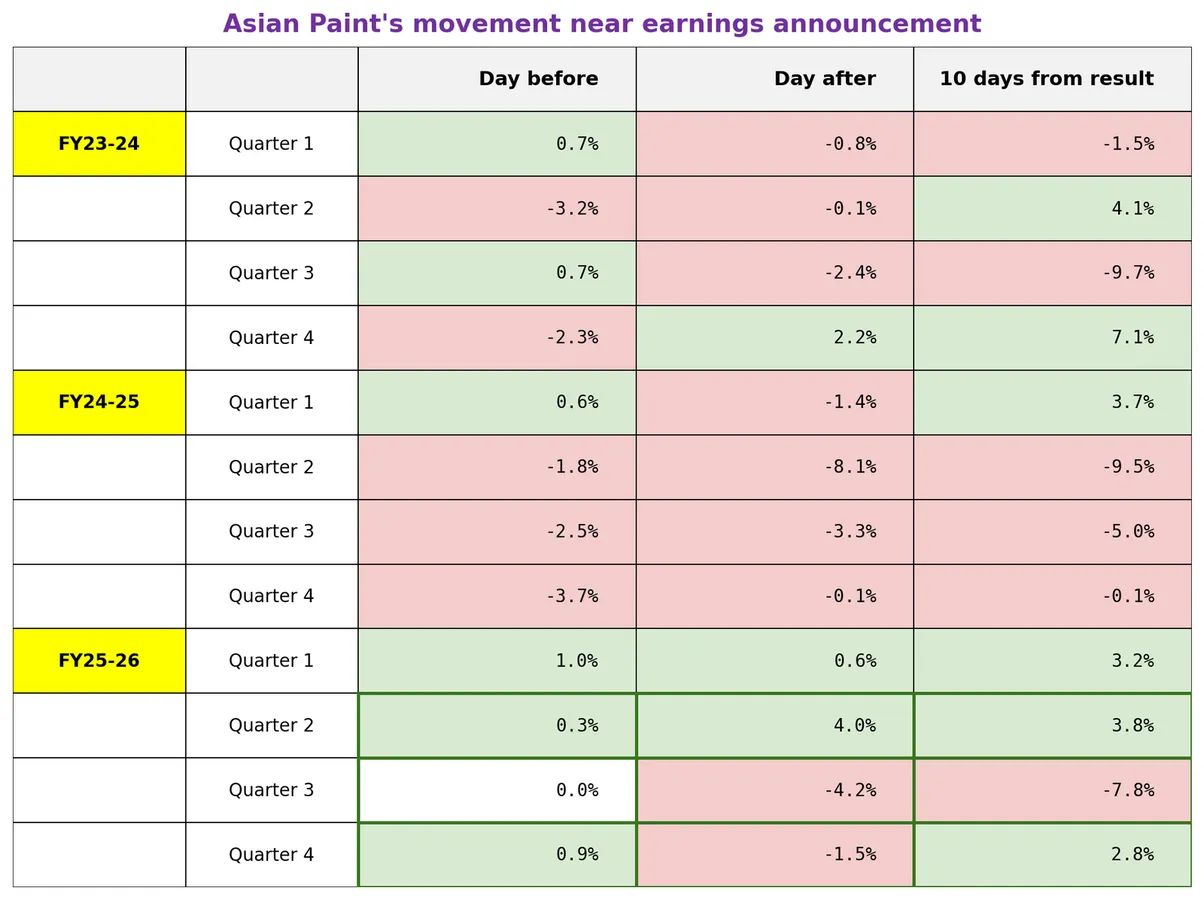
Let’s examine how Asian Paints stock has reacted to its quarterly earnings announcements over the past three years to gain insights into its price movements.
Options strategy for Asian Paints
Given the implied move of ±6.1% from the options data, traders can initiate either a long or short volatility trade, taking into account the price movement. To trade based on volatility, a trader can take a Long or Short Straddle route.
Straddles are the options strategies that are primarily used on the basis of volatility. In simple terms, in a Long Straddle, a trader can buy an ATM call and a put option of the same strike and expiry of Asian Paints, looking for a move of more than ±6.1% on either side.
On the other hand, the Short Straddle capitalises on the fall in volatility. In a Short Straddle, a trader sells both ATM call and a put option of the same strike and expiry. This strategy is deployed when the trader believes that the price of the Asian Paints after the earnings announcement will be confined in a range of ±6.1%.
Disclaimer:
Derivatives trading must be done only by traders who fully understand the risks associated with them and strictly apply risk mechanisms like stop-losses. We do not recommend any particular stock, securities, or trading strategies. The securities quoted are exemplary and not recommendatory. The stock names mentioned in this article are purely to show how to do an analysis.
About The Author
Next Story