The new UPI MDR framework is set to take effect from October 15, 2026, with the impact expected to be concentrated on larger merchant transactions.
The new UPI MDR framework will leave most consumers largely unaffected.
The return of Merchant Discount Rate (MDR) on UPI transactions has given rise to many questions about the impact on businesses and general consumers.
On Tuesday, the government announced a revised framework for MDR, under which 0.4% charge, capped at ₹300 per transaction, will apply to specified person-to-merchant (P2M) UPI transactions above ₹2,000.
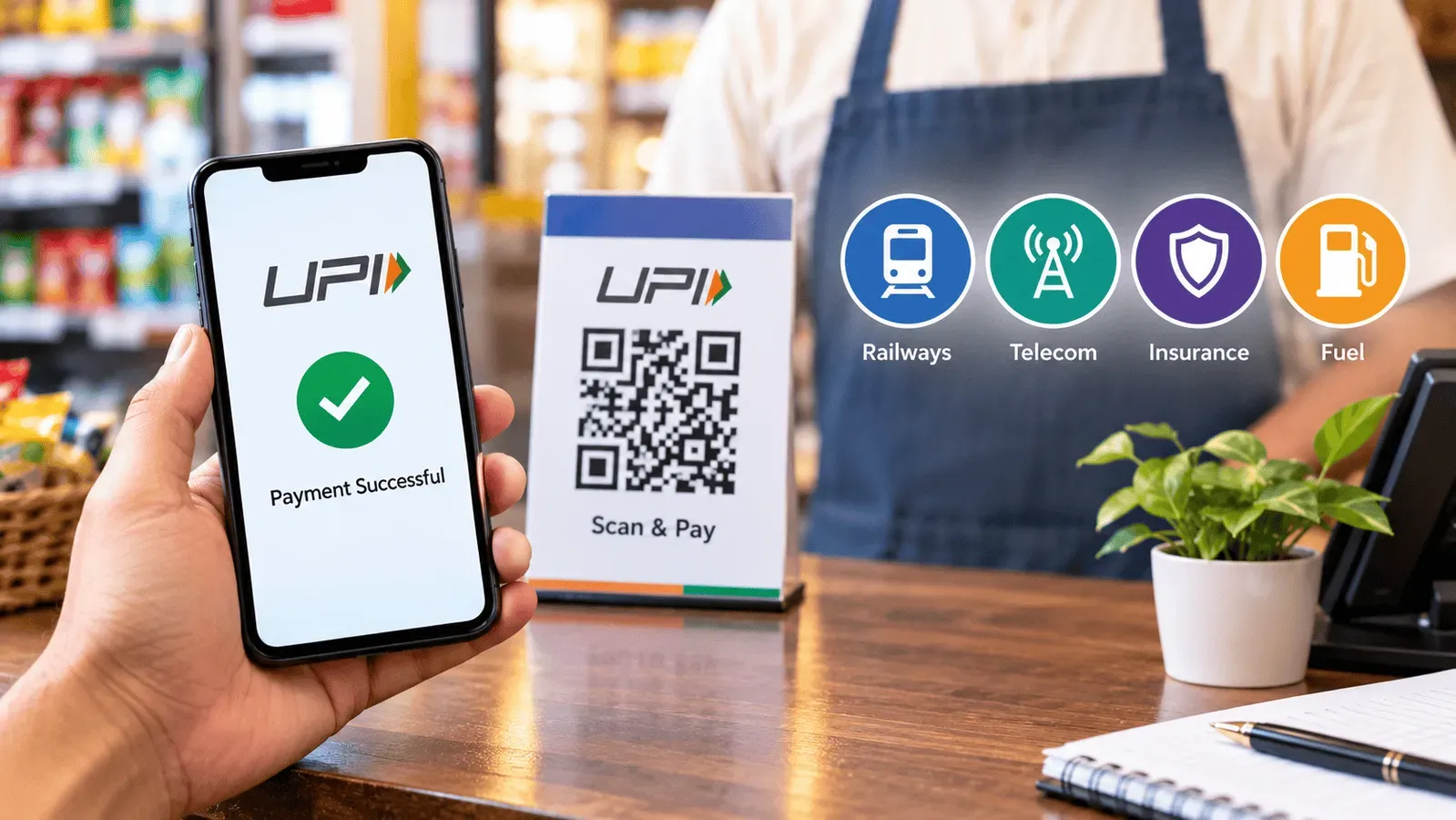
The framework also provides for a flat ₹5 charge on transactions above ₹2,000 in select sectors such as railways, telecommunications, insurance and fuel.
Payments relating to mutual funds, securities, stockbrokers and dealers will attract a lower MDR of 0.02%, also capped at ₹300 per transaction.
According to the finance ministry, the new UPI MDR framework will leave most consumers largely unaffected.
"MDR is a charge within the merchant payment ecosystem. It is not a charge on customers making UPI payments," the ministry said in a statement.
1. Will consumers have to pay a charge for making UPI payments to merchants?
No. According to the National Payments Corporation of India (NPCI), consumers will continue to use UPI without transaction charges. NPCI, which operates retail payments and settlement systems, asserted that individual account holders can continue making routine UPI payments without paying a fee.
2. Will sending money to friends or family attract a charge?
No. All person-to-person (P2P) UPI transactions will remain free for both the sender and recipient, irrespective of the amount transferred. Also, no charges will be levied on performing self-transfers across your own linked bank accounts.
3. Will UPI apps start charging a platform fee?
No. NPCI clarified that UPI application providers are not allowed to impose a platform fee or any other charge on UPI payments.
4. Will consumers be charged extra when they scan a shop's UPI QR code?
No. Customers will not be charged for scanning and paying through UPI QR codes at local markets, street vendors or retail shops.
5. What happens when a consumer makes a UPI payment of more than ₹2,000 to a merchant?
Specified P2M transactions above ₹2,000 will attract MDR at 0.4% rate, capped at ₹300 per transaction. The cap means any MDR on transactions above ₹75,000 will not exceed ₹300. The MDR is a merchant-side payment ecosystem charge, not a fee that consumers have to pay.
6. Can a shopkeeper add MDR to my bill?
Merchants cannot pass MDR charges on to buyers. But this is a grey area. A merchant that absorbs the MDR takes a small hit to its margin; one that adjusts prices or changes payment incentives could indirectly shift some of the cost.
Customers also often complain about how businesses refuse credit card payments and insist on cash or UPI to avoid the MDR, which typically range from 1.5% to 2.5% per transaction. It is yet to be seen how the MDR on UPI transactions, which has been a preferred method of payment, will impact the purchase experience.
7. Are there any monthly limits on free UPI transactions?
No. There are no monthly quotas or volume-based fee thresholds for consumers. Banks and NPCI may impose daily transaction limits for security and risk-management purposes, but these are not charges.
8. Will small purchases such as groceries, food or local shopping become more expensive because of MDR?
UPI payments up to ₹2,000 remain free of MDR. The framework also provides zero-MDR treatment for eligible small merchants under the P2PM category.
9. What about petrol, insurance and utility payments above ₹2,000?
Specified sectors such as fuel and insurance have a flat MDR of ₹5 for transactions above ₹2,000, rather than the standard 0.4% rate.
10. Will UPI AutoPay or recurring payments attract MDR?
According to NPCI, automated recurring payments made through UPI Mandates or AutoPay do not carry the prescribed MDR charges. This includes recurring utility bills, OTT subscriptions and recurring investments.
How will micro and small merchants be impacted?
1. Will small merchants, vendors have to pay MDR on UPI payments?
Eligible small merchants and vendors, receiving up to ₹1 lakh per month through UPI QR codes directly into their accounts, will continue to enjoy zero MDR.
2. What happens if a small merchant receives a payment above ₹2,000?
An individual payment above ₹2,000 does not automatically make an eligible P2PM merchant liable for MDR. The merchant's overall account categorisation determines whether MDR applies.
3. Does a small merchant need GST registration to get zero MDR?
GST registration is not required for P2PM zero-MDR protection. Eligibility is based on the applicable monthly collection threshold and bank-account categorisation.
4. What if a small merchant consistently receives more than ₹1 lakh a month?
Merchants acquired under P2PM are monitored for their monthly inward UPI payments. If their inward UPI credits exceed ₹1 lakh per month for three consecutive months, they are transitioned to the P2M category.
5. What happens when a merchant is no longer eligible for P2PM?
Once a merchant is transitioned into the regular P2M category, the standard MDR framework can apply.
So, for a neighbourhood shopkeeper, street vendor or other eligible micro merchant, the immediate impact is limited.
Flat MDR regime
A flat ₹5 MDR will apply to specified merchant transactions above ₹2,000 in railways, telecommunications, insurance and fuel. Payments below ₹2,000 will continue to carry zero MDR.
Insurance premium payments above ₹2,000, for instance, will attract a flat ₹5 MDR rather than the standard 0.4% rate. Similarly, UPI payments at petrol pumps above ₹2,000 will attract ₹5 MDR.
Public utility payments, including electricity and water charges, above ₹2,000 will also attract a flat ₹5 MDR under the designated industry programme category, while payments below ₹2,000 will remain free of MDR.
The revised MDR framework is scheduled to take effect from October 15, 2026.
Kunal Gaurav is a multimedia journalist with over seven years of experience delivering sharp, timely, and engaging news coverage. A former IT professional, Kunal earned his postgraduate diploma in journalism from the Asian College of Journalism, Chennai.