
Business News
Centre unveils Delhi-2047 master plan: 40 lakh homes, 695-km Metro network planned
.png)
3 min read | Updated on August 20, 2026, 16:55 IST


SUMMARY
Delhi's existing 416-km Metro network is proposed to expand to 695 km by 2047, while the RRTS network is planned to reach around 383 km.
The plan promotes transit-oriented development (TOD) along Metro, RRTS, railway and high-speed rail corridors.
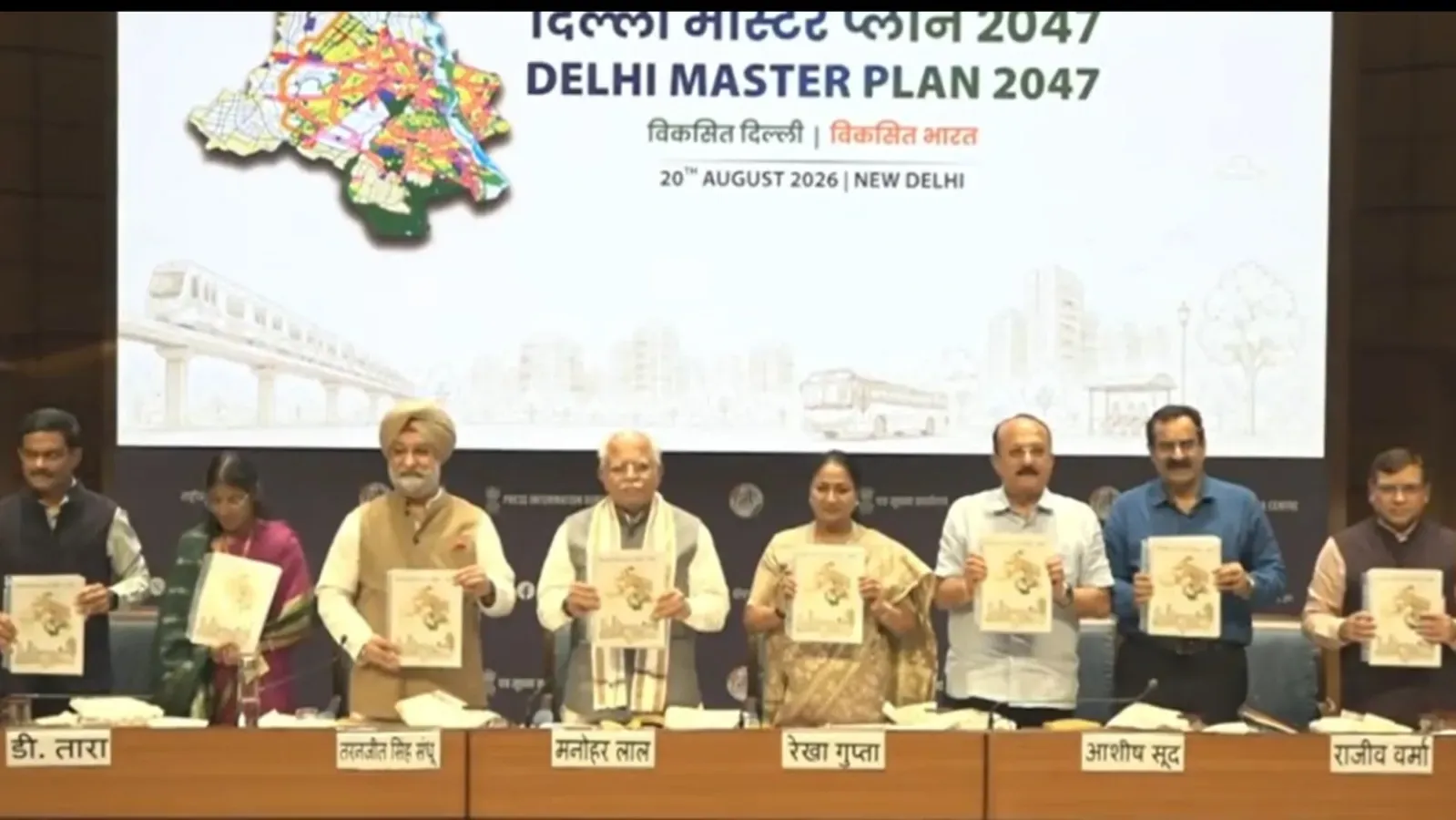
The Centre on Thursday unveiled the Master Plan for Delhi-2047, setting out a long-term framework for the national capital's development with a focus on housing, public transport, redevelopment of existing areas and environmental sustainability.
The Master Plan for Delhi-2047 aims to transform the capital into an inclusive, economically vibrant and environmentally resilient city capable of accommodating nearly 3.2 crore people by 2047.
Urban Affairs Minister Manohar Lal said that around 40 lakh homes will be constructed in the city and the metro rail network will be expanded to 695 km by 2047 to support the growing population.
Addressing a joint press conference along with Delhi Lieutenant Governor T S Sandhu and Chief Minister Rekha Gupta, Lal said that Delhi's population is expected to grow to 3.20 crore, which places pressure on development.
To meet the housing demand, the master plan proposes a two-pronged strategy involving redevelopment and densification of existing urban areas as well as planned development of new greenfield areas.
Existing neighbourhoods, ageing housing stock, under-utilised plots and low-density areas with infrastructure already in place will be targeted for redevelopment and regeneration.
The plan also provides for in-situ rehabilitation of slums and JJ clusters under the principle of "Jahan Jhuggi, Wahan Makan".
It also provides a framework for improvement, regularisation and redevelopment of unauthorised colonies through infrastructure augmentation, better connectivity, public amenities and appropriate development norms.
For new urban expansion, the plan relies on the Land Pooling Policy and other development models, with an inclusive zoning approach allowing a mix of housing, commercial, industrial, public and recreational uses.
Transit-oriented development (TOD) zones covering around 200 sq km along Metro corridors and within the influence areas of RRTS, railway and high-speed rail stations will facilitate compact, mixed-use development with a focus on affordable housing.
The plan also envisages a high-density corridor along the executed stretch of Urban Extension Road-II, covering around 20 sq km, with residential, warehousing, logistics and commercial uses.
The plan seeks to move Delhi towards a transit-oriented and walkable city, with public transport, walking and cycling prioritised over private vehicles. It proposes integrated pedestrian and cycling infrastructure, better last-mile connectivity and adoption of electric, hydrogen and other low-emission transport technologies.
Delhi's existing 416-km Metro network is expected to expand by another 279 km, while the RRTS network is planned to reach around 383 km, connecting the capital with regional centres including Ghaziabad, Meerut, Panipat, Karnal and Alwar.
The plan calls for ecological restoration, expansion of urban forests, biodiversity conservation and rejuvenation of the Yamuna and other water bodies, besides creating a "Green Connect" network linking parks, forests, biodiversity parks and ecological corridors.
Nearly 22% of the National Capital Territory is currently under green cover, and the plan seeks to strengthen and diversify this green network.
The plan seeks to shift urban planning from a primarily regulatory approach towards a development-oriented framework supporting investment, innovation and job creation. It also incorporates GIS-based planning, digital land management and technology-driven governance.
The document is divided into three parts covering the background and existing scenario, vision and spatial development strategies, and detailed development control norms, including provisions relating to mixed-use development and Transferable Development Rights.
About The Author
Next Story

