
Upstox Originals
Why did gold ETF flows collapse 78% in February 2026?

4 min read | Updated on March 25, 2026, 17:27 IST


SUMMARY
After a stellar 2025, India’s gold ETFs hit a bump in early 2026. February inflows tumbled 78% month-on-month to ₹5,254 crore. Profit-booking, a stronger US dollar, and rising US yields weighed on the rally, while domestic demand stayed soft. So, what does this mean for gold ETF flows in the months ahead?

February inflows into gold ETFs tumbled 78% month-on-month to ₹5,254 crore
In 2025, gold had a banner year. Prices surged steadily, hitting multi-year highs, and investors poured money into gold ETFs as a safe-haven play. Many retail and institutional investors treated gold as a hedge against inflation, currency fluctuations, and global uncertainty.
But 2026 has started differently. In February, inflows into gold ETFs fell sharply, dropping 78% month-on-month to ₹5,254 crore from ₹24,039 crore in January, according to the Association of Mutual Funds in India (AMFI).
The decline came after an exceptional January, when investors had rushed into gold following its strong rally.
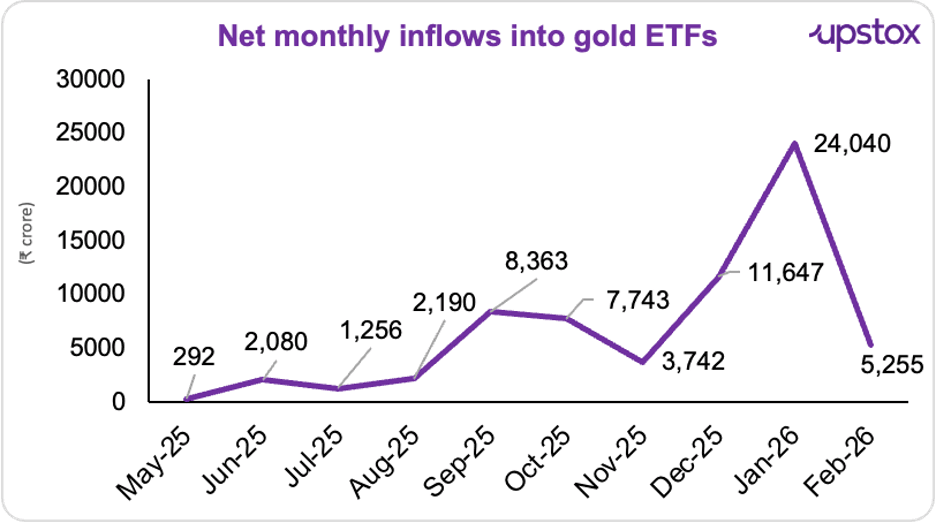
Source: AMFI
What makes this particularly noteworthy is the contrast with last year. In 2025, periods of global uncertainty and geopolitical tensions supported strong inflows into gold ETFs, as investors turned to safe haven asset. However, the current decline came despite rising tensions in the Middle East, a time when gold would typically attract fresh demand.
Equity rotation and a “Risk-On” mindset
As equity markets stabilised, investors unwound defensive gold positions in favour of growth-oriented assets. Equity mutual fund inflows rose 8% MoM to ₹25,978 crore (marking the 60th consecutive positive month), with mid-cap, small-cap, and thematic funds leading gains of up to 26%.
This "risk-on" pivot reduced gold's appeal as a safe-haven proxy after January's defensive surge. Within this, the strongest inflows were in riskier segments such as mid-cap, small-cap, and sectoral/thematic funds, while large-cap funds saw a modest decline.
| Category | Jan-26 (₹ crore) | Feb-26 (₹ crore) | MoM Change |
|---|---|---|---|
| Large Cap | 3,125 | 2,921 | -7% |
| Mid Cap | 3,870 | 4,212 | 9% |
| Small Cap | 4,115 | 4,527 | 10% |
| Sectoral/Thematic | 3,618 | 4,563 | 26% |
Source: AMFI
Price correction and profit-booking
Gold cooled off in February after January’s sharp surge, contributing to the slowdown in gold ETF inflows. MCX gold futures, which had touched around ₹1.90 lakh per 10 grams, mostly traded in the ₹1.55–₹1.62 lakh range during the month, ending near ₹1,60,565–₹1,60,850 by late February.
After delivering over 50 all-time highs and 60% returns across the year, investors began booking profits. Gold prices have also fallen around 14% since the Iran conflict began, showing that short-term movements are being driven more by macro factors like interest rates, the US dollar, and overall market positioning.
The correction was driven by a stronger US dollar, with the Dollar Index (DXY) rising from around 97 in mid-February to 100.15 by mid-March, and higher US bond yields, which made gold less attractive. At the same time, investors who entered near the peak chose to exit amid rising volatility, adding to selling pressure and leading to moderation in ETF inflows.
Domestic gold discount
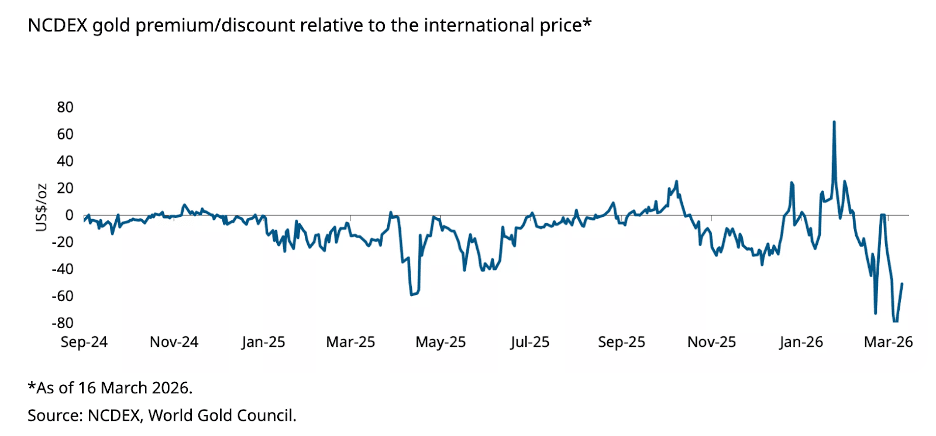
During the month of February, gold traded at a discount to international prices due to weak jewellery demand and subdued buying interest in India.
In the week ending February 13, 2026, gold began trading at a discount of up to $12 per ounce, compared to premiums in the previous week. This trend intensified in the week ending February 27, 2026, with discounts widening to as much as $65 (deepest in 10 months) per ounce, indicating continued weakness in physical demand.
So, what’s next?
Looking ahead, regulatory changes introduced by SEBI in February 2026 could influence future ETF flows. Equity mutual funds are now allowed to invest up to 35% of their non-core assets in gold and silver ETFs, potentially increasing institutional participation over time. In addition, a new gold ETF launch is taking the total number of ETFs in India to 26, improving investor access.
From April 1, 2026, gold and silver ETFs will also shift to using domestic exchange-published spot prices for NAV calculation instead of international benchmarks. This will make ETF pricing more transparent and more closely aligned with Indian gold prices.
Taken together, these structural changes suggest that future flows into gold ETFs will likely be shaped by macro trends, currency movements, yield dynamics, and market structure, rather than automatically responding to geopolitical headlines.
In summary
Gold ETFs are showing that markets don’t always follow traditional safe-haven patterns. After an extended rally, flows cooled as investors balanced gains against macro headwinds like rising yields, a stronger dollar, and domestic price pressures. Regulatory changes and new ETF launches are adding complexity, suggesting that the next phase of gold investment will depend less on headline events and more on how macro and market dynamics shape investor choices.
About The Author
Next Story



