
Upstox Originals
The real cost of cooking: Can induction actually beat LPG?

4 min read | Updated on April 06, 2026, 15:04 IST


SUMMARY
For decades, the blue flame has been a quiet constant in Indian kitchens. But global uncertainty has forced a lookaround. Induction, once an emergency alternative, is slowly becoming a serious option—driven not by novelty, but by convenience. Is this switch a clean break? Or is the flame just learning to share space.

Compared to LPG, induction is more energy-efficient, converting up to 90% of energy into usable heat
The blue flame has had a long, comfortable run in the Indian kitchen. But with LPG prices staying stubborn and supply risks never too far away, the real question now is whether the future of cooking sounds less like a hiss, and more like a beep.
Rising LPG imports
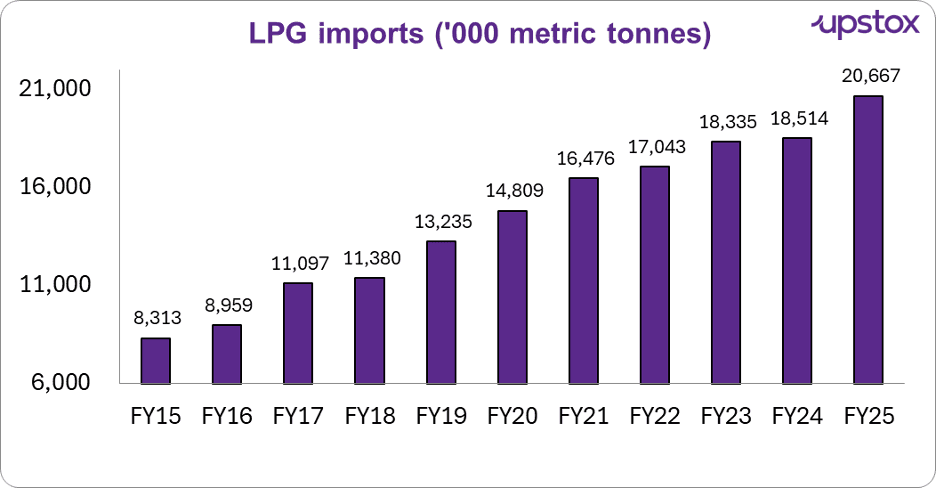
Source: PPAC
For all its familiarity, LPG comes with an external dependency, and that dependence has only deepened over time. India’s LPG imports have risen by nearly 150% over the past decade, underlining how closely the Indian kitchen remains tied to global fuel markets.
That linkage matters more when prices turn volatile.
That is the opening through which induction enters the conversation.
Enter induction
Induction cooktops have long sat on the margins of the Indian kitchen, useful in a pinch, but rarely the default. That perception is beginning to shift.
The trigger is simple: cost visibility. As LPG refills become more expensive and more noticeable in monthly budgets, households are starting to evaluate alternatives more actively, and induction is the most immediate one.
At first glance, the case for induction seems straightforward.
| Metric | LPG | Induction |
|---|---|---|
| Energy efficiency | 40–55% | 85–90% |
| Monthly running cost* | ₹900–₹1,100 | ₹720–₹1,200 |
| Upfront cost | Low | ₹1,200–₹3,000 |
| Cost predictability | Refill-based, lumpy | Depends on electricity rates |
| Best suited for | Heavy, traditional cooking | Light-to-moderate daily cooking, urban homes |
| Key constraint | Import-linked price volatility | Power supply, tariff, compatible utensils |
Source: Rentomojo, note: *Assuming a typical household of three to four members; induction cost varies by electricity rates, wattage and daily usage.
The comparison reveals an important nuance. Induction is far more energy-efficient, converting up to 90% of energy into usable heat, compared to roughly 40–55% for LPG, where much of the flame’s heat escapes into the surrounding air. But that efficiency advantage does not automatically translate into lower costs.
In practice, induction is not dramatically cheaper; it is conditionally cheaper. At moderate electricity rates, it can undercut LPG on monthly expense. But as electricity becomes more expensive, or cooking becomes heavier and more flame-intensive, that advantage narrows quickly.
The bigger hurdle is upfront cost. A basic induction cooktop costs around ₹1,200–₹3,000, and compatible utensils can add another ₹500–₹2,000, taking the starting bill to roughly ₹1,700–₹5,000. In smaller urban homes with lighter daily cooking, that cost can be recovered over time. In more traditional Indian kitchens, where meals are longer, hotter, and less suited to induction, the payback is far less certain.
The dependency swap
Induction may remove the cylinder from the kitchen, but it does not remove dependence from the system.
LPG ties households to global fuel markets. Induction shifts that dependence to the electricity grid with its pricing, reliability, and fuel mix. And that matters because coal still accounts for roughly over 70% of India’s electricity generation, which means the switch is not a clean break from fossil-fuel dependence.
Over time, that equation could improve as renewable power grows. But for now, moving from LPG to induction is not a move from dependence to independence, just from one energy system to another.
When induction works, and when LPG still does Induction works best in urban homes with stable electricity, moderate power costs, and lighter everyday cooking. It fits smaller households and routine use such as tea, breakfast, boiling, reheating, where convenience matters as much as cost.
LPG still makes more sense where the flame matters: rotis, high-heat cooking, and homes where power cuts or high electricity bills make induction less practical. So, the real shift is not from one fuel to another, but towards kitchens that use both.
To sum up
Induction is no longer just a stop-gap, but it is not about to replace LPG everywhere either.
In many households, especially where electricity is reliable and affordable, it now has a credible long-term case, one that can even recover its upfront cost over time. But in heavier-use kitchens, from roti-heavy homes to hotels and restaurants, LPG still holds advantages that induction cannot easily erase.
It is not the end of the flame, but the end of its monopoly.
About The Author
Next Story



