
Upstox Originals
The ‘crude reality’ India needs to address

6 min read | Updated on March 06, 2026, 16:17 IST


SUMMARY
Every oil crisis leaves something behind, not just higher prices, but a permanent shift in how countries think about energy. With the Strait of Hormuz now caught up in the middle of a war, India faces a question it has dodged before: is this finally the crisis that forces a real rethink?
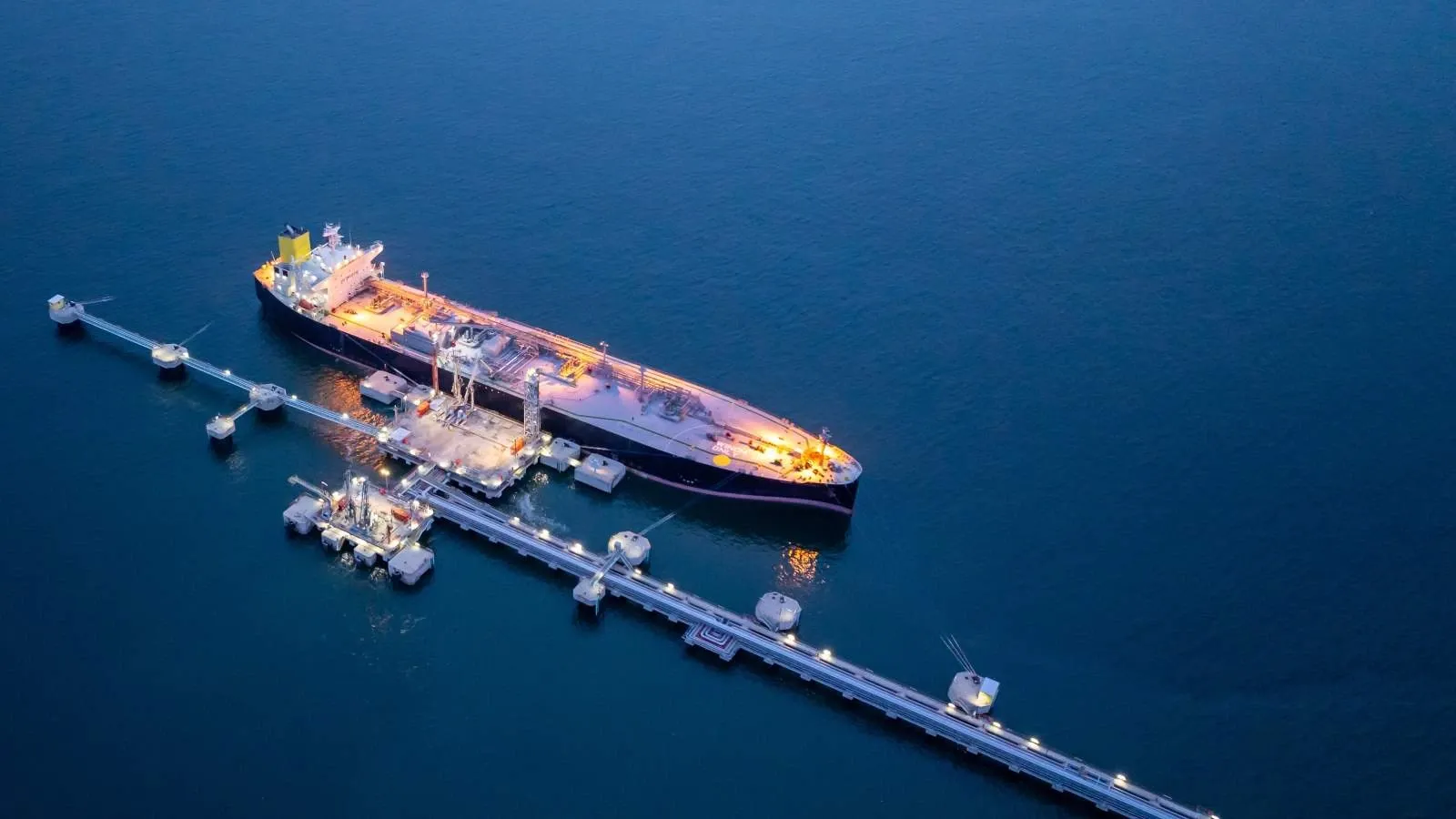
India sources crude from over 40 countries now versus 27 a decade ago. |Image: Shutterstock
Every time the world's oil system breaks down, it leaves something behind, not just higher prices or emptier reserves, but a permanent scar on how countries think about energy. The question worth sitting with right now, as missiles fly over the Persian Gulf and 150 tankers (at the time or writing) sit stranded in the Strait of Hormuz, is a simple one: what does this crisis leave behind for India?
History suggests the answer matters far more than the price of crude this week.
The last time the world ran out of oil
On 17th October 1973, Arab members of OPEC turned off the tap. Petrol queues stretched across the United States. European governments banned Sunday driving. Japan's GDP contracted for the first time in the post-war era.
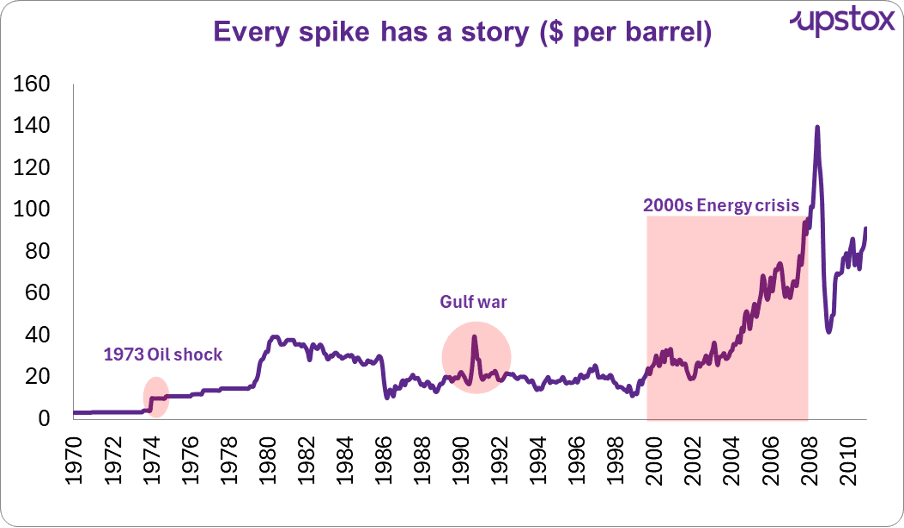
Source: Macrotrends
Crude went from $2.75 a barrel in January 1973 to $11.10 by March 1974, a 4x rise in just over a year. The chaos lasted months. What came after lasted decades.
-
France went nuclear. Within two decades, nuclear power's share of French electricity rose from 8% to nearly 80%, a scale no other country has matched since.
-
The United States built the Strategic Petroleum Reserve, 727 million barrels of crude stored in underground salt caverns along the Gulf Coast, starting in 1975.
-
OECD countries created the International Energy Agency, which introduced the now-standard rule that members hold at least 90 days of emergency oil reserves.
None of these were temporary fixes. They were structural decisions made in the middle of a crisis. The decisions were taken in 1974. The transformations took a decade. But crucially, they were never reversed.
Countries that patched and moved on showed up at the next crisis just as exposed. India may now be standing at a similar fork in the road.
India’s uncomfortable truth
India looks, on the surface, like a country that has done its homework. It now sources crude from over 40 countries, up from 27 a decade ago. It hit its 20% ethanol blending target ahead of schedule. EVs account for roughly 8% of new vehicle registrations, and renewables make up over half of installed electricity capacity.
These are real achievements. But they obscure a vulnerability this crisis has made impossible to ignore.
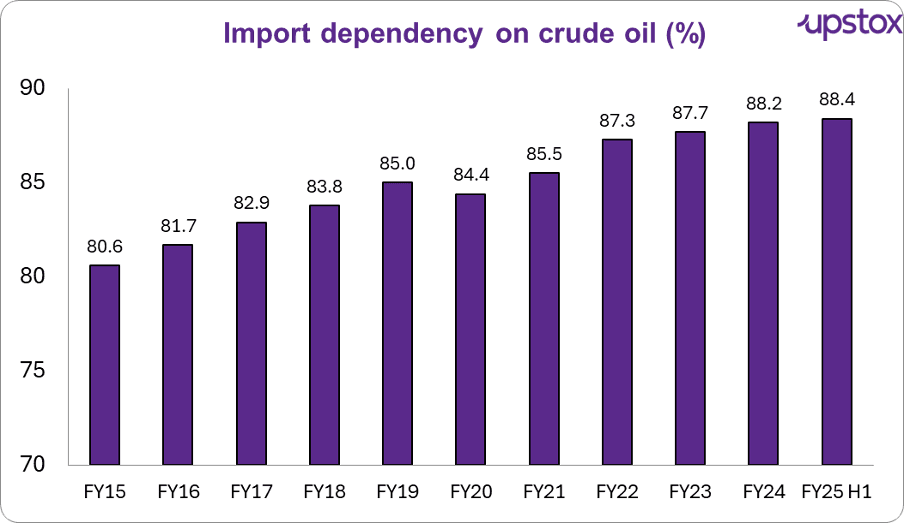
Source: Petroleum planning and analysis cell, ready reckoner reports
A decade of diversification, and India’s import dependence has only moved in one direction.
Since FY15, crude import dependency has risen by nearly 8 percentage points, climbing from about 80% to nearly 88% today. India has diversified its suppliers, but not its vulnerability.
It is the equivalent of having 40 different bank accounts, all on the same street that floods every monsoon.
According to government sources cited by The Hindu, India currently holds roughly 25 days of crude oil reserves, along with another 25 days of refined products. Even combined, that falls well short of the IEA’s 90-day emergency benchmark.
When strategic reserves at Mangalore, Padur, and Visakhapatnam are included, the buffer extends to roughly 40–45 days, comfortable for a short disruption, but thin for a prolonged one.
What crises force countries to do
Structural energy changes rarely happen during comfortable times. They happen when a crisis makes the cost of inaction too high to ignore.
For India, that moment may be approaching.
India's Strategic Petroleum Reserves hold roughly 5.3 million tonnes across Mangalore, Padur, and Visakhapatnam. Plans for expansion have existed for years, a serious disruption could finally turn them into action. But a larger reserve is a painkiller, not a cure. France didn't just stockpile more oil after 1973. It decided to need less of it.
The government has already pushed ethanol blending to 20% and is accelerating EV adoption. If oil stays volatile, those transitions move faster, and this time with a national security argument behind them.
The question is whether this becomes one of those turning points, or just another crisis that passed.
What needs to change?
The path forward for India isn’t a mystery. It has three parts, and each ones requires a different kind of commitment.
The first is domestic production
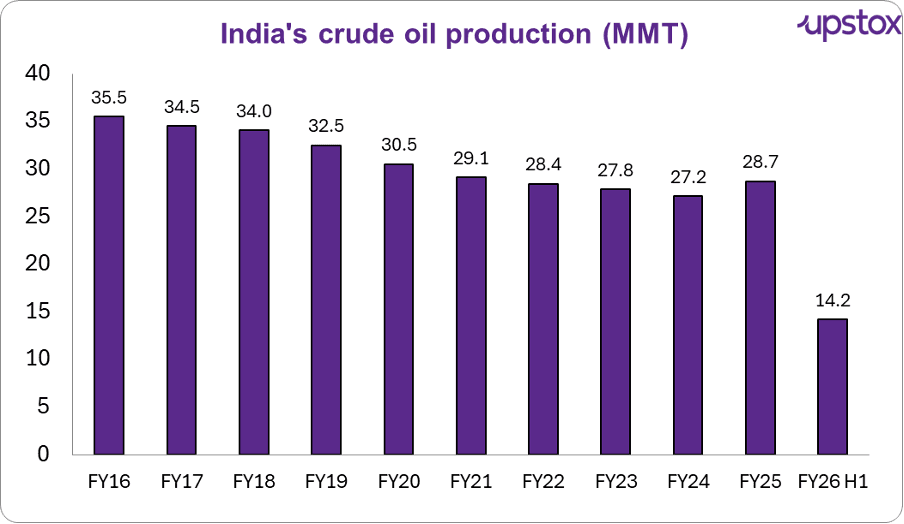
Source: Petroleum planning and analysis cell, ready reckoner reports
India’s domestic output has fallen by nearly 20% since FY16, every barrel lost at home is a barrel that must be imported through a chokepoint India cannot control.
India imported 243.3 million tonnes of crude oil in FY25 against domestic production of just 28.7 million tonnes, a ratio that has become wide over the past decade. Closing even a fraction of that gap, through deeper exploration, private sector participation and faster field development, reduces the volume that needs to transit Hormuz at all.
No choke point is a problem if you need it less.
The second is getting the energy transition right
EVs and renewables are moving in the right direction, but the transition carries its own dependency risk. In mid-2025, Maruti Suzuki cut near-term production targets for its first electric vehicle by two-thirds because of rare earth shortages. India currently imports 100% of its lithium, cobalt, and nickel, the minerals that power EV batteries. Swapping oil dependency for mineral dependency is not energy security. It is a change of address.
The third is speed
India's crude import dependency is projected to rise further to 92% by 2035 as demand grows faster than domestic production and the energy transition can offset. The window to act structurally is narrower than it appears.
France's lesson was not that it found the perfect solution. It was that it moved fast enough, and decisively enough, that the solution had time to work. That is the standard India now needs to measure itself against.
In summary
Oil crises have a way of feeling urgent in the moment and forgettable once the price falls. The countries still benefiting from 1973 are the ones that refused to let the urgency fade.
The Strait of Hormuz will reopen. It always does. The question is what India looks like when it does.
About The Author
Next Story



