
Upstox Originals
Stuck in the US green card queue - Is EB-1A the way out?

8 min read | Updated on December 26, 2025, 14:53 IST


SUMMARY
For a long time, the US green card felt like a waiting game that eventually paid off. You got a job, moved to an H-1B, and trusted the system to do its job. Somewhere along the way, the line stopped moving, timelines stretched (into decades sometimes!). That quiet breakdown is why EB-1A; once reserved for the extraordinary, has suddenly become part of the mainstream conversation for Indian professionals.
India’s EB-2 category is still processing priority dates from around May 2013, while EB-3 remains stuck near September 2013
If you applied for an Indian EB-2 or EB-3 green card today, your turn would likely come sometime in the late 2030s; or later.
That’s not speculation. It’s what the system already shows.
Today, estimates based on USCIS data suggest that over one million Indians, including dependents, are stuck in employment-based green card backlogs. If immigration law remains unchanged, projections indicate that this number could cross two million by the early 2030s.
The December 2025 visa bulletin makes the problem painfully visible. India’s EB-2 category is still processing priority dates from around May 2013, while EB-3 remains stuck near September 2013. For someone applying today, that translates into 12–15+ years of waiting, even after their green card process has officially begun.
For years, the assumption was that patience would eventually pay off. But when timelines stretch across decades, that assumption breaks down.
But before we go further, here’s a quick cheat sheet on the visas we’ll be talking about; so we’re on the same page.
- H-1B: A temporary US work visa tied to your employer
- EB-2 / EB-3: Employer-sponsored green card categories with long waiting lines for Indians
- EB-1A: A green card category that allows individuals to self-petition based on exceptional professional achievement
- I-140: The Immigrant Petition for Alien Worker; a USCIS filing that confirms you qualify for a specific employment-based green card category (such as EB-1A, EB-2, or EB-3). Approval of the I-140 puts you in the green card queue.
How the system broke down?
The US green card problem didn’t explode overnight. It crept up quietly. Every year, the US hands out about 140,000 employment-based green cards. And to keep things “fair”, no country is allowed to get more than 7% of them. That rule made sense decades ago, when skilled workers were spread across the world.
Over the last fifteen years, Indian professionals became the backbone of US tech, engineering, and IT services. Naturally, applications surged. But the green card tap stayed the same. So the queue grew longer. And longer.
This breakdown shows up most clearly in the visa bulletin. India’s EB-2 and EB-3 categories are still stuck in 2013, while applicants from many other countries are effectively “current” - meaning there is little to no waiting period. Same rules. Same system. Completely different outcomes.
Now add the H-1B visa into the mix.
For years, H-1B was supposed to be a bridge; work for a few years, get your green card, move on. But as green card timelines stretched, that bridge started looking more like a traffic jam. Renewals became routine. Job switches got risky. Careers began to revolve around visa expiry dates.
Then the pressure increased. More scrutiny. More uncertainty. And from September 2025, a proposed $100,000 fee for new H-1B applications. At the same time, tech layoffs reminded everyone how fragile employer-sponsored visas can be during downturns.
Where EB-1A fits in?
For a long time, EB-1A sounded mythical.
The law defines it as a category for individuals with “extraordinary ability in the sciences, arts, education, business, or athletics,” demonstrated by sustained national or international acclaim. In practice, many assumed this meant Nobel laureates, Turing Award winners, or globally famous artists.
Unlike traditional employment-based routes:
- There is no PERM labour certification (A permanent labor certification issued by the Department of Labor allows an employer to hire a foreign worker to work permanently in the US), so no years lost in recruitment and Department of Labor queues.
- No permanent job offer is required, since self-petitioning is allowed.
- EB-1A sits ahead of EB-2 and EB-3 in the visa hierarchy.
The timelines tell the real story. As of 2025, EB-1A I-140 processing takes roughly 6–12 months under regular processing. With premium processing, available for about USD 2,805, USCIS (United States Citizenship and Immigration Services) must adjudicate the petition in 15 calendar days.
Once approved, adjustment of status often takes another 6–12 months, placing realistic end-to-end timelines around 12–18 months for Indians who qualify, depending on visa bulletin movement.
For someone facing a 12–20 year wait under EB-2 or EB-3, the appeal was obvious.
What the data shows
The numbers back up the behavioural shift.
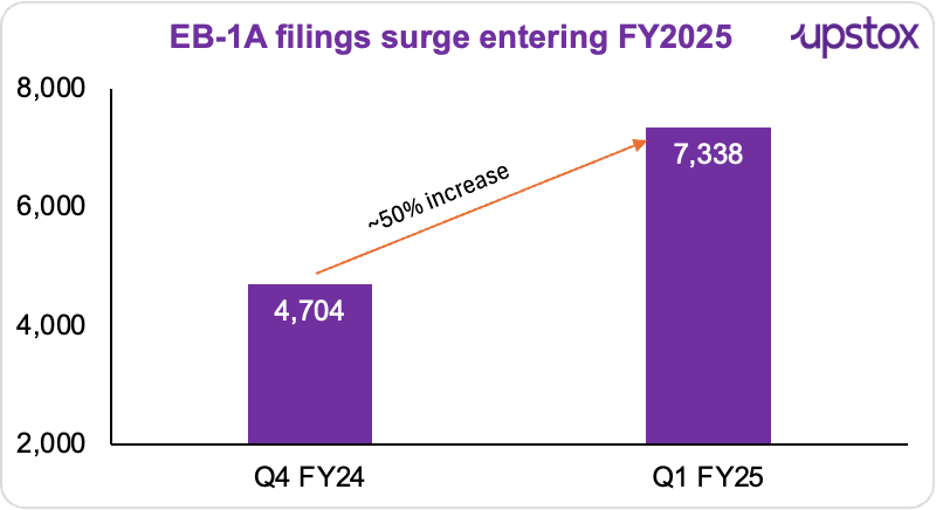
USCIS I-140 data for FY2025 Q1 shows that 7,338 people applied for the EB-1A green card. USCIS hasn’t ruled on all of them yet. So far, it has approved 3,291 cases and rejected 1,105, meaning 4,396 applications have been decided and 2,942 are still pending. Among the cases that have already received a decision, the approval rate works out to 74.9%. But if you look at approvals as a share of all applications filed, approvals currently stand at about 44.8%, simply because a large number of cases are still waiting for a decision.
While USCIS doesn’t publish nationality breakdowns, immigration firms consistently report that Indian and Chinese applicants form a large share, especially in STEM-heavy fields.
Source: USCIS
Looking at longer-term trends:
-
Law firm reviews of FY2024 data estimate overall EB-1A approval rates in the low-70% range, with strong, well-prepared cases achieving internal success rates of 85–95% at some firms.
-
Independent trackers report sharp growth in EB-1A filings during 2024–2025 from Indian professionals in software engineering, data science, AI, cybersecurity, product management, academia, and entrepreneurship.
On the backlog side, community analyses suggest that EB-1 India demand sits in the tens of thousands, not the hundreds of thousands. Estimates place pending EB-1 India demand, including dependents, between 36,000 and 45,000, compared to seven-figure backlogs in EB-2 and EB-3.
EB-1 India can still retrogress, but the scale of the queue is materially smaller, and that difference alone has changed how Indians approach the system.
Who actually qualifies?
The perception that EB-1A is only for the top 0.001% is slowly fading.
Regulations allow applicants to qualify either through a single major achievement or by meeting at least three out of ten regulatory criteria, which include awards, memberships, published material, judging work, original contributions, authorship, leadership roles, high salary, and commercial success.
Indian applicants increasingly map their careers to these criteria with evidence:
-
Tech professionals rely on patents, citations, open-source impact, quantified business outcomes, and judging roles.
-
Researchers and academics use publications, citation counts, h-index, invited talks, and peer review work.
-
Founders and business leaders highlight funding rounds, revenue milestones, press coverage, accelerator participation, and mentorship roles.
The bar remains high. But in technical fields, extraordinary ability is now measured in metrics, not celebrity.
What’s the real challenge?
The hardest part of EB-1A isn’t the filing fee.
It’s the paperwork.
USCIS follows a two-step review process; first checking whether at least three criteria are met, and then conducting a final merits determination to assess whether the evidence collectively demonstrates sustained acclaim.
That means:
-
6–12 months of preparation is common.
-
RFEs are frequent, with some analyses estimating 20–30% of cases receiving them during high-volume periods.
-
Expert letters matter, and generic praise carries little weight without quantified impact. For many Indians, this legal-style evidence mapping is unfamiliar—and often the biggest barrier.
Why does the timeline difference matter?
Put side by side, the contrast is stark.
| Stage | EB-2 / EB-3 Path | EB-1A Path (Strong Case) |
|---|---|---|
| Initial requirement | 1–2 years for PERM | 6–12 months of preparation |
| I-140 processing | Several months | 15 days with premium processing |
| Final wait | 10–15+ years due to visa bulletin | 6–12 months for adjustment of status |
Source: Government documents, news
A shift in mindset
What’s really happening here isn’t just a legal pivot.
EB-2 and EB-3 treat Indian professionals primarily as employer-sponsored workers. EB-1A forces a different framing; one where individuals present themselves as contributors whose work advances a field.
That shift changes how careers are planned, which projects are chosen, and how impact is measured. The move from waiting in line to actively building a case is demanding, but it gives professionals agency in a system that otherwise offers very little.
EB-1A isn’t a solution for everyone. But for a specific subset of highly accomplished Indians, it has become a real exit door from a system that otherwise stretches across decades.
And for those stuck in the long corridors of the H-1B to EB-2/EB-3 pipeline, that door, while narrow, is no longer imaginary.
About The Author
Next Story



