
Upstox Originals
Analysing the impact of buyback and dividends for investors
.png)
4 min read | Updated on June 20, 2024, 17:57 IST


SUMMARY
Here is a question for all you investors out there. Given a choice between dividends and buybacks, which would you choose? Where do you stand to make better returns?

Buyback versus dividends - what would investors prefer
Every company looks to deploy free cash flows towards profitable opportunities. However, if the company doesn’t have such opportunities, it may choose to return the cash to shareholders.
Why?
Undeployed cash will end up reducing the return on capital employed and hurt the company's profitability metrics.
How is the money returned?
A company typically has two ways of returning surplus cash to its shareholders: buybacks and dividends.
What is the impact on shareholders?
There is no impact on investors, in the following scenarios:
- If the dividend is in line with past trends or investor expectations.
- The buyback is done at market prices.
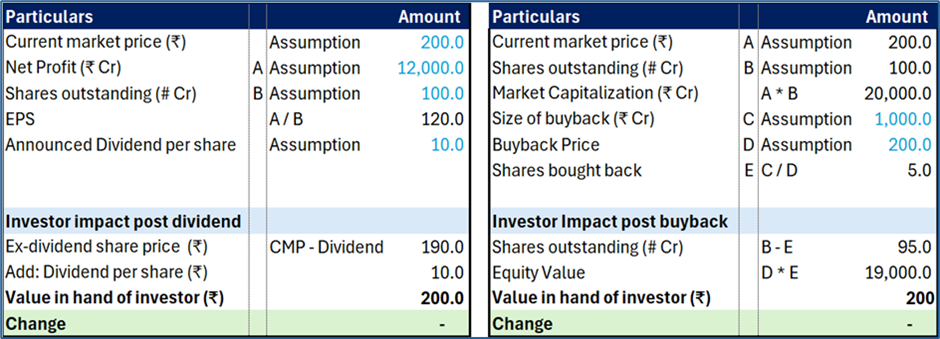
In that case, let us examine what could potentially create or destroy value for investors:
| Dividend | Buyback | |
|---|---|---|
| Creates value | Initiation of a dividend (positive signal to markets) Higher than expected payout | Shares repurchased at a higher than market price |
| Destroys value | Lower than expected or past dividend payout ratio Discontinuation of dividend | Shares repurchased at a lower than market price |
Does taxation have any impact?
From a standalone taxation point of view, buyback lead to no taxation in the hands of a shareholder, whereas dividends are taxable as per the applicable slab. The net surplus available to shareholders may be up to ~26.48% higher for buybacks vis-à-vis dividends.
Buyback vs dividend - Tax incidence on residents as per Indian laws
| # | Option | Buyback | Dividend |
|---|---|---|---|
| A | Assumed distributable surplus | 123.3 | 123.3 |
| B | Taxability in the hands of | Company | Shareholders |
| C | Tax rate to the company while distributing to the shareholders | 23.3% | - |
| D | Tax in the hands of company [A-(A/(1+C))] | 23.3 | - |
| E | Gross amount to shareholders [A-D] | 100.0 | 123.3 |
| F | Tax rate in the hands of shareholders on buyback/dividend at highest slab | - | 35.88% (30% tax plus 15% surcharge plus 4% cess)* |
| G | Tax in the hands of shareholders (A*F) | - | 44.3 |
| H | Total tax in the hands of company & shareholders (D+G) | 23.3 | 44.3 |
| I | Net surplus for shareholders (A-H) | 100.0 | 79.1 |
Besides taxation, in the table below, we compare dividends versus buyback on some other relevant metrics.
| Particulars | Dividend | Buyback |
|---|---|---|
| Effect on shares outstanding | NA | Reduces the number of shares |
| EPS / Profitability impact | NA | Optical increase in EPS and Return on equity (due to lower number of shares outstanding) |
| Flexibility / frequency? | Less flexible. Typically, investors expect a consistent dividend payout | More flexibility. The company can choose the timing |
| Any signal to market? | Can signal confidence in stability/growth of earnings | Management belief in the company’s future Can also signal that shares are undervalued at current price |
| Investor impact? | Provides steady (hopefully regular) income | Brings capital appreciation and returns |
| Ownership | No impact | Ownership gets diluted |
What does this mean for investors?
Dividends and share buy backs both have their own merits and signal different things to investors and the broader markets. That said, holding all else constant, taxation skews the impact of both in the hands of the investors - making buybacks a much more preferred mode of returning capital to shareholders than dividends.
About The Author
Next Story



