
Personal Finance News
Senior citizen paid ₹9 lakh tax on tax-free bond income by mistake, but IT Dept denied refund; here's how he got it back

4 min read | Updated on September 25, 2026, 13:42 IST


SUMMARY
The senior citizen had invested ₹2 crore in IIFCL 8.48% tax-free bonds and ₹1 crore in Rural Electrification Corporation (REC) 8.46% tax-free bonds
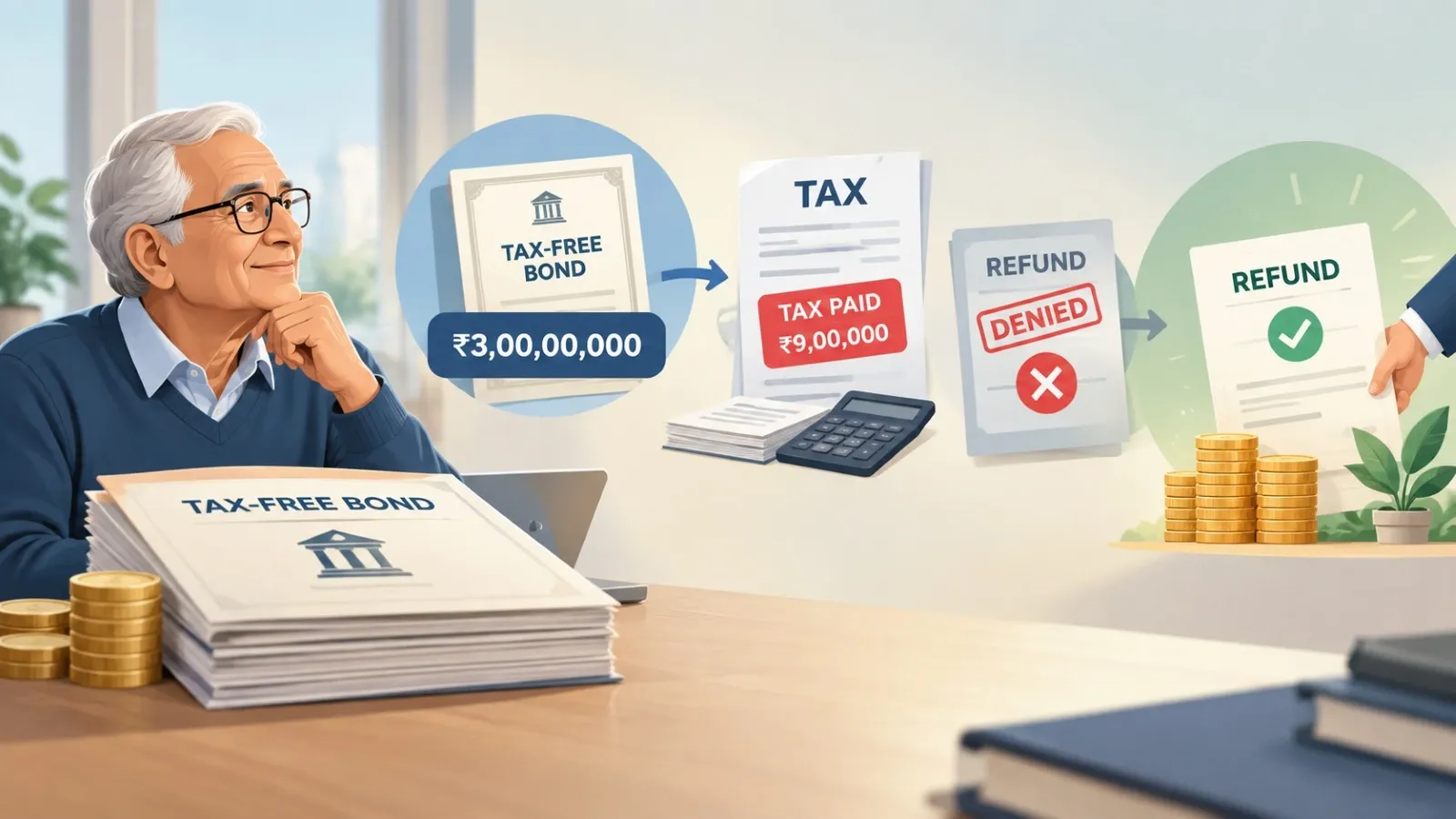
Bakaya consistently showed this interest as exempt income in his returns for AYs 2018-19 to 2024-25. | Representational image
The ruling matters well beyond this one senior citizen. It underlines that if a taxpayer has disclosed an income in the return and merely put an exempt receipt in the wrong column, the department cannot sit on a technicality and keep the excess tax.
Case history
The case concerns Ajay Kumar Bakaya, a resident senior citizen from Gurugram, who has been regularly filing his returns. Back in February 2013, he invested ₹3,00,00,000 in tax-free bonds:
-
₹2,00,00,000 in India Infrastructure Finance Company Ltd (IIFCL) 8.48% tax-free bonds
-
₹1,00,00,000 in Rural Electrification Corporation (REC) 8.46% tax-free bonds
Interest on both these bonds is exempt under section 10(15)(iv)(h) of the Income-tax Act, 1961.
Bakaya consistently showed this interest as exempt income in his returns for AYs 2018-19 to 2024-25. For AY 2022-23, however, the interest of ₹25,42,000 (₹16,96,000 from IIFCL and ₹8,46,000 from REC) was mistakenly included as taxable income under income from other sources, resulting in excess tax of ₹9,91,370.
By the time he noticed the mistake, the window to file a revised return under section 139(5) had lapsed. So, on January 19, 2024, he applied to the assessing officer under section 154 for rectification and a refund.
In an order dated April 7, 2025, the AO rejected the rectification solely on the ground that the "Jurisdictional Assessing Officer cannot entertain a claim for deduction otherwise than by filing a revised return", citing the Supreme Court's Goetze (India) Ltd. v. CIT judgement.
The AO's refusal was off as his order had recorded that a "categorical factual finding that the income from the bonds was 'erroneously added as taxable income while filing the tax return' and ought to be treated as exempt income." With this the AO himself acknowledged the mistake, yet declined to correct it on a purely technical ground, according to the ITAT order.
Later, the CIT(A)/NFAC sustained the addition, pushing Bakaya to the tribunal.
What the ITAT said
The tribunal agreed with Bakaya's counsel that the rectification did not seek any new claim, since the interest income was disclosed in the return itself and the only error was classification. It observed that "the rectification sought by the assessee is a correction of a mistake apparent from the record and not a fresh claim," and that SC decision in Goetze (India) Ltd. was not applicable to these facts.
The bench followed its coordinate decision in Kapil Dev Nikhanj v. ACIT, which held: "It is trite law that right amount of tax should be collected from the right person in accordance with law. Article 265 of the Constitution provides that no tax could be collected except by an authority of law". That order had further reasoned that when a statute exempts a particular receipt, "the said receipt cannot be brought to tax merely because the assessee had offered erroneously in the return of income," and that "revenue cannot take advantage of ignorance of the assessee while determining the taxable income".
Directing relief, the ITAT ordered the interest to be treated "as exempt under section 10(15)(iv)(h)" and directed the assessing officer "to grant the consequential refund of ₹9,91,370 to the assessee, along with interest as admissible under law".
For bond investors, or any other investor, the takeaway from this case is very practical: Wrongly taxed exempt interest, any tax paid my mistake, can be recovered even after the revised-return window has closed. For this, however, the income must be disclosed in the return. The best option through, is double-checking the exempt column before filing returns.
Related News


About The Author
Next Story

