
Personal Finance News
Buying property below stamp duty valuation: ITAT says no tax applies till 5-10% tolerance limit

3 min read | Updated on September 22, 2026, 18:53 IST


SUMMARY
The ITAT order may serve as relief for home and land buyers who routinely face tax notices when the stamp duty value of their purchase is higher than the actual price.
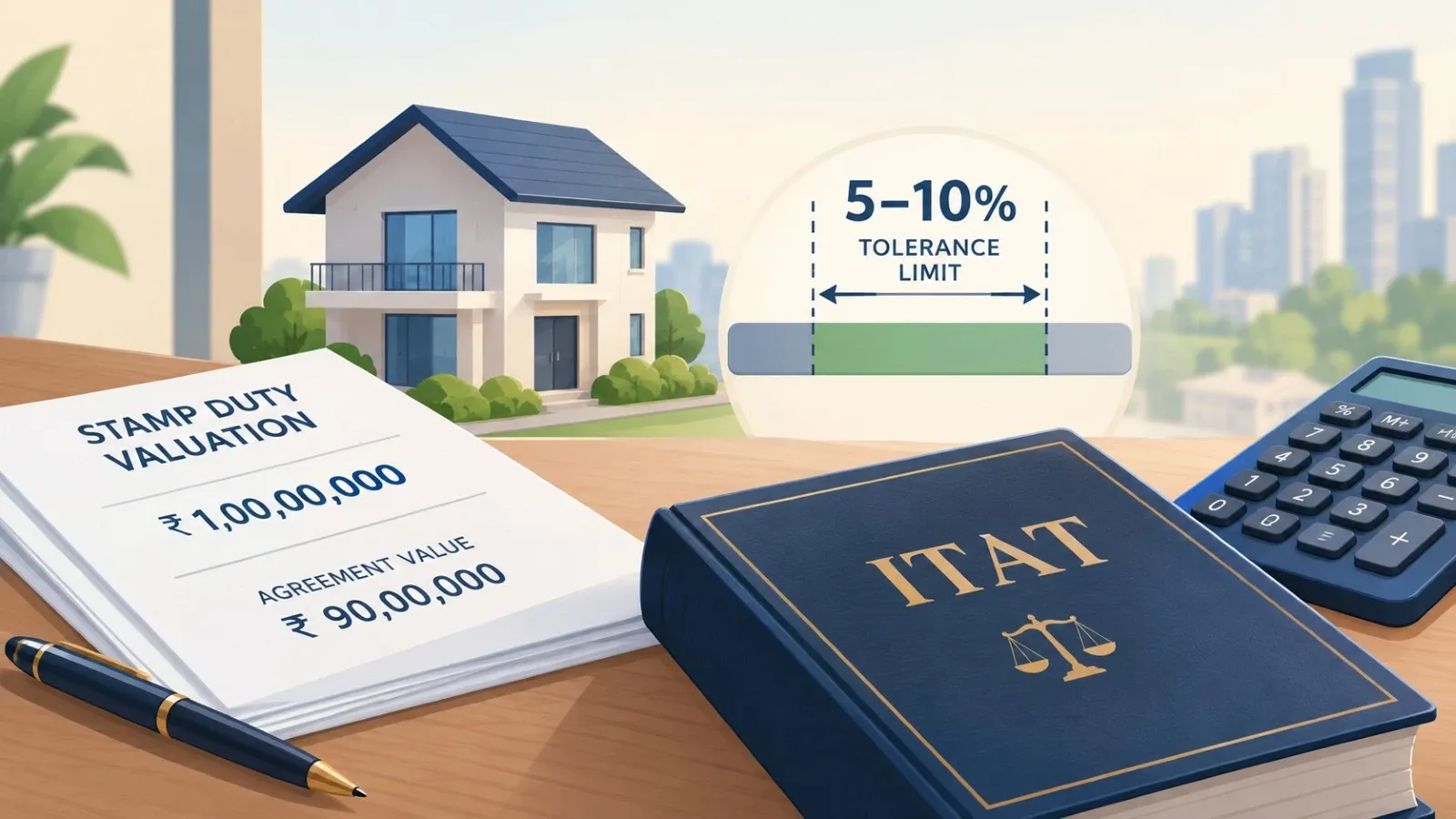
If the shortfall is within the tolerance band, the taxman cannot treat it as your income. | Representational image
Buying a house or plot at a price lower than the government's stamp duty valuation does not automatically invite tax on the shortfall, according to a recent order of the Pune bench of the Income Tax Appellate Tribunal (ITAT). The tribunal has held that no addition can be made under Section 56(2)(vii)(b) of the Income-tax Act where the gap between the price paid and the property's fair value falls within the permissible tolerance limit of 5-10%, even if the difference exceeds the ₹50,000 threshold built into the provision.
The case was about one Aslam Sadule Khan, an individual, who filed his return for Assessment Year 2016-17 on October 17, 2016, declaring a total income of ₹11,54,390. His return was picked up for scrutiny under Computer-Assisted Scrutiny Selection (CASS) where it emerged that he had purchased land admeasuring 2080.28 sq. mtrs. at Mauje Khandala from Shri Behram Kali Mehta for ₹3,91,00,000 under a purchase deed dated July 1, 2015. The entire consideration was paid through account payee cheque.
There was a problem, however, noted by the assessing officer (AO). The Stamp Duty Valuation Authority had valued the land at ₹6,00,00,000. The assessing officer held that under Section 56(2)(vii)(b), where immovable property is purchased for a consideration less than its stamp duty value by more than ₹50,000, the difference is taxable as income from other sources. The AO, therefore, added the entire difference of ₹2,09,00,000 to Khan's income.
The assessment was completed under Section 143(3) on December 28, 2018, determining total income at ₹2,20,54,390, subject to rectification once the Departmental Valuation Officer's report came in.
Khan had argued that the property was under litigation for cancellation of the sale deed, with an injunction filed by the seller, and that ₹3,91,00,000 reflected the true price while the stamp value was excessive.
The report of Departmental Valuation Officer (DVO) dated June 3, 2019 pegged the fair market value at ₹4,03,10,000, and the AO rectified the assessment, reducing the addition to ₹12,10,000.
The first appellate authority, CIT(A)/NFAC, Delhi, however dismissed Khan's appeal on December 11, 2025.
Before the ITAT, Khan's counsel submitted that the difference between the consideration paid and the DVO-determined fair market value was less than 10% of the consideration, and hence within the permissible tolerance limit. The Departmental Representative supported the lower orders but "could not bring on record anything to controvert" this submission, the order noted.
The Tribunal found the gap of ₹12,10,000, about 3% of the ₹3,91,00,000 consideration, was squarely protected.
"The said difference falls within the permissible tolerance limit of 10% as per 3rd proviso to section 50C(1) of the Act," the bench observed. It also noted that "the tolerance limit of 5% was introduced by the Finance Act, 2018 w.e.f. 01-04-2019" and "the 5% limit has been substituted by 10% by the Finance Act, 2020 w.e.f. 01-04-2021". The tribunal applied this protection to a purchase made in AY 2016-17, before the proviso even existed, holding that coordinate benches "have held [its] applicability... to have retrospective effect. Thus, the impugned issue is no more res integra", it said.
Setting aside the CIT(A) order, the ITAT held the addition "not sustainable" and directed the AO to modify the assessment "after due verification of the claim of the assessee.
Related News



About The Author
Next Story

