
Personal Finance News
He sold two plots for ₹21 lakh and claimed a loss. Taxman valued them at ₹51 lakh and turned it into a ₹36 lakh gain; What ITAT held

5 min read | Updated on November 23, 2026, 22:17 IST

SUMMARY
The ITAT, Mumbai's ruling is relevant for anyone selling land or property below the circle rate and disputing it.
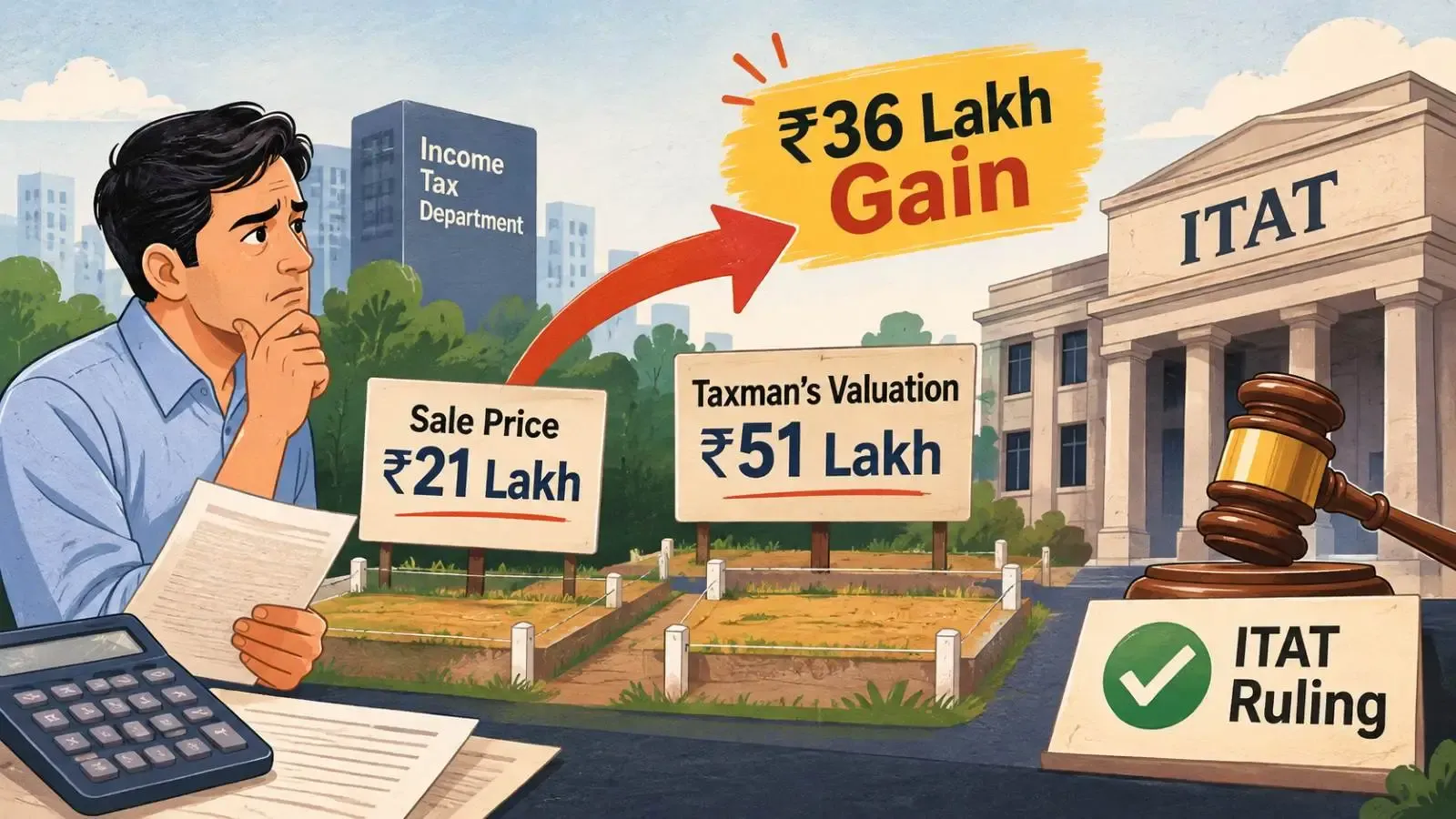
A seller who receives less than the circle rate should object to the stamp valuation in writing. | Representational image/AI generated
A Mumbai investor sold two plots of land in Bhinmal, Rajasthan, for a total of ₹21,00,000 (₹3 lakh for one plot and ₹18 lakh for the other) and claimed a long-term capital loss on the transactions. However, the assessing officer compared the declared sale consideration with the stamp duty valuation of the plots, which was significantly higher at ₹51,15,887, and substituted it as the full value of consideration.
As a result, what the investor had reported as a long-term capital loss was converted into a long-term capital gain of ₹36.27 lakh. The Commissioner of Income Tax (Appeals) [CIT(A)] also upheld the assessing officer's stand.
Based on the ITAT's October 16, 2026 order in Sawalchand Chunilal Bafna HUF v. ITO, this article explains the facts of the case and takeaways for investors and taxpayers.
Case history
The investor (assessee), with income from other sources, filed his return on March 27, 2012, declaring a total income of ₹5,00,380. It was processed under section 143(1) and later picked for scrutiny to examine the sale of immovable property.
The AIR (Annual Information Report) showed two plots were sold. The first was sold under an agreement dated October 25, 2011 for ₹3,00,000. Its cost, per a 1988 agreement, was ₹60,000. The second was sold under an agreement dated January 25, 2011 for ₹18,00,000, against the acquisition cost of ₹4,01,000. When asked to explain the computation, the assessee furnished details and claimed an aggregate long-term capital loss of ₹12,26,145 on a total consideration of ₹21,00,000.
However, the officer noticed that the AIR reflected ₹51,15,887. The Sub-Registrar informed him that the market values of the plots were ₹6,40,032 and ₹51,15,887. The assessee explained that stamp duty had been paid on the actual consideration at the time of impounding of the documents. And he was unaware of any additional duty paid by the purchasers later. He also said that the actual consideration received was only ₹21,00,000.
The assessee further added that both plots were under dispute over encroachment when sold. They had been sold orally about three years before registration. The purchasers had settled the disputes using their own resources. He then asked the officer to refer the properties to the Departmental Valuation Officer if the stamp value was to be substituted. The officer did make that reference, but completed the assessment without waiting for the report, adopting the stamp values and making the addition.
The first appellate authority upheld the officer's decision. It argued that Section 50C is a special provision that overrides the general computation rules. Where the declared consideration is below the stamp value, the latter is deemed the full value. It also held that the statute provides an in-built remedy under section 50C(2), by which the assessee may seek a reference to the Valuation Officer, and recorded that "no such request was made, nor has the appellant demonstrated with any material evidence that the stamp duty valuation exceeded the fair market value."
It held the officer was justified in adopting ₹6,40,032 and ₹51,15,887. However, this finding on the record was where the case turned, because the assessing officer had in fact made the reference.
What the ITAT held
The tribunal found the assessment unsustainable. It relied on its coordinate bench's decision in Rajni Arvind Birla v. ITO, which had held that "the assessment should be completed on the basis of the DVO's determination and not by preempting it. Completion of assessment without awaiting the report would defeat the very purpose of the statutory reference mechanism."
The same decision also described that section 50C(2) as "a mandatory procedural safeguard in favour of the assessee whenever the value adopted by the stamp valuation authority is disputed" and noted that the procedure carries with it an opportunity of hearing before the Valuation Officer, which the assessee is deprived of if the assessment is closed first. Applying that to the present facts, the tribunal said, "The significance of these circumstances, however, is not that financial hardship or a pending dispute, by itself, displaces the statutory mandate of section 50C," it observed, "but that the assessee had raised a specific objection to the stamp-duty valuation and invoked the statutory valuation mechanism."
"The Ld.AO, having made a reference to the DVO under section 50C(2) of the Act, erred in completing the assessment and making the impugned addition without awaiting the valuation report," the bench held, adding that the failure to await the report also deprived the assessee of an effective opportunity to place objections and material on the valuation.
The tribunal deleted the capital gain addition made by the tax office.
Takeaway
The ITAT, Mumbai's ruling is relevant for anyone selling land or property below the circle rate and disputing it. Section 50C lets the stamp duty value stand in for the sale price, but it also gives the seller a statutory right to have the fair market value independently determined. This order holds that once the officer acts on that right and makes the reference, he cannot pre-empt the answer.
The case shows that a seller who receives less than the circle rate should object to the stamp valuation in writing and ask for a section 50C(2) reference, and then insist that the reference be carried to its conclusion.
What the case does not do is decide the valuation itself. The fair market value of the two plots is still to be determined, and the loss the assessee claims will depend on that answer.
Related News


About The Author
Next Story

