
Personal Finance News
GST checklist: Full list of documents and proofs required for GST registration as per revised guidelines

10 min read | Updated on October 27, 2026, 17:30 IST

SUMMARY
CBIC’s Circular No. 257/03/2026-GST attaches a constitution-wise checklist and a premises-wise list of acceptable proofs. Together they settle what an applicant must upload — and, just as usefully, what a tax officer may no longer ask for.

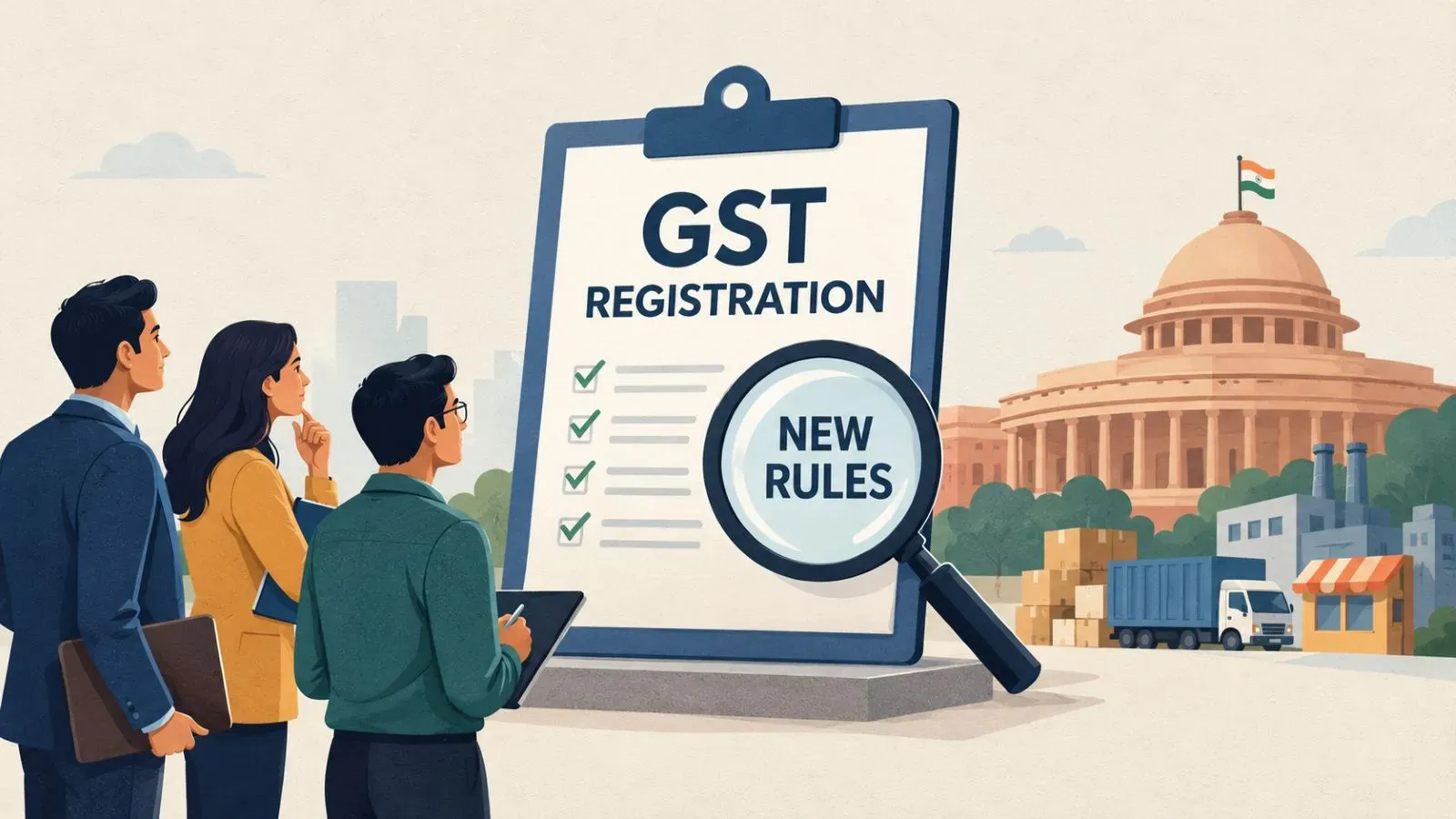
Here's the full list of documents required for GST registration. | Image: Shutterstock
Most GST registration applications that go wrong do so over paperwork rather than principle. Analysing rejections and the queries raised by tax officers, the Central Board of Indirect Taxes and Customs found the deficiencies were “commonly observed in respect of identity details of the applicant, proof of principal place of business, details relating to the constitution of the business, and identity details of the authorized signatory”.
-
The Annexure-II of the circular provides a checklist of documents arranged by the constitution of the business.
-
Annexure-III provides that the list of documents accepted as proof of the principal place of business.
The circular said that these lists are meant to close the question. “… officers have been directed to process applications “by adhering strictly to the prescribed list of required documents, ensuring that no additional or unnecessary papers are sought from applicants,” the circular said.
This article provides the full list of required documents as per the circular,
Documents for identity, constitution of business and photographs
Every applicant must first establish who the business is and who runs it. Part B of FORM GST REG-01 requires the correct constitution to be selected — proprietorship, partnership, HUF, private or public limited company, LLP, trust, association of persons, local authority, PSU and so on — supported by the matching document like the partnership deed for a firm, the registration certificate or proof of constitution for a society, trust, club, government department, association or body of individuals, and the Karta document for an HUF. The full constitution-wise list is reproduced below.
| Constitution of business | Documents to be furnished |
|---|---|
| Proprietorship | PAN of the proprietor; photograph of the proprietor; bank account details of the proprietor or the firm; address proof of the principal place of business (Annexure III). |
| Partnership, LLP and foreign LLP | PAN of the firm; partnership deed or certificate of incorporation/establishment; photographs of the managing, authorised or designated partners; authorisation form prescribed in FORM GST REG-01 instructions; bank account details of the firm; address proof of the principal place of business. |
| Hindu Undivided Family (HUF) | PAN of the HUF; photograph of the Karta; bank account details of the HUF; address proof of the principal place of business. |
| Private, public, unlimited, foreign and one-person companies | PAN of the company; certificate of incorporation or establishment; photographs of the managing director and directors; authorisation form; PAN, Aadhaar and photograph of the authorised signatory; bank account details of the company; address proof of the principal place of business. |
| Society, club, association of persons and trust | PAN of the society, club, AOP or trust; registration certificate or proof of constitution; photographs of trustees or managing committee members, including the President, Secretary or Chairman; authorisation form; photograph of the authorised signatory; bank account details; address proof of the principal place of business. |
| Government department | PAN of the department; proof substantiating the constitution; letter of appointment of the Drawing and Disbursing Officer (DDO); authorisation form; photograph of the DDO or authorised signatory; address proof of the principal place of business. |
| Public sector undertaking (PSU) | PAN of the PSU; certificate of incorporation or proof of constitution; authorisation form; photograph of the Chief Manager or authorised signatory; bank account details; address proof of the principal place of business. |
| Local authority or statutory body | PAN of the authority; proof substantiating the constitution; authorisation form; photograph of the Chief Executive Officer (CEO) or equivalent officer; bank account details; address proof of the principal place of business. |
Photographs are treated as a document in their own right and are the most frequent cause of avoidable queries. Recent photographs are required of the proprietor; of the managing, authorised or designated partners (all partners where there are up to 10, and 10 of them where the firm has more); of the Karta; of the managing director or authorised person of a company; of the managing trustee; of members of a managing committee including the chairman; and of the CEO or person in charge in other cases.
Each photograph must be of that individual, “not part of a group photograph”. It must show the full front face, and “should not be a copy of any identity document, such as PAN, Adhaar Number, Driving License, Passport, etc., either as such or in cropped form”.
For directors of companies and designated partners of LLPs, the Director Identification Number is mandatory and “will be validated through MCA”.
The e-mail address and mobile number of every promoter, partner and authorised signatory must be given correctly “for verification and future communications”. The company information, including the CIN, will be validated online by the system at the time of submission.
Authorised signatory and representative
Up to 10 authorised signatories may be named. Each require the full set of personal details, a photograph, and “an authorization letter issued by the proprietor/ Partners/ Board/ Trust/ Management Committee, etc, appointing the said person as authorised signatory of the entity”.
Any person who is not a minor can be a signatory, though for a non-resident taxable person filing FORM GST REG-09, the signatory must be an Indian national and not a minor.
CBIC has advised naming at least two signatories “a primary and an alternate to ensure smooth handling if one signatory is unavailable for e-sign, DSC, or Aadhaar verification”.
The primary signatory must sign the application digitally. Where a GST practitioner is named as authorised representative, the enrolment ID issued under Section 48 must be furnished. For any other representative, name, designation, mobile number, e-mail address and PAN are required.
Proof of the principal place of business
This is where applications are most often returned. As per the circular, the address given in the form must “match the address mentioned in the document ... furnished and uploaded with the application, as proof of Principal Place of Business”.
What counts as proof depends on how the premises is held, and the circular has set out a separate route for each case — owned, inherited, rented or leased, held without any agreement, used on consent, occupied in a co-working space, or located in an SEZ.
| Nature of premises | What to upload |
|---|---|
| Owned premises | Any one of the following: latest property tax receipt, municipal khata, document certifying property identification, latest electricity bill, or latest water bill, in the applicant’s name and showing the full address. |
| Owned by a deceased ancestor, no document in the applicant’s name | Copy of the death certificate of the deceased ancestor; an affidavit by the applicant in the Annexure-IV format; and any one of the ownership documents listed above in the name of the deceased ancestor or the applicant. |
| Rented or leased, where a registered agreement is mandated | A clear and legible copy of the registered rent or lease agreement. |
| Rented or leased, agreement not registered | The rent or lease agreement, along with any one of the ownership documents listed above in the name of the landlord or lessor. Where the utility connection stands in the tenant’s name, the latest bill in the tenant’s name with the rent agreement may be accepted in lieu of the lessor’s document. |
| Rented or leased, no agreement at all | An undertaking by the applicant in the Annexure-V format, along with a document showing possession, such as the latest electricity bill or water bill in the tenant’s name showing the full address. |
| Premises on consent (neither owned nor rented) | A consent letter on plain paper in the Annexure-VI format, signed by the owner, along with any one of the ownership documents listed above in the consenter’s name. Where the property is co-owned, consent of all co-owners is required. |
| Co-working space, premises owned by the provider | The membership agreement showing the allotted desk, cabin or suite, along with any one of the ownership documents listed above in the provider’s name. |
| Co-working space, premises leased by the provider | The registered rent or lease agreement between the property owner and the co-working provider, along with the membership agreement with the applicant. |
| Special Economic Zone (SEZ) unit or developer | A copy of the Letter of Approval (LoA) or Letter of Permission (LoP), with due validity, issued by the Development Commissioner of the SEZ. |
Three formats accompany the list and must be used as drafted
-
The affidavit for inherited property on non-judicial stamp paper of a minimum value of ₹100 (Annexure-IV, page 35)
-
The undertaking for premises held without a rent agreement (Annexure-V, page 36)
-
The consent letter on plain paper (Annexure-VI, pages 37-38).
The consent letter in particular must identify the consenter, the applicant, the property, the portion allotted where relevant, and “the relationship between the consenter and the applicant”.
For additional places of business, the requirements are the same as for the principal place. Proof must be uploaded separately for each branch declared. Telecom towers and bank ATMs, being unmanned installations, need not be declared at all.
Bank account, goods and services, State-specific papers
Bank account details are optional at the time of application but compulsory within 30 days of registration, or before filing outward supplies in FORM GSTR-1, whichever is earlier.
The proof accepted for this purpose is “scanned copy of first page of the bank passbook, or the relevant page of the Bank Statement, or the scanned copy of the cancelled cheque” showing the account holder’s name, account number, IFSC and branch name.
Up to 10 accounts may be listed. Further, goods and services must be described accurately with HSN or SAC codes, at least for the most prominent items, and can be added later through FORM GST REG-14.
Applicants in Maharashtra, Rajasthan, Odisha, Andhra Pradesh, Assam and Madhya Pradesh must also furnish the electricity connection details for the premises, including the name of the electricity board or unit and the consumer account number (para 3.10, page 10).
What is not required
The CBIC circular has devoted an unusual space to documents that must not be demanded. For instance, it said that an Udyam certificate is not a document at all for this purpose.
“Neither the Udyam/MSME certificate is required nor it can be treated as a proof of PPoB/APoB”. Nor will a photograph of the applicant or landlord at the premises serve as address proof. “Only the documents as prescribed in the List of documents are required.
Further, a post office box is not acceptable as a business address, since GST registration requires a verifiable physical address, and an applicant whose residential address lies in another State, district or city cannot be refused on that ground. Officers, the circular said, “should not seek unwarranted documents or raise any presumptive query which is not relevant for processing of registration application”.
However, what remains non-negotiable is legibility. Before uploading, an applicant must ensure that “the name and address mentioned in the document match with the details provided”, that any electricity or water bill is the latest copy, and that the file is “clear, complete, and legible”.
An applicant whose earlier registration was suspended or cancelled must also show that all pending returns, including the final return in FORM GSTR-10, have been filed before applying again.
Related News
About The Author
Next Story

