
Personal Finance News
Village vs city living: Where inflation is hitting consumers harder

4 min read | Updated on May 22, 2026, 17:30 IST


SUMMARY
The April 2026 data underscores a key takeaway: Inflation is no longer just an urban story. While cities continue to grapple with rising costs, villages are also increasingly feeling the squeeze.
The key drivers for higher inflation in rural areas in April were rising food prices
Though living in villages is traditionally believed to be more affordable than in cities, recent inflation trends are challenging this long-held assumption.
According to the Consumer Price Index (CPI) data for April 2026, while both rural and urban consumers are facing rising costs, inflation is hitting consumers harder in rural areas than in urban.
Rural inflation edges ahead
In April 2026, rural CPI inflation rose to 3.74%, outpacing urban inflation, which stood at 3.16%.
While inflation increased across rural and urban areas in April, compared to March, the sharper rise in rural areas suggests that price pressures are more intense outside cities.
Food prices drive rural prices
According to an analysis of the inflation data by SBI Research, the key drivers for higher inflation in rural areas in April were rising food prices and supply-side constraints.
“Though both, Rural and Urban CPI inflation has increased in April but Rural inflation (3.74%) outpaced urban inflation (3.16%), primarily driven by sharper food price increases (4.26%) in rural vs. (4.10%) in urban) and supply-side constraints,” SBI Research said.
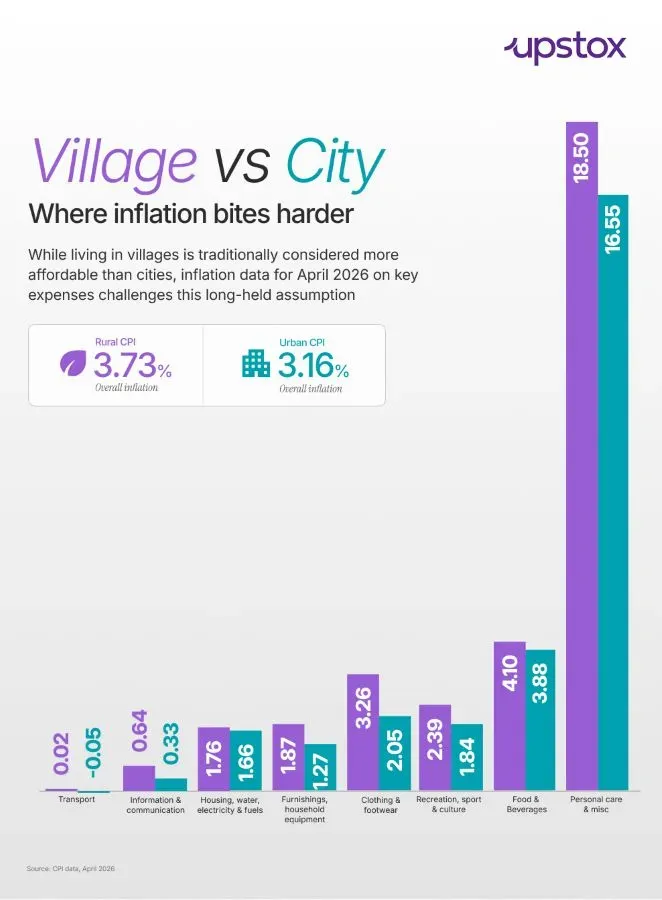
In April, food and beverages inflation in rural areas stood at 4.1%, witnessing a sharp jump of 30 basis points from March 2026. Rural food inflation was also significantly higher than the 3.88% recorded for the same in urban areas in April.
The reasons for higher inflation in rural areas are rooted in supply-side constraints and distribution challenges. Rural markets are often more vulnerable to disruptions in supply chains, weather-related shocks, and higher transportation costs.
As food forms a larger share of rural household expenditure, even a modest increase can have a disproportionate impact on their finances.
In April, however, higher inflation in rural areas was no longer limited to essentials like food but extended to several other essential expenses (see infographic)
What became affordable in rural areas vs urban
While the price of most items increased, inflation in health, education services, restaurant, and accommodation services was lower in rural areas in April, compared to urban areas.
Compared to March, rural areas witnessed an increase in inflation in most items. However, inflation in some items eased.
For instance, inflation in education services declined from 2.95% in March to 2.92% in April. Similarly, inflation in “personal care, social protection and miscellaneous goods and services” decreased from 19.52% in March to 18.5% in April.
In urban areas, however, more items witnessed declining inflation. For instance,
-
Clothing and footwear: Inflation decreased from 2.06% in March to 2.05% in April
-
Housing, water, electricity, gas and other fuel: Decreased from 1.86% in March to 1.66% in April
-
Health: Decreased from 1.91% in March to 1.77% in April
-
Transport: Decreased from -0.01% to -0.05%.
-
Recreation, sport and culture: Decreased from 2.49% in March to 1.84% in April
-
Education services: Decreased from 3.55% in March to 3.3% in April
-
Personal care, social protection and miscellaneous goods and services: Decreased from 17.46% in March to 16.55% in April
Inflation gap not uniform but widespread
The rural-urban inflation divide is not universal, but it is widespread. As per SBI Research, out of 36 states and Union territories, only seven recorded higher inflation in urban areas than in rural areas. This means the majority of regions are experiencing stronger inflationary pressures in villages than in cities.
What it means for households
For rural households, the implications of rising inflation are significant.
The April 2026 data underscores a key takeaway: Inflation is no longer just an urban story. While cities continue to grapple with rising costs, villages are also increasingly feeling the squeeze.
As a larger portion of income is spent on essentials like food and basic services, rising inflation can directly erode the purchasing power of rural consumers. Unlike urban consumers, who are likely to have more diversified income sources and better access to alternative income sources, rural consumers often have fewer buffers against price shocks.
Related News


About The Author
Next Story

