
Personal Finance News
EPFO wage hike impact: How your October 2026 salary slip could change, from CTC to take-home pay

4 min read | Updated on September 28, 2026, 13:14 IST


SUMMARY
EPF members should read the EPFO's reassurance with one nuance: the EPS part of the employer's contribution is the part that converts into a pension, on the scheme's terms and timetable.
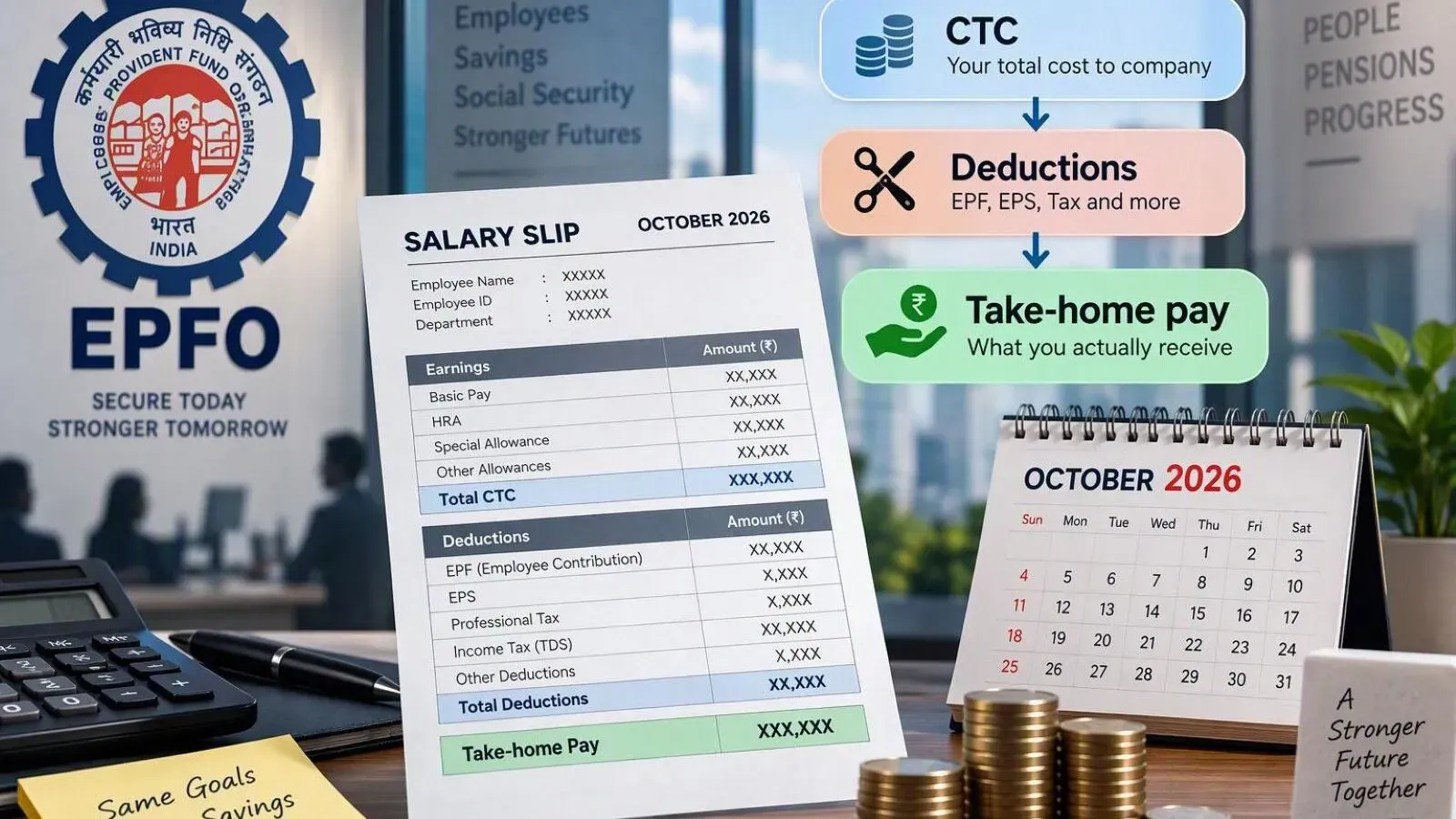
New wage limit became effective from September 2026. | Representational image
-
Will the change affect my CTC?
-
Can my employer recover the extra cost from me?
-
Will my take-home salary shrink after EPFO wage hike?
The EPFO has answered all three questions in its FAQs on the ceiling revision, The answers draw a firm line between what an employer may and may not do.
On whether the wage ceiling will affect cost-to-company, the EPFO said, "CTC is not itself a statutory concept for determining the employer's PF liability. PF contributions have to be determined with reference to the applicable statutory definition of wages and the relevant provisions."
What is not in doubt is the direction of the cost: "If contributions were being made on the earlier wage ceiling of ₹15,000 but the actual PF wages were higher, the increase in the wage ceiling will increase the EPF, EPS, EDLI and Admin charges accordingly," EPFO said. For example, suppose employee's basic+DA is ₹20,000 and he was contributing ₹1800/month at ₹15,000 ceiling. After wage limit hike, he will have to contribute at the full ₹20,000 and his monthly contribution will increase from ₹1,800 to ₹2,400 a month, before EDLI and administration charges.
The answer, as per EPFO, is no.
"The employer's contribution and the employee's contribution are legally distinct." the FAQs said.
"The employer's statutory contribution cannot simply be treated as an employee deduction merely by describing it as part of CTC."
EPFO has also warned that "Employers should ensure that statutory employer contributions are made correctly and that the employee's statutory wages are not reduced contrary to applicable law."
So, as per EPFO, an employer cannot restructure a pay package so that the enhanced employer contribution effectively comes out of the employee's pocket.
But practically, many employers may need to adjust employees' CTCs to negate the impact of higher EPFO contributions on their finances. Therefore, if would be wise to check with your HR department on whether they are considering any CTC adjustments.
From October, an employee on ₹20,000 will see the PF deduction rise from ₹1,800 to ₹2,400, ₹600 less in hand each month. Employee's PF contribution at ₹25,000 wages will be ₹3000, which is ₹1200 more than the ₹1800 contribution at ₹15,000 ceiling. The EPFO, however, says this is not a loss for the employee.
"The PF contribution goes to the Employee's own PF account (except the EPS contribution which is used to provide pension later)," the FAQs said, calling the change "a small trade-off for lifelong security."
"It may be thought of as moving from the 'take home pocket' to the 'PF account pocket' of the employee. It is his own money and always available to him. The balance in the PF account is easily accessible and can be withdrawn to the extent of 75% at any time for any need. It is the same as having money in your bank account," EPFO said.
Related News


About The Author
Next Story

