
Personal Finance News
Central government employees' bonus for 2025-26: Who qualifies, how much they get and 8 key rules explained
.png)
4 min read | Updated on October 16, 2026, 15:32 IST


SUMMARY
Check eligibility, bonus amount, calculation formula and key rules for Central government employees' ad-hoc bonus for 2025-26.
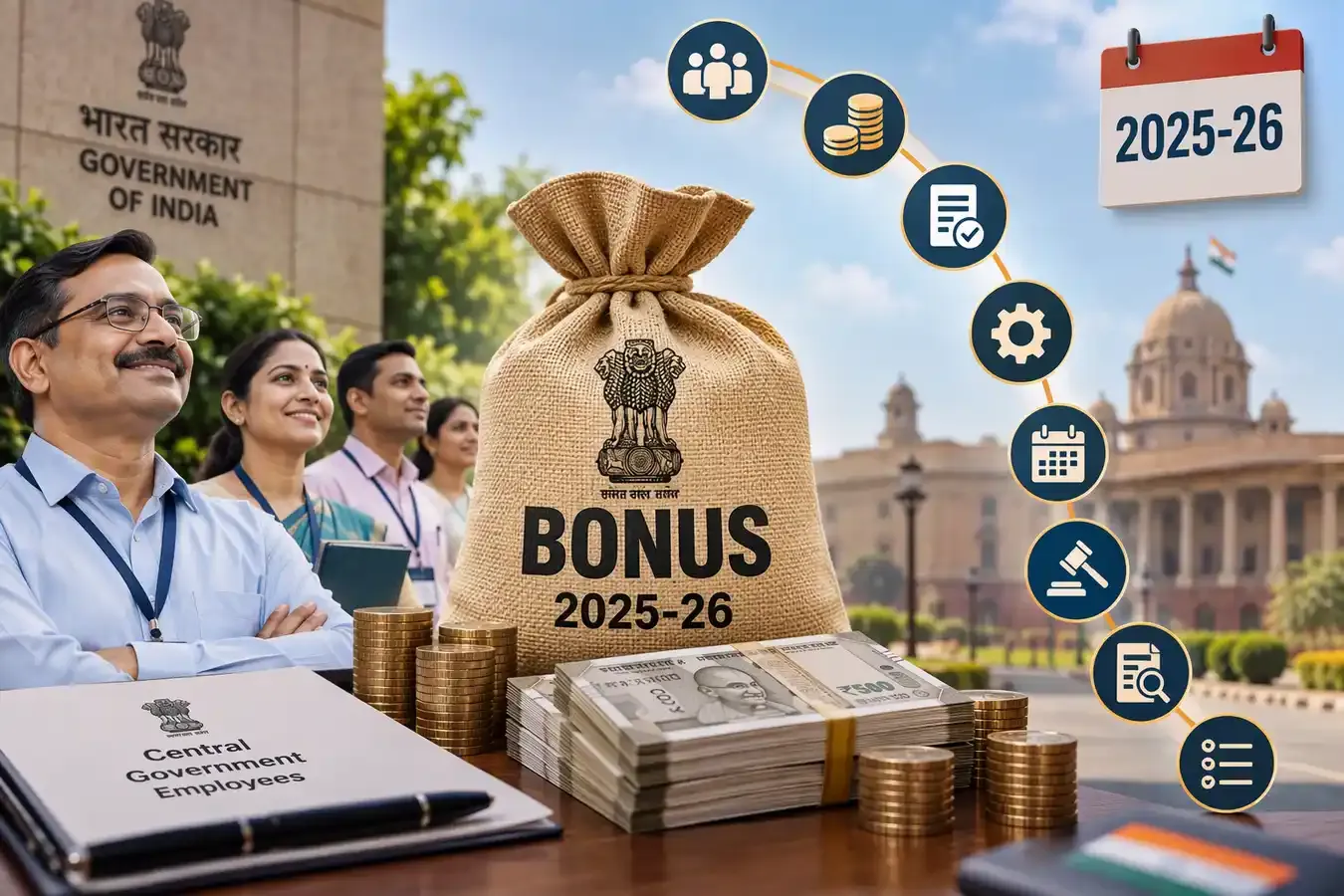
Employees transferred between ministries, departments or offices covered by the ad-hoc bonus orders can qualify on the basis of their combined service, provided there is no break in service. | Representational image
The Central government has approved a 30-day Non-Productivity Linked Bonus (ad-hoc bonus) for eligible Group C and non-gazetted Group B employees for the accounting year 2025-26.
According to an Office Memorandum issued by the Ministry of Finance’s Department of Expenditure on October 15, 2026, the bonus applies to employees not covered by a Productivity Linked Bonus (PLB) scheme. The monthly emoluments ceiling is ₹7,000, making the maximum bonus for 30 days ₹6,908. The actual amount may be lower depending on an employee’s average emoluments and eligible service.
The order also covers eligible personnel of the Central Para Military Forces and Armed Forces, as well as employees of certain Union Territory administrations.
1. Who is eligible for the ₹6,908 bonus?
Eligible Group C and non-gazetted Group B employees must generally have been in service on March 31, 2026, and completed at least six months of continuous service during 2025-26.
Employees with six months to less than one year of eligible service will receive the bonus on a pro-rata basis, calculated according to the number of months of service, rounded to the nearest month.
2. How is the bonus calculated?
The bonus is calculated using average monthly emoluments or the ₹7,000 ceiling, whichever is lower. The monthly amount is divided by 30.4 and multiplied by 30 days.
For employees whose average monthly emoluments are at least ₹7,000, the calculation is ₹7,000 × 30 ÷ 30.4, giving ₹6,907.89, rounded to ₹6,908. Employees earning less will receive a lower amount. All payments are rounded to the nearest rupee.
3. What bonus will eligible casual labourers receive?
Casual labourers who have worked at least 240 days annually for three years or more in offices following a six-day week, or 206 days annually for three years or more in offices following a five-day week, may qualify.
The bonus is calculated using monthly emoluments of ₹1,200, resulting in ₹1,184 for 30 days. If actual monthly emoluments are lower, the calculation will use the actual amount.
The memorandum allows qualifying workdays across eligible government offices to be combined, subject to specified conditions. Unlike regular employees, casual labourers do not have to be employed on March 31, 2026, to qualify. Separate provisions apply to casual labourers regularised during the accounting year.
4. Are temporary employees eligible?
Yes. Employees appointed on a purely temporary or ad-hoc basis may qualify if they have completed at least six months of continuous service and were in service on March 31, 2026.
5. What if an employee retired or died before March 31, 2026?
As a special case, employees who superannuated, retired due to medical invalidation or died before March 31, 2026, may receive a pro-rata bonus if they completed at least six months of regular service during 2025-26.
Employees who resigned or retired in other circumstances are subject to the separate conditions specified in the annexure.
6. How are leave and suspension treated?
Leave other than leave without pay is generally counted towards the eligibility period. Extraordinary leave and dies non are excluded from the eligibility period but do not count as a break in service.
Subsistence allowance paid during suspension is not treated as emoluments. An employee may qualify if reinstated with the benefit of emoluments for the suspension period. Otherwise, the suspension period is excluded when determining eligibility, subject to the memorandum’s provisions.
7. Are employees on deputation eligible?
Employees deputed to state governments, Union Territory administrations, public sector undertakings and other organisations generally cannot claim the bonus from their lending department. The borrowing organisation’s applicable bonus, PLB, ex-gratia or incentive scheme determines eligibility.
Employees on reverse deputation from state governments, Union Territories or public sector undertakings to the Central government may qualify, subject to conditions, including restrictions on additional incentives and the lending authority’s approval.
8. What happens when employees transfer between departments?
Employees transferred between ministries, departments or offices covered by the ad-hoc bonus orders can qualify based on their combined service, provided there is no break in service.
Payment is generally made by the organisation where the employee was working on March 31, 2026. Separate rules apply to employees moving between ad-hoc bonus and PLB schemes.
For re-employed pensioners, eligibility is calculated separately for the period before retirement and the re-employment period. The total bonus cannot exceed the maximum admissible under the orders. Part-time employees engaged on nominal fixed payments are not eligible.
The expenditure will be debited to the respective object head under the Department of Expenditure’s notification dated December 16, 2022. The amount will be met from the sanctioned budget provisions of the concerned ministries and departments for the financial year 2026-27.
Related News

About The Author
Next Story

