
Personal Finance News
79 years, 8 pay commissions: How salaries have changed since 1947

3 min read | Updated on August 13, 2026, 19:11 IST


SUMMARY
Every pay commission in the past has tried to simplify the pay structure by cutting down both the number of pay scales and the compression ratio. The scale of this simplification has often been dramatic.

Central government employees are currently paid as per the recommendations of the 7th CPC.
Whether the 8th CPC meets these expectations remains to be seen, but, with the benefit of hindsight, it can be said that employees have reason to be optimistic about a substantial revision in their pay and allowances.
As per data since 1947, the minimum salary of central government employees has increased nearly 327 times since Independence, while the maximum salary has surged up to 125x.
The following infographic shows how the minimum and maximum salaries of central government employees have increased since the First Pay Commission in 1946-47.
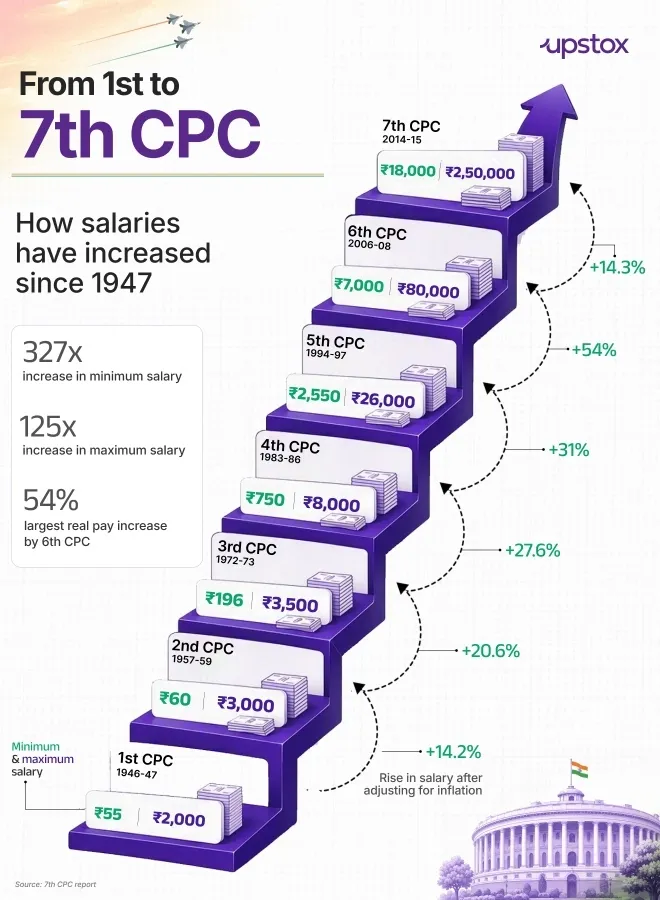
Currently, central government employees are paid as per the recommendations of the 7th CPC whose tenure will end by December 31, 2025.
What to expect from the 8th CPC
Looking back at how previous pay commissions have shaped salaries offers a useful guide to what employees might reasonably expect from the 8th CPC.
So far, India has had seven pay commissions since 1947. The first CPC was set up in May 1946, while the most recent, the 7th CPC, submitted its recommendations in 2014-15. There are a few clear patterns emerging from the recommendations of the past pay commissions:
Every pay commission in the past has tried to simplify the pay structure, by cutting down both the number of pay scales and the compression ratio, which is the gap between what the top bureaucrat (the Cabinet Secretary) earns and what the lowest-paid central government employee takes home.
The scale of this simplification has often been dramatic. For instance, while the 3rd Pay Commission cut the number of pay scales from 500 down to just 80, the 6th Pay Commission trimmed 35 scales down to 19.
While each successive pay commission has pushed salaries higher, the biggest jump was made possible by the 6th CPC. According to the 7th CPC report, the real pay under the 6th CPC rose by 54%, which is the largest increase among all the commissions so far.
Beyond the numbers, the way salaries are structured has changed significantly over the decades. Up to the 4th CPC, most employees were paid on individual, fixed pay scales, with only a limited move toward "running" pay scales for the defence forces. The system of individual scales largely remained for other employees till the 5th CPC.
However, the 6th CPC introduced running pay bands and grade pay across both civilian and defence posts. The 7th CPC then removed the pay band and grade pay system entirely, replacing them with a new pay matrix. Under the pay matrix system, an employee's status is now defined by his position, or "level," within that matrix rather than by a separate grade pay number.
If the pattern holds, employees can reasonably expect the 8th CPC to bring further simplification of the pay matrix, along with an increase to both the minimum and maximum pay scales. However, one should note that the exact change would be know only after the pay commission's recommendations are finalised.
Related News


About The Author
Next Story

