
Personal Finance News
₹50,000 cash or investment as a Rakhi gift? Which makes more sense?

4 min read | Updated on August 28, 2026, 14:02 IST


SUMMARY
This article explores whether ₹50,000 in cash or an investment makes a smarter Rakhi gift, weighing immediate financial needs, long-term wealth creation and the tax implications of each option.
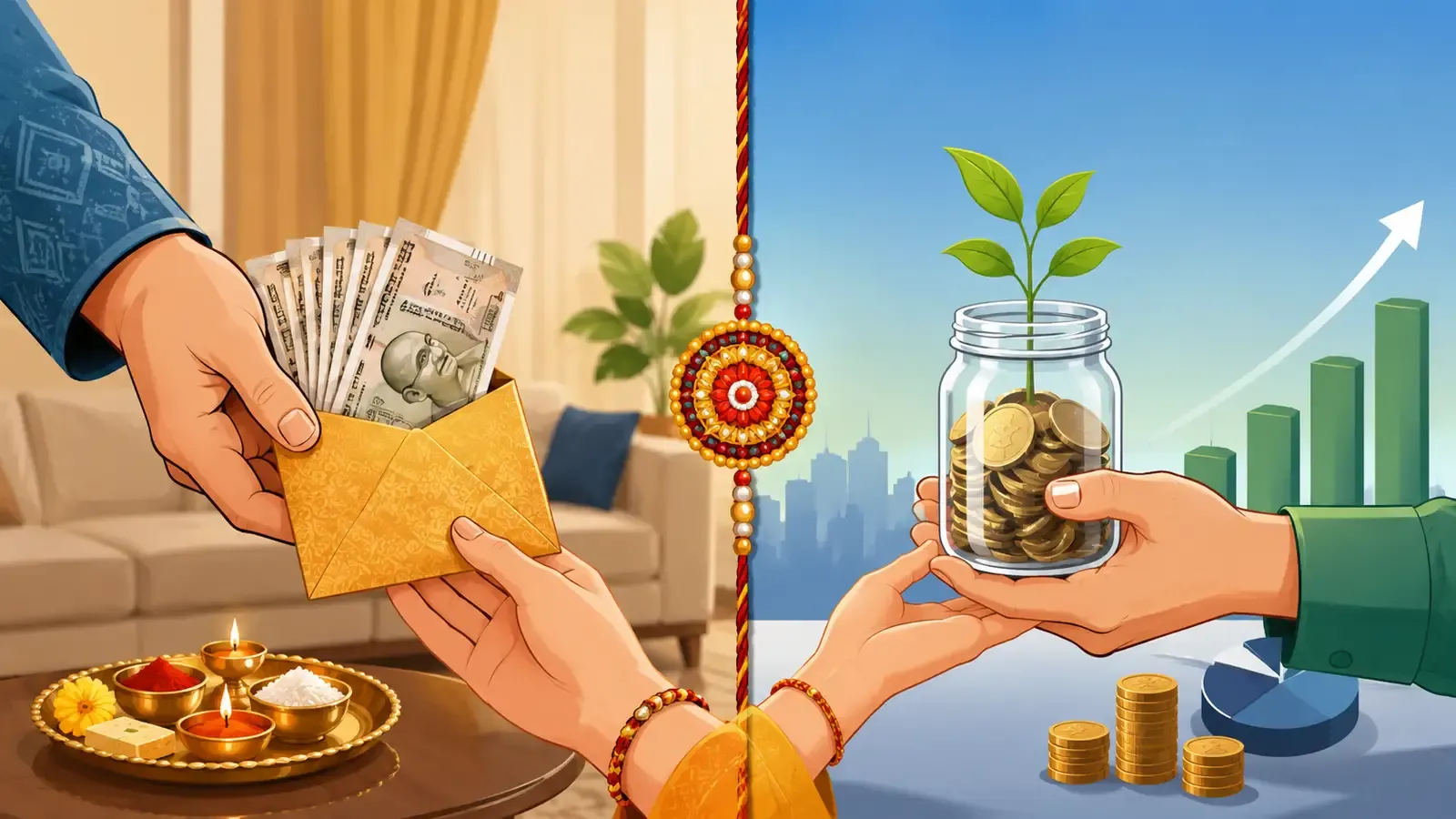
A cash gift can be useful for immediate expenses, while an investment could potentially grow over the years.
Raksha Bandhan 2026: Cash has always been one of the simplest Rakhi gifts. But if you are planning to give your sibling ₹50,000 this year, there is another option: putting the money to work through an investment.
A cash gift can be useful for immediate expenses, while an investment could potentially grow over the years. So, which option makes more sense?
₹50,000 cash or investment for Rakhi 2026?
Tax and investment expert Balwant Jain said the choice should depend on the recipient's financial needs.
“Cash may get spent sooner, while an investment may compound in the long run as it is not likely to be spent soon. However, the immediate needs of the sister should be given priority,” Jain said.
Shweta Shastri, CFP and founder at Finnora wealth studio said investing the gift could make sense if the recipient does not need the money immediately.
“If your sibling does not immediately need the money, investing a part or all of the gift can make it more meaningful. At an assumed 10% annual return, ₹50,000 could potentially grow to around ₹1.30 lakh in 10 years and ₹3.36 lakh in 20 years,” Shastri said.
Please note that these calculations are only illustrations. Market-linked investments do not offer guaranteed returns.
Cash or investment: What should you choose?
Cash can make more sense when your sibling has an immediate expense, an emergency or outstanding debt.
“If there is an immediate need, emergency requirement or debt to manage, cash can be the better choice,” Shastri said.
For those who want to combine the two approaches, she suggested a middle path.
“A middle path could be to give ₹10,000 to ₹15,000 to enjoy today and invest the balance for tomorrow,” she said.
You could also give cash and encourage your sibling to invest some or all of it, depending on their financial goals and risk appetite.
What about tax on a ₹50,000 cash gift?
Under India's income-tax rules, gifts received from specified relatives are generally exempt from tax. The definition of “relative” includes relationships such as a brother or sister of the individual and certain other specified family members.
For a Rakhi gift between a brother and sister, the gift falls within the specified-relative category. Therefore, the ₹50,000 cash gift itself would generally not be taxable in the recipient's hands.
What if you gift mutual fund units or stocks?
For listed equity shares and equity-oriented mutual funds, long-term capital gains apply when the investment is held for more than 12 months. LTCG is taxed at 12.5% on gains exceeding ₹1.25 lakh in a financial year, subject to the applicable conditions. Short-term capital gains on such securities are taxed at 20%.
So, while the gift itself generally does not trigger capital-gains tax, your sister could have a tax liability when she eventually sells the shares or mutual fund units.
The actual tax would depend on the gain, the type of investment and the period for which it is held.
So, should you gift cash or an investment?
There is no one-size-fits-all answer. If your sibling needs the money now, cash may be the more useful gift. If they have their immediate finances in place and are investing for a long-term goal, an investment could turn the Rakhi gift into something that potentially grows over time. A combination can also work. Ultimately, the best Rakhi gift may depend less on the amount and more on what your sibling actually needs.
Raksha Bandhan 2026
Raksha Bandhan 2026 will be celebrated on Friday, August 28. The festival celebrates the bond between brothers and sisters, with sisters traditionally tying a Rakhi around their brothers' wrists and families exchanging gifts and sweets.
Related News

About The Author
Next Story

