
Personal Finance News
EPF wages vs gross salary: Why a ₹50,000 employee may qualify but a ₹60,000 employee may not

3 min read | Updated on October 09, 2026, 17:05 IST


SUMMARY
The EPF wage ceiling is applied to wages as defined under section 2(88) of the Code on Social Security, 2020 and not simply the employee’s total gross salary.
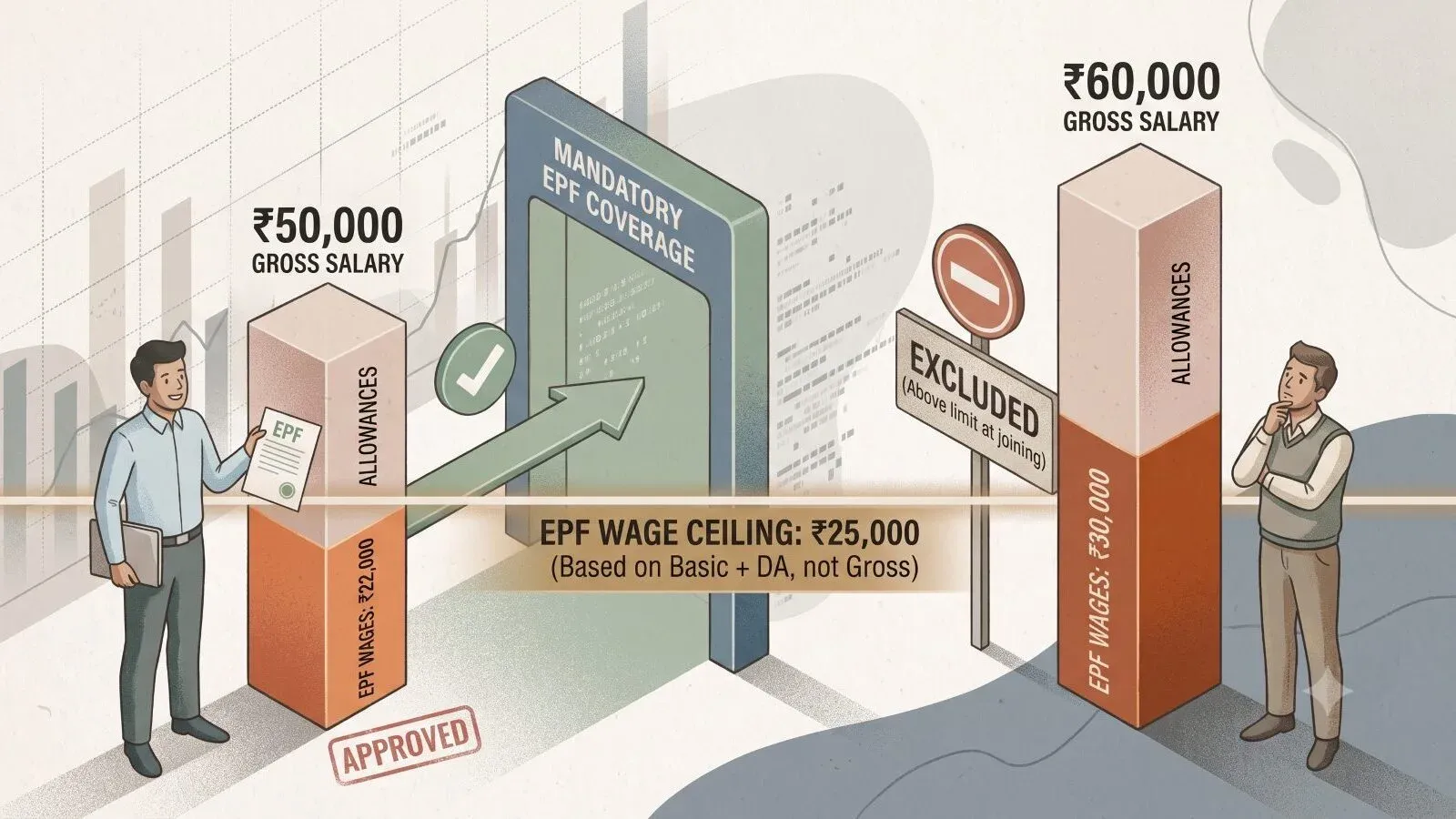
EPF coverage brings a lifelong pension on retirement, survivor benefits for the family, and insurance cover of up to ₹7 lakh under the EDLI scheme. | Representational image/AI generated
Well, the number that decides their EPFO coverage is not salary, rather it is their PF wage, which is basically a narrower, statutorily defined figure that bears little resemblance to the gross figure on a salaried employee's offer letter.
The EPFO's recent frequently asked questions on the wage ceiling revision spelt out difference between gross salary and PF wages, saying, "The wage ceiling and gross salary are not synonymous. PF contribution continues to be determined with reference to PF wages and the contribution provisions applicable under the EPF Scheme and related statutory provisions, not the entire gross salary."
What is PF wage, then?
The wage ceiling is applied to "wages as defined under section 2(88) of the Code on Social Security, 2020 and not simply the employee's total gross salary," according to the FAQs. The EPFO describes EPF wages as Basic plus Dearness Allowance plus Retaining Allowance.
CTC components that typically form the gross salary, such as house rent allowance, special allowances, bonus, overtime, etc., do not count towards PF wages.
So a salary structure may look large on paper, the PF wage stays modest, or the reverse. Coming back to the start of the article, that is how the two colleagues diverge.
For the employee on ₹50,000 gross salary, whose PF wages are ₹25,000, the answer is unambiguous: "Yes, you are required to be a member under all three schemes — EPF, EPS and EDLI. The fact that your gross salary is ₹50,000 does not by itself exclude you. Your relevant EPF wages are ₹25,000, which is within the revised wage ceiling," EPFO says.
For the colleague on ₹60,000 gross with EPF wages of ₹30,000, the EPFO's reply is equally clear: "No. However, you can voluntarily opt to become a member of EPF with the consent of your employer."
EPF coverage brings a lifelong pension on retirement, survivor benefits for the family, and insurance cover of up to ₹7 lakh under the EDLI scheme. Exclusion from it means absence of those protections, irrespective of the pay packet's size. And where the PF wage does exceed the ceiling, the contribution does not chase the full salary.
"Where the wages exceed ₹25,000, the statutory contribution may generally be restricted to the prescribed ceiling unless the employee is covered/contributing on higher wages under the applicable provisions and scheme requirements," the FAQ says.
For the higher-paid employee who wants EPFO coverage, there is a route. The Employees' Provident Funds Scheme, 2026 provides that any employee and his employer may jointly opt in writing, to enrol such employee as a member or allow him to contribute on such wages exceeding wage ceiling limit. The scheme also defines such a person as an "excluded employee" or "an employee whose wage at the time he is otherwise entitled to become a member of the Fund, exceeds wage ceiling as prescribed under the Code."
Related News

About The Author
Next Story

