
Personal Finance News
Dhanteras 2026: NSE's Electronic Gold Receipts trading crosses ₹93 crore; What investors should know about costs and liquidity

4 min read | Updated on October 28, 2026, 07:42 IST

SUMMARY
Electronic Gold Receipts offer demat-based ownership of vaulted gold, but trading activity, transaction costs and physical redemption remain important considerations for investors
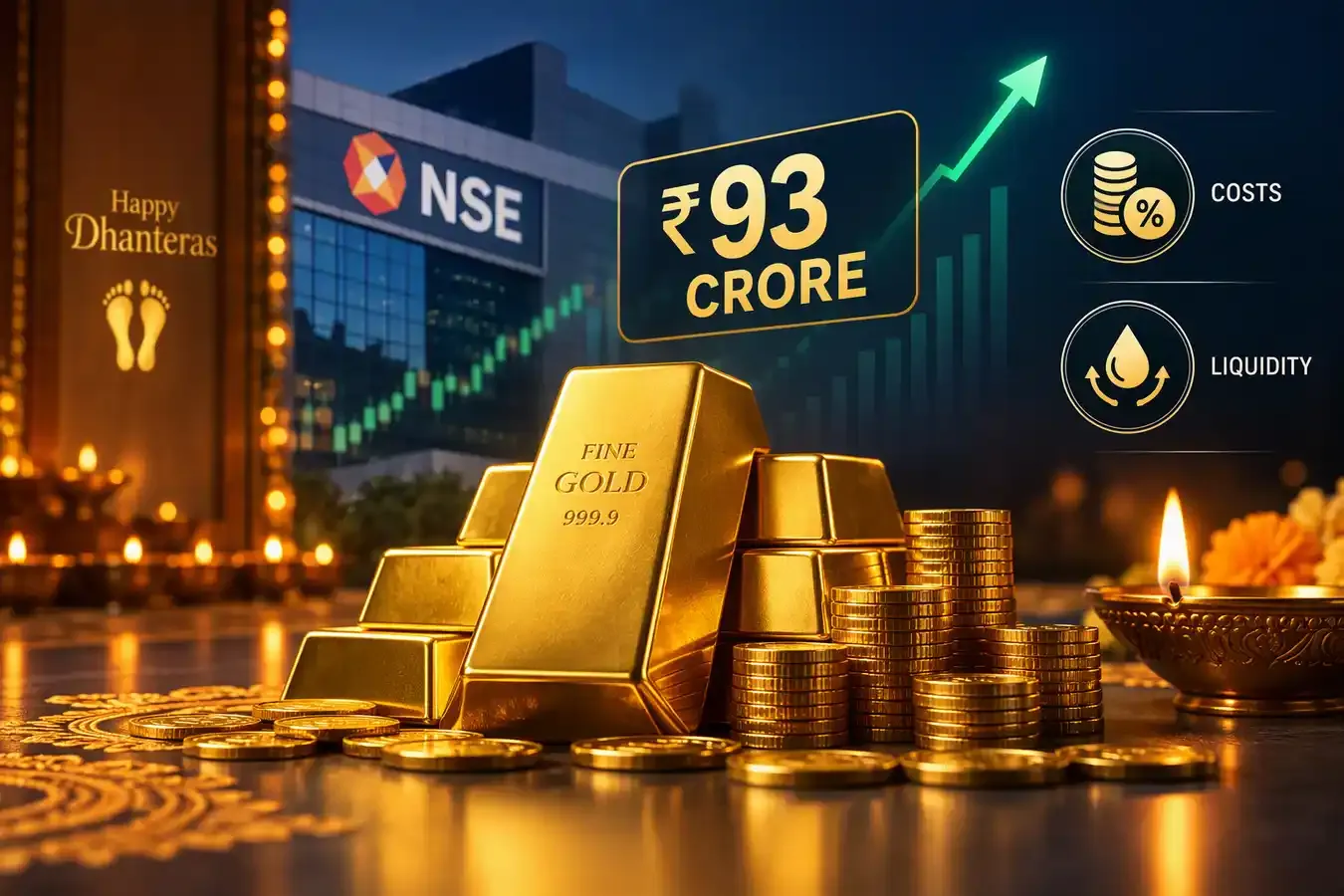
According to NSE's October 2026 Market Pulse report, the EGR segment recorded cumulative traded value of approximately ₹93.30 crore. Representational image/AI generated.
Investors need to understand the costs of trading EGRs, the liquidity available in the market and the process of converting electronic holdings into physical gold.
According to NSE's October 2026 Market Pulse report, the EGR segment recorded cumulative traded value of approximately ₹93.30 crore, with more than 5,900 EGR units traded, up to October 16, 2026.
The turnover offers an early measure of activity in the newly launched segment, although it does not establish how easily investors can buy or sell EGRs at competitive prices.
NSE flags the need for a stronger ecosystem
In its Market Pulse report, NSE said the EGR segment “remains at an early stage of development”, with significant scope to expand trading activity, market participation and supporting infrastructure.
The exchange's assessment highlights a key consideration for retail investors: the practical usefulness of an exchange-traded gold instrument depends not only on its structure but also on the market infrastructure supporting it.
NSE says an efficient EGR market requires an integrated ecosystem covering “refining, assaying, vaulting, depository services, trading and physical delivery”.
To strengthen this ecosystem, NSE has onboarded Parker Precious Metals, Augmont Enterprises and Gujarat Gold Centre under its NSE Refiners Standards framework. It is also progressively activating gold collection centres in coordination with SEBI-approved vault managers.
In September 2026, the exchange empanelled Augmont Gold Tech Private Limited to facilitate EGR creation and extinguishment, strengthen operational support and encourage participation across the gold value chain.
These initiatives are intended to improve access to gold deposits, support the creation of EGRs and facilitate their conversion back into physical gold.
What EGR ownership means for investors
EGRs are held in dematerialised form and traded on recognised stock exchanges. NSE offers receipts backed by gold of 995 and 999 purity in six denominations: 10 milligrams, 100 milligrams, 1 gram, 10 grams, 100 grams and 1 kilogram.
The structure allows investors to hold ownership of vaulted gold without personally storing the metal. Physical conversion is possible, subject to the applicable rules, procedures and charges.
For investors, however, electronic ownership does not automatically mean that holding or selling gold will be cost-free. Brokerage, exchange transaction charges and demat-related costs may apply. Physical redemption can involve additional delivery expenses and tax implications.
The World Gold Council has called for clearer GST rules governing EGR conversion and redemption and has recommended tax-exempt conversion of physical gold into EGRs. These are recommendations aimed at encouraging adoption; they do not themselves change the prevailing tax rules.
Liquidity is as important as the gold price
Investors also need to distinguish between the underlying gold price and the price at which they can actually trade an EGR.
India's privately held gold presents a long-term opportunity
NSE estimates that India holds approximately 30,000–35,000 tonnes of privately owned gold. The exchange sees this as an opportunity to bring a portion of existing gold holdings into the regulated financial ecosystem.
In its report, NSE said wider EGR adoption could support “improved liquidity, broader participation and greater integration of gold with India’s formal financial markets”.
For Dhanteras buyers, the broader development is the emergence of another regulated mechanism for holding gold.
Related News

About The Author
Next Story

