
Market News
Week ahead: RBI policy, US bond yields, crude oil and TCS earnings in focus

6 min read | Updated on October 04, 2026, 12:26 IST


SUMMARY
In the week ahead, the RBI policy decision, US Federal Reserve minutes, and US bond yields will be in focus. Crude oil will remain important for the rupee and inflation, while TCS will open India’s September quarter earnings season.

NIFTY50 dropped 3% in the previous week, clocking eighth consecutive week of losses. Image: Shutterstock.
Indian markets extended the losing streak for eight weeks in a row and closed at 22,421, down 3.1%, while SENSEX closed at 71,909, down 2.7%. In a truncated week both benchmarks witnessed their longest losing sequence in 25 years.
Persistent foreign selling, the rise in the US 10 year Treasury yield to a 24 year high, crude oil above $100 and a weaker rupee kept investors cautious. Expectations that the RBI could raise rates at its October meeting added pressure to domestic risk assets.
The sell-off extended beyond the headline indices. The Nifty Midcap 150 declined about 3.5 % to 21,643, the Nifty Smallcap 250 lost about 3.1% to 17,589, and India VIX rose 18.9 % to 14.46.
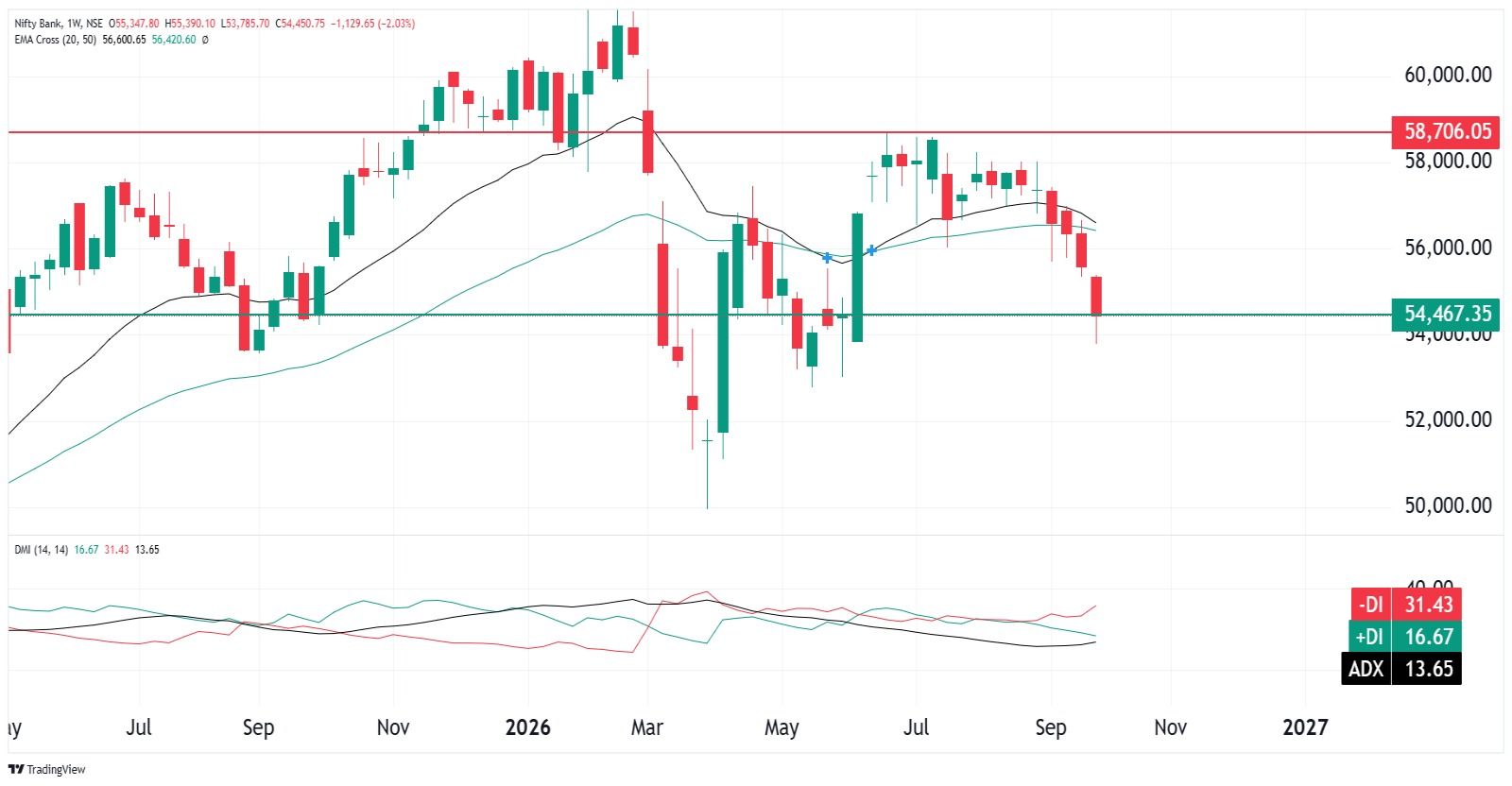
Sector performance was weak and substantially broader than the benchmark decline. Nifty IT was the only major sector to end higher, gaining about 0.5%. Nifty Private Bank declined about 0.7% and Nifty Bank fell 2 %, making both relative outperformers despite negative absolute returns. Consumer durables declined 6.1 %, Automobiles 5.9 %, Metals 4.8% and FMCG 4.7 %, all underperforming the NIFTY50.
Weak September vehicle sales, rate sensitivity and concerns over household demand hurt automobiles and consumer-facing sectors. IT shares received support from the weaker rupee and lower expectations of an immediate US rate increase.
🛡️Spotlight: Banks and NBFCs will be in focus ahead of the RBI policy decision on 7 October. Experts believe a 25 basis point increase in the repo rate to 5.50%. Elevated crude prices, a weaker rupee and broader inflation pressures have brought the possibility of renewed tightening into focus. The decision and guidance on further increases will matter for loan demand, funding costs and lending margins.
The sector’s performance was uneven in the week ended 1 October. Nifty PSU Bank fell more than 4%. Meanwhile, Yes Bank, LIC Housing Finance, SBI Cards and HUDCO were among the laggards, while Bajaj Finance contributed significantly to the erosion in market value.
A rate increase would have different effects across lenders. Banks could initially benefit if floating loan rates rise faster than deposit costs. That benefit could narrow as deposits reprice. However, NBFCs relying on bank loans and market borrowing could face margin pressure if funding costs rise.
In the United States, the Federal Reserve will publish minutes from its 15 and 16 September meeting on Wednesday, 7 October. Meanwhile, the September jobs report, released on 2 October, showed growth of just 29,000, below the 90,000 expected. The softer labour-market data supported expectations of a Fed pause. By Friday, markets priced a 22.7 % probability of an October rate hike, down from 64.2% a week earlier. Meanwhile, the US bond market and treasury supply will be an important global trigger after the US 10 year yield touched a 24 year high.
Meanwhile, the seven core OPEC+ producers meet on Sunday, 4 October, before Asian markets open for the coming week. The group is expected to keep November production targets unchanged after maintaining October targets, while a separate cut of about 20 lakh barrels per day remains in place through the end of 2026.
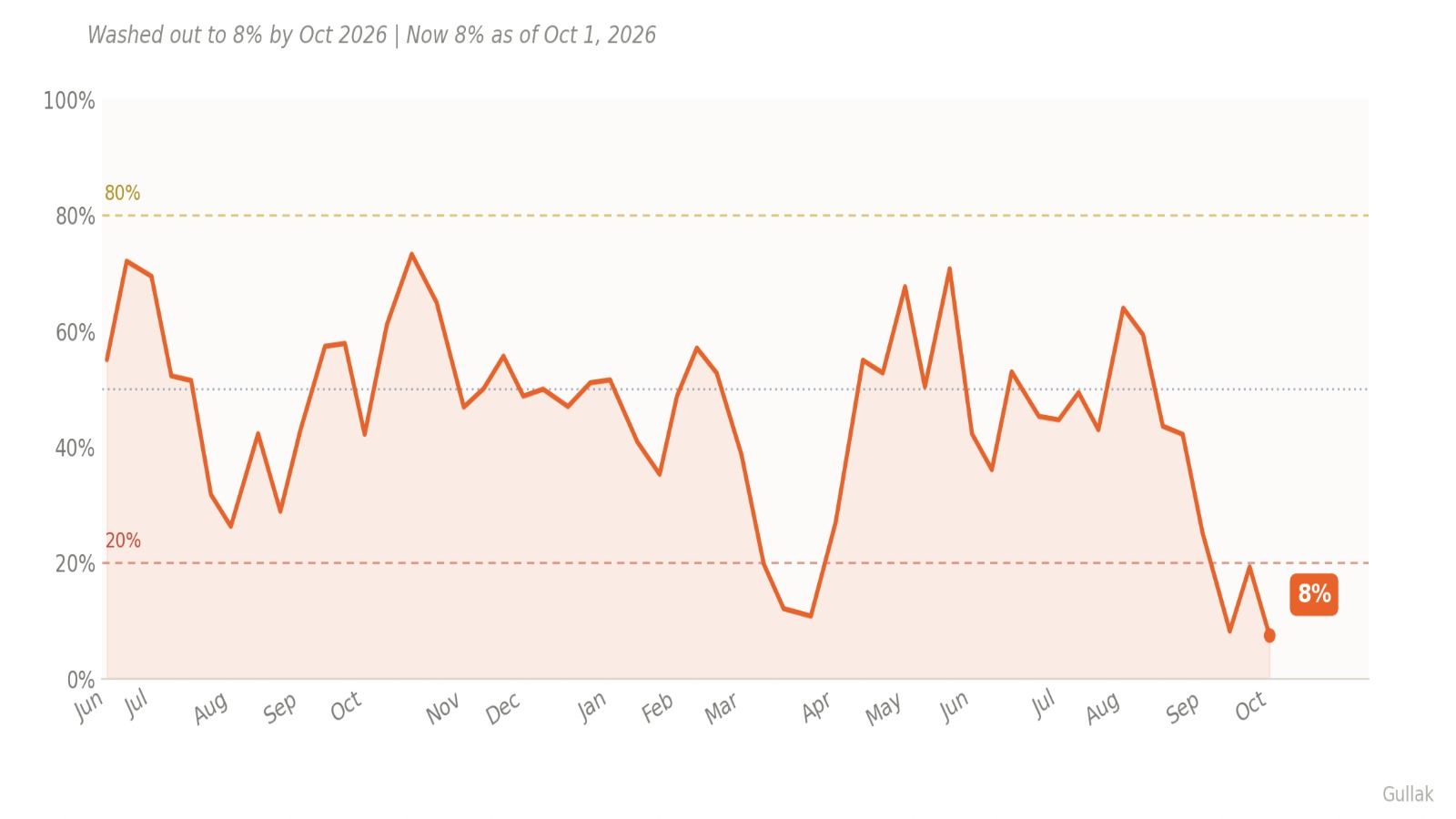
As of 1 October, only 8% of NIFTY50 stocks were trading above their 50 day moving average. The reading indicates widespread weakness across the index and supports the benchmark’s declining trend. Such weak breadth can accompany a rebound, but it does not establish a bottom. A recovery would carry more weight if more stocks regain their 50 day moving average alongside an improvement in the index.
Foreign investors positioning
During the trading week of 28 September to 1 October, foreign institutional investors (FIIs) sold equities worth ₹34,966 crore, extending their selling streak to six weeks. The net sell figure for September stood at ₹44,012 crore — the highest in the last two months.
Meanwhile, domestic investors bought equities worth ₹33,455 crore during the same week, absorbing most of the selling by FIIs. For September as a whole, they remained net buyers to the tune of ₹76,030 crore.
NIFTY50 outlook
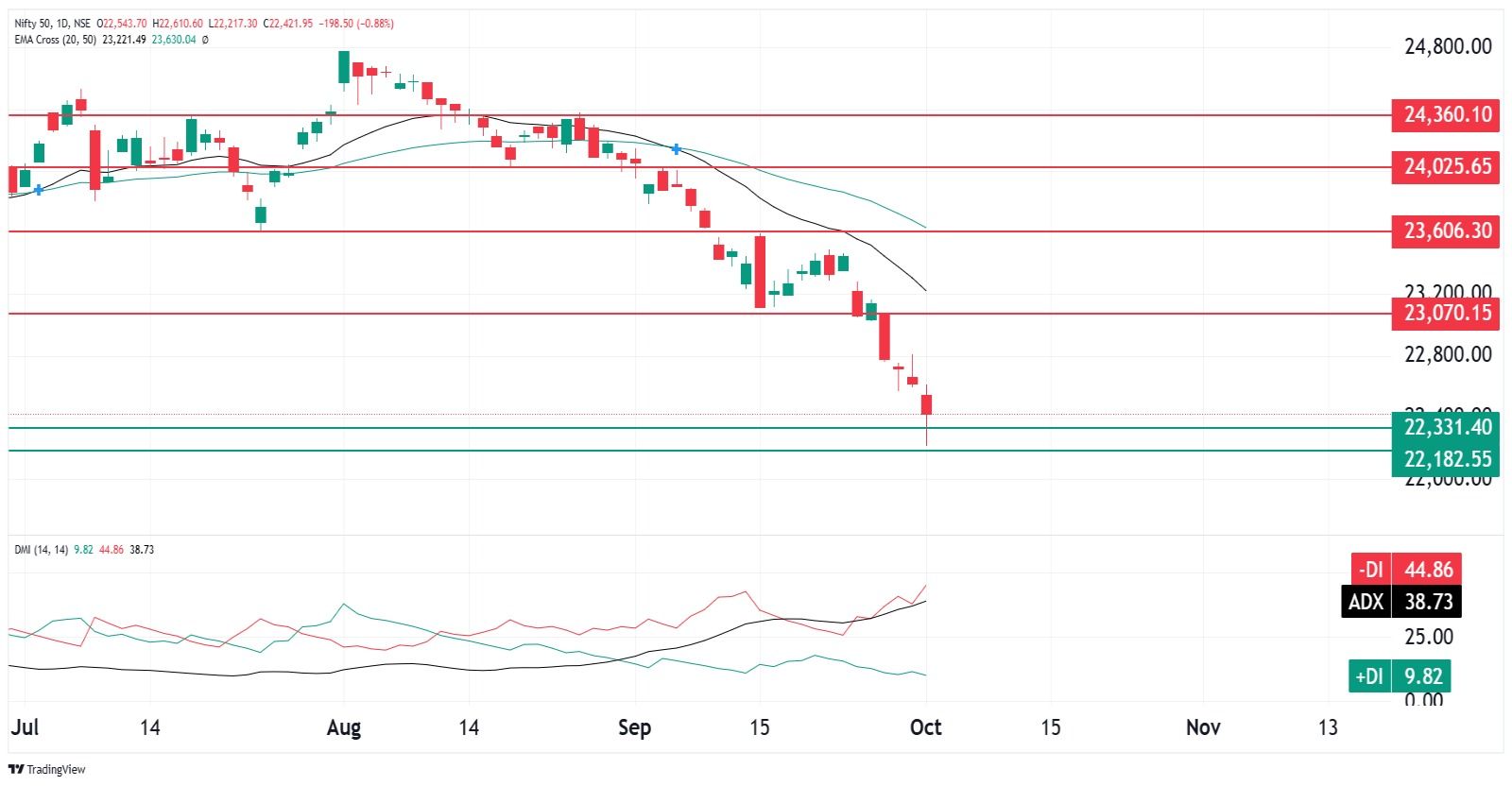
The NIFTY50 index continued its sequence of lower highs and lower lows. The index remains below the falling 20 day EMA and 50 day EM, keeping the prevailing structure bearish. Meanwhile, Thursday’s recovery from the intraday low of 22,217 shows buying within the marked support band, but the close has not yet changed the broader trend.
The immediate support stands between 22,182 and 22,331. If this band holds, a rebound is possible, but a daily close back above 23,070 would be an initial sign of improving price structure. The 20 day EMA near 23,221 would then be the next hurdle, followed by the 23,606 to 23,630 resistance area. If NIFTY50 closes decisively below 22,182, the support band would fail and the risk of further downside would rise.
About The Author
Next Story

