
Market News
FPIs withdraw ₹62,853 crore from equities in June so far; total 2026 outflows reach ₹2.87 lakh crore
.png)
4 min read | Updated on June 14, 2026, 12:04 IST


SUMMARY
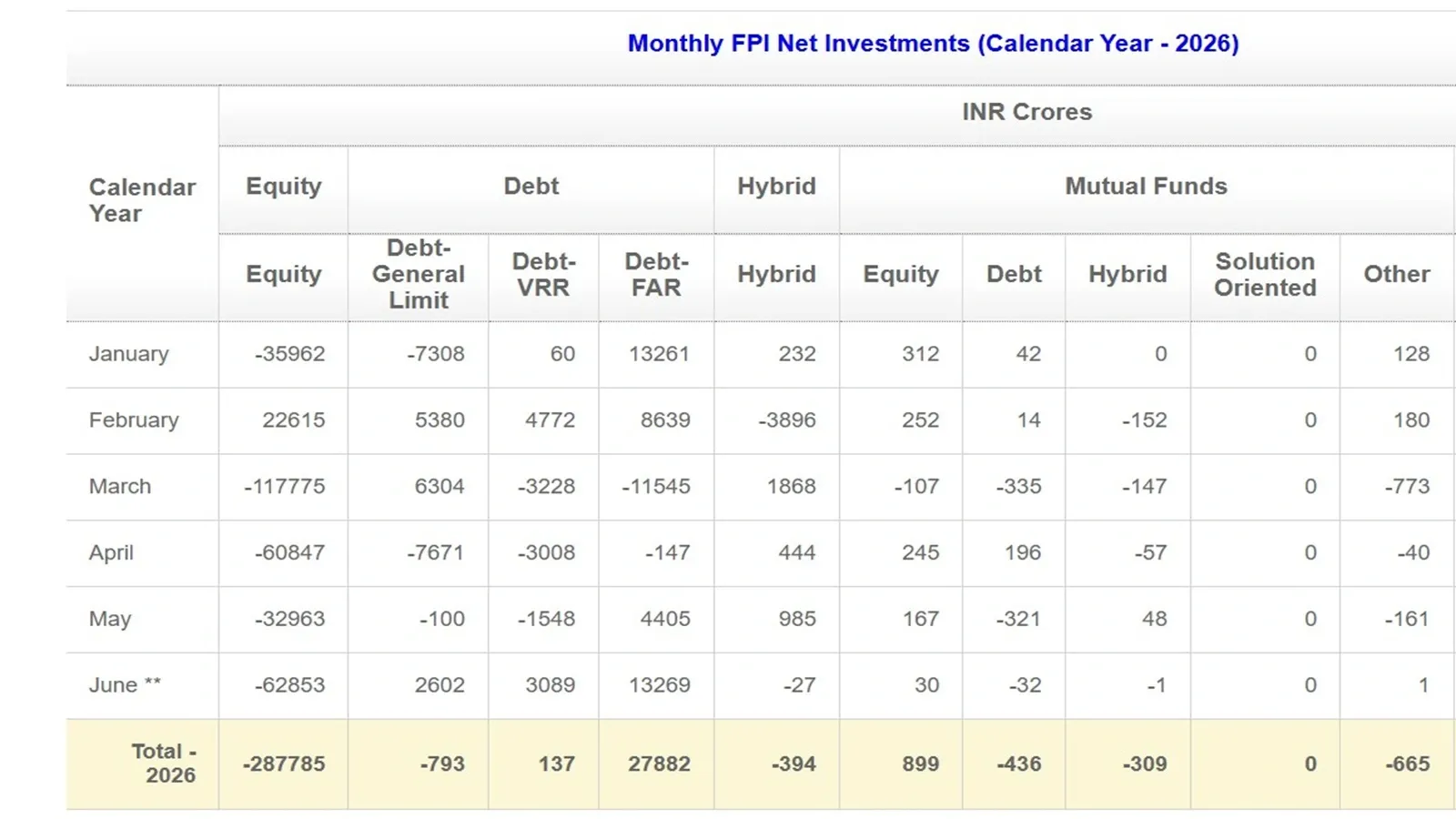
The latest selloff has taken cumulative FPI outflows from Indian equities to ₹2.87 lakh crore so far in 2026, exceeding the ₹1.66 lakh crore withdrawn during the whole of 2025, according to data from the National Securities Depository Ltd (NSDL).

The Indian currency has weakened nearly 6% so far in 2026 and around 10% over the past year. Image: Shutterstock
Foreign Portfolio Investors (FPIs) continued to offload Indian equities, pulling out more than ₹62,853 crore in the first fortnight of June amid escalating geopolitical tensions, concerns over global economic growth, and persistent weakness in the rupee.
The latest selloff has taken cumulative FPI outflows from Indian equities to ₹2.87 lakh crore so far in 2026, exceeding the ₹1.66 lakh crore withdrawn during the whole of 2025, according to data from the National Securities Depository Ltd (NSDL).
NSDL data shows that foreign investors have been net sellers in every month of 2026 except February. After withdrawing ₹35,962 crore in January, FPIs turned net buyers in February with investments of ₹22,615 crore — their highest monthly inflow in 17 months. However, selling resumed thereafter and has continued through June.
The trend, however, reversed sharply in March, when foreign investors pulled out a record ₹1.17 lakh crore. The selling pressure continued in April with net outflows of ₹60,847 crore and in May with withdrawals of ₹32,963 crore.
In June, FPIs have already withdrawn ₹62,853 crore during the first two weeks of the month.
Expert Take
Himanshu Srivastava, Principal, Manager Research, Morningstar Investment Research India, said investors continue to navigate an environment marked by elevated uncertainty around the interest-rate trajectory of major central banks, geopolitical developments, and concerns over global growth.
"In such phases, emerging markets often witness tactical de-risking as investors seek safety and rebalance portfolios towards developed markets and defensive assets," Srivastava said.
Srivastava added that India's relatively rich valuations compared with several emerging-market peers may also have prompted foreign investors to adopt a more selective approach towards allocations.
Market participants said the persistent depreciation of the rupee has emerged as another key factor behind the sustained outflows.
Rupee slide
The Indian currency has weakened nearly 6% so far in 2026 and around 10% over the past year, falling from the mid-80s level to about 95 against the US dollar despite efforts by the Reserve Bank of India (RBI) to stabilise the currency.
However, the pace of FPI outflows moderated significantly in the latter half of last week, indicating that while risk aversion remained elevated, the intensity of foreign selling eased gradually.
On Friday, FPIs sold equities worth only ₹1,082 crore in the cash market.
What analysts have said
Analysts said recent geopolitical developments and expectations of a potential peace agreement between the US and Iran have led to a sharp correction in Brent crude prices to below $87 per barrel.
For India, one of the world's largest crude oil importers, lower oil prices are expected to provide relief to the country's external accounts. Analysts noted that India is projected to run a balance of payments deficit of around $60 billion in FY27.
Given the importance of foreign portfolio inflows in financing the current account deficit and supporting the balance of payments, policymakers have announced a series of measures to attract overseas capital.
These include the Reserve Bank of India absorbing hedging costs on FCNR deposits mobilised by commercial banks, expanding the forex swap window, widening access to government securities through the Fully Accessible Route (FAR), and increasing investment limits for non-resident Indians (NRIs) and Overseas Citizens of India (OCIs) in domestic equities.
In contrast to the equity outflows, FPIs invested more than ₹13,200 crore in debt securities through the FAR route during the first fortnight of June, taking total investments through this channel to nearly ₹28,000 crore so far this year.
Stock market on Friday, June 12
The domestic stock market rallied sharply on Friday, June 12, with the BSE benchmark index SENSEX jumping 1,695 points and the broader NSE's NIFTY50 closing above the 23,600 mark. The rally was driven by a fall in crude oil prices and a global stocks rally after US President Donald Trump's statements suggested the US-Iran war would end soon.
The 30-share BSE SENSEX jumped 1,695.40 points, or 2.30%, to settle at 75,527.95. During the day, it surged 1,775.47 points, or 2.40%, to 75,608.02.
The 50-share NSE NIFTY50 index ended sharply higher by 461.30 points, or 1.99%, to close at 23,622.90. Intra-day, the benchmark index zoomed 483.75 points, or 2%, to 23,645.35.
US President Donald Trump said that a deal to end the war with Iran is nearly complete and is expected to be signed over the weekend in Europe, as he called off military strikes on the Islamic Republic hours after threatening to take control of its oil industry.
Crude oil prices tanked nearly 4% in global markets after Trump's comments.
Related News

About The Author
Next Story

