Market News
TCS Q4 results: Flat revenue, AI updates, FY27 outlook in focus; what investors should know ahead of earnings

6 min read | Updated on April 08, 2026, 08:50 IST


SUMMARY
TCS is set to release its Q4 results, kicking off the earnings season for the January to March quarter of FY2025-26 on April 9. From flat revenue expectations to US dollar support, here's what investors need to know ahead of the company earnings release.
Stock list
TCS's revenues are likely to remain flat due to the current geopolitical situation in the fourth quarter of FY2025-26.
As TCS earnings mark the start of the season, stock market investors are now focusing their attention on the financial results amid the mixed geopolitical cues over the US-Iran conflict.
India’s IT sector has witnessed certain headwinds in the third quarter, with the newly launched labour code norms, but the fourth quarter results are expected to be driven by factors like the AI updates, currency fluctuations and high dollar demand in the market due to the West Asia crisis.
Experts say that TCS’s results will get support from the US dollar's appreciation in the market. However, they also anticipate that the IT sector company's revenues are likely to remain flat due to the current geopolitical situation, considering a large portion of clients are foreign.
“This quarter is expected to be subdued for the IT sector. Although we need to see the employee turnover, the headcounts are expected to come down this quarter,” said Ambareesh Baliga, a Mumbai-based independent analyst, highlighting that the management commentary will be in focus more than the upcoming Q4 results.
Did TCS’ stock outperform NIFTY50?
In the fourth quarter of FY2025-26, TCS’s stock price failed to outperform the benchmark NIFTY50 and the sectoral Nifty IT index due to the highly volatile price movement caused by the geopolitical crisis, high foreign investors' outflow from the equity markets and an elevated dollar.
TCS shares lost over 26% in the fourth quarter of the financial year ending 2025-26, as per the official data.
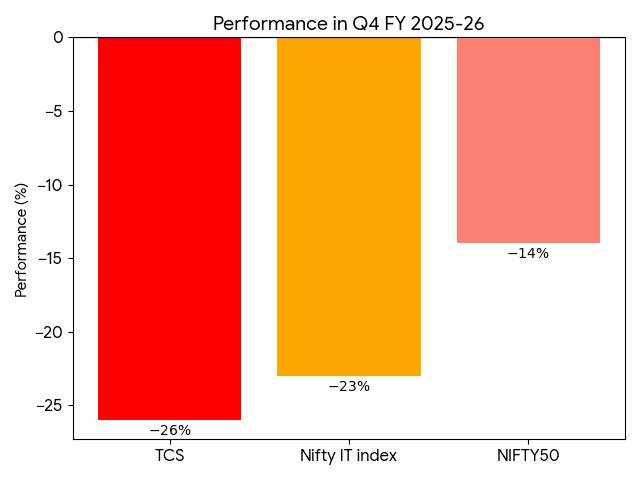
NIFTY50 has lost 3,798 points or over 14%, closing at 22,331.40 points as of March 30, 2026, compared to its 26,129.60 points at the beginning of the quarter, according to NSE data.
In the same period, the exchange data also showed that the Nifty IT index lost 23% in the January to March quarter of the fiscal year ended 2025-26, closing at 29,062 points on March 30, compared to 37,884 points at the beginning of the quarter.
TCS Q3 results snapshot
India’s largest IT company, Tata Consultancy Services (TCS), announced its October to December quarter results on January 12, 2026. The company recorded a 16% year-on-year (YoY) fall in net profits to ₹10,720 crore in the third quarter, compared to ₹12,444 crore in the same period a year ago, according to the consolidated financial statements.
The company’s revenue from core operations rose 4.8% to ₹67,087 crore in the third quarter of the fiscal year ended 2025-26, compared to ₹63,973 crore in the same quarter of the previous financial year, as per the NSE filing.
The central government’s new Labour Code norms weighed on the IT company’s net profits for the period. TCS also disclosed that the company recorded a ₹2,128 crore impact from the new labour codes.
The financials also showed that the company spent ₹1,010 crore in provisioning towards legal claims and used ₹253 crore for re-structuring expenses. Banking, Financial Services, and Insurance, along with Consumer business clients, are the biggest revenue generating segment for the IT major.
TCS’s board of directors also announced a third interim dividend of ₹11 per share, along with a special dividend of ₹46 apiece for every equity share with a face value of ₹1 per share, according to the NSE filing.
The company’s net profits also dropped on a quarter-on-quarter (QoQ) basis, dropping 11% to ₹10,720 crore, compared to ₹12,131 crore in the same quarter of the previous financial year.
| Key Highlights | Value | % Change |
|---|---|---|
| Net Profit (YoY) | (₹1,724 crore) | -16% |
| Net Profit (QoQ) | (₹1,411 crore) | -11% |
| Revenue (YoY) | ₹3,114 crore | 4.8% |
| Labour Code Impact | ₹2,128 crore | - |
| Provision for Legal Claims | ₹1,010 crore | - |
| Re-structuring | ₹253 crore | - |
| 3rd interim dividend | ₹11/share | - |
| Special dividend | ₹46/share | - |
Latest updates in Q4
Earlier this year, in January, TCS announced a strategic collaboration with global giant AMD to help enterprises scale AI adoption from pilots to production, modernise legacy environments, and build secure, high-performance digital workplaces, co-developing industry-specific AI and GenAI solutions.
In the same month, TCS also announced the construction of its largest delivery centre in Londrina, Brazil, for which the company will invest $37 million. The project is expected to generate more than 1,600 jobs, and the construction is set to be completed by 2027.
Among the most talked-about collaborations this year was the TCS-OpenAI deal, where the two global giants announced a multi-dimensional strategic partnership that will drive AI-powered innovation across enterprise, consumer, and social sectors.
As part of the AI deal, TCS will build a 100 megawatt (MW) AI data centre hub with an option to scale to 1 gigawatt in an effort to power next-generation AI workloads and position India as a global AI hub.
Thousands of employees at TCS will get access to Enterprise ChatGPT, accelerating innovation and productivity, as the company aims to leverage the global giant’s OpenAI Codex to boost software engineering outcomes.
In an exchange filing in March, TCS announced the launch of its seventh Gemini Experience Centre (GEC) at its Innovation Hub in Troy, Michigan, United States, in partnership with Google Cloud.
The company also said that by the end of 2026, TCS and Google Cloud will have a total of 13 GECs worldwide, with six additional centres set to launch this year, according to the company’s statement.
TCS share price trend
TCS shares closed 2.8% higher at ₹2,543.50 after the stock market session on Tuesday, April 7, compared to ₹2,473.90 at the previous market close, according to NSE data.
Shares of TCS have lost more than 22% over the last five years and over 21% of its value in last three-year period. The IT company’s shares dropped 22% over the last one-year period, according to the exchange data.
On a year-to-date (YTD) basis, TCS shares are down 21.19% so far in 2026, and have lost 0.55% in one month, but the IT stock is trading 7.83% higher over the last five market sessions on the Indian stock market.
TCS shares hit their 52-week high of ₹3,630.50 on May 12, 2025, while the 52-week low was at ₹2,346.20 on March 30, 2026, according to NSE data. The IT company’s market capitalisation (M-Cap) stood at over ₹9.20 lakh crore as of the stock market close on Tuesday, April 7, 2026.
Related News


About The Author
Next Story