Market News
Tata Motors shares jump 6% on strong Q1; analysts see earnings momentum building

4 min read | Updated on August 13, 2026, 09:55 IST


SUMMARY
The company reported an 83% jump in consolidated net profit to ₹2,556 crore in the first quarter ended June 30, 2026 (Q1 FY27), led by a mark-to-market gain on investments in Tata Capital Ltd.
Stock list
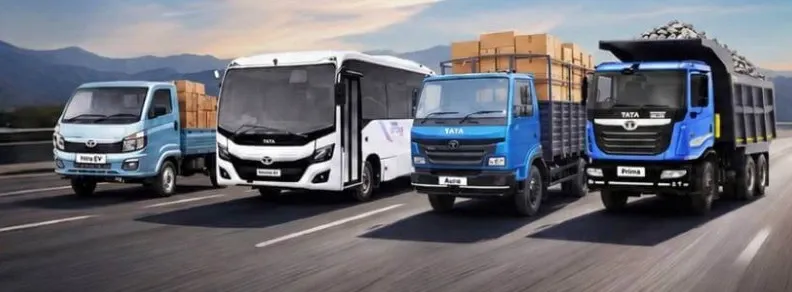
Tata Motors had posted a consolidated net profit of ₹1,397 crore in the corresponding quarter of the previous fiscal year. Image: Company website
Tata Motors shares were trading with impressive gains in the early trade on Thursday, August 13, after the leading commercial vehicle maker on Wednesday reported an 83% jump in consolidated net profit to ₹2,556 crore in the first quarter ended June 30, 2026 (Q1 FY27), led by a mark-to-market gain on investments in Tata Capital Ltd.
Mark-to-market (MTM) gains are the profits a company or investor has on an investment because its market value has increased, even if the investment has not actually been sold. For example, if you buy shares for ₹100 and their current market price rises to ₹120, you have an MTM gain of ₹20. However, the gain is only on paper until you sell the shares. If the market price subsequently falls, the MTM gain can reduce or turn into a loss.
The company had posted a consolidated net profit of ₹1,397 crore in the corresponding quarter of the previous fiscal year, Tata Motors Ltd said in a regulatory filing.
Consolidated total revenue from operations in the first quarter stood at ₹20,667 crore as against ₹17,324 crore in the year-ago period, it added. Vehicle wholesales in the quarter stood at 1,08,700 units, a growth of 26% over the year-ago period, it said.
Total expenses in the quarter under review were higher at ₹18,038 crore as compared to ₹15,982 crore in the same period a year ago, the company said.
CEO statement
Commenting on the performance, Tata Motors Ltd MD & CEO Girish Wagh said, “Tata Motors delivered a strong quarter, with volumes growing 26 per cent year-on-year, driven by a winning portfolio, focused market interventions, and disciplined execution. These efforts helped us strengthen customer preference and further consolidate our market position.”
Wagh said the commercial vehicle industry remained resilient in Q1 FY27, supported by India’s strong economic fundamentals, healthy fleet utilisation, and sustained demand across key sectors.
On the company’s acquisition of Iveco update, Tata Motors said the regulatory approvals are in the final stage, with only one approval pending, the company said.
What analysts are saying
Nomura cited a strong Q1 performance across segments, with EBITDA ahead of estimates. The investment firm expects margins to improve further, supported by price hikes. It also sees a brighter outlook for the commercial vehicle segment and has raised its FY27 forecast for medium and heavy commercial vehicle (MHCV) demand growth to 8% year-on-year from 5% earlier.
On management commentary, Nomura highlighted that 2QFY27 is expected to see healthy double-digit MHCV growth. Electric vehicle (EV) growth remains strong, with total cost of ownership (TCO) benefits kicking in earlier and EV penetration in small commercial vehicles (SCVs) reaching 10%*. The Indonesia order is expected to be delivered over FY27-28E.
On costs, the company expects some pressure ahead and has already taken a 2.5% price hike in July, while strong demand has also led to some supply constraints. The Iveco deal is expected to close by early November 2026.
CLSA on Tata Motors CV
CLSA reported a Q1 EBITDA margin of 11.3%, down 76 basis points year-on-year, but around 50 basis points ahead of consensus estimates. Tata Motors CV highlighted that the bulk of the margin decline was driven by commodity inflation, which had a 340-basis-point negative impact year-on-year. This was partly offset by operating leverage and price hikes, which provided a 140-basis-point positive impact.
While commodity costs remain inflationary, Tata Motors CV expects to mitigate the impact through the 2.5% price hike implemented in July, along with ongoing cost-reduction measures.
On demand, the company said underlying momentum remains healthy and expects commercial vehicle industry demand to remain robust, with 2QFY27 volumes likely to deliver double-digit growth.
Related News


About The Author
Next Story