
Market News
FIIs pump ₹22,693 crore into Indian equities after 5-day buying streak; what’s driving the massive inflows?

5 min read | Updated on November 06, 2026, 18:08 IST

SUMMARY
Foreign investors pumped ₹22,693 crore into Indian equities, maintaining a 5-day buying streak in search of lower-risk bets at a time when global equities remain under pressure due to the AI stocks rout.

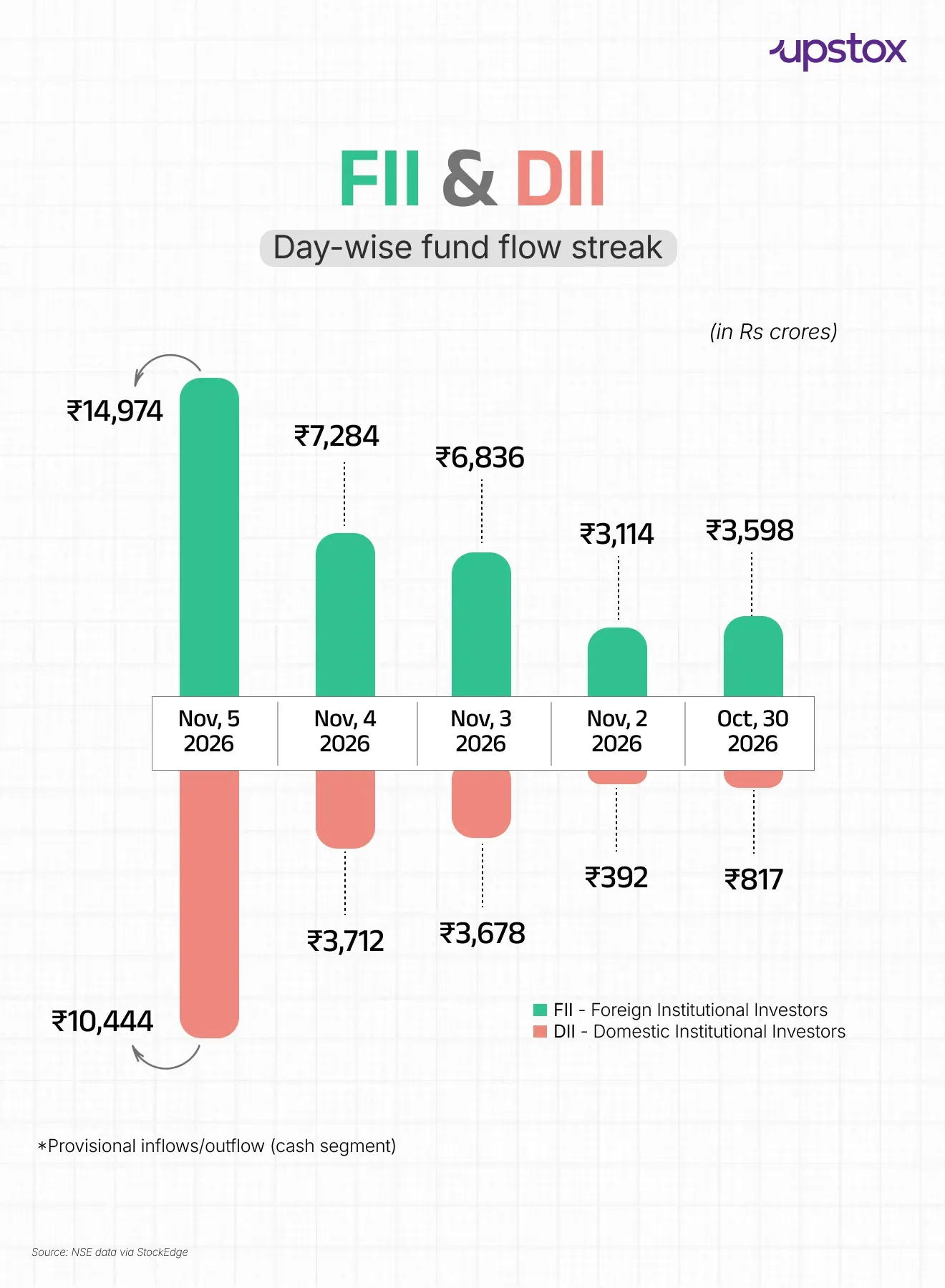
FIIs purchased net investments worth ₹22,693 crore in the Indian stock markets from the beginning of this month till Thursday, November 5.
The benchmark NIFTY50 index gained more than 9% in the last six days to hit its intraday high above 25,000 levels on Friday, November 6, as foreign institutional investors (FIIs) maintained their five-day buying support as of Thursday’s close, pumping around ₹22,693 crore this month into Indian equities at a time when global markets suffered massive losses.
The data for the final day of the week, i.e., Friday, November 6, will be released later in the evening; however, the intraday rally indicated that FIIs maintained their massive buying support throughout the day.
Despite the highly volatile crude oil prices, elevated risk sentiment due to the escalations in the US-Iran conflict, and a bloodbath in the global equity markets due to the AI trade reversal, FIIs seem to like Indian equities, offering them some stability and gains.
On Friday, the NIFTY50 index rallied 2% to hit an intraday high of 25,030.35 points on Friday’s market, in comparison to 24,536.60 points at the previous close level, as per NSE data.
The BSE SENSEX index surged 2.1% to hit a high of 81,028.02 points on November 6, reclaiming its above 80,000 levels on Friday’s market, in comparison to the previous market close of 79,310.01 points.
In the last six days, the benchmark index has delivered around 9.1% returns to investors at its day-high levels as of Friday’s market, as the outlook for Indian equities provides a low-risk bet with strong fundamentals for foreign investors amid the AI trade reversal on the global front.
Data also showed that BSE SENSEX gained 9.2% or over 6,800 points in the last six trading sessions as of Friday’s intraday high, when compared to the closing levels on October 29.
How much did FIIs buy in November?
So far in November alone, FIIs purchased net investments worth ₹22,693 crore in the Indian stock markets from the beginning of this month as of the market close on Thursday, November 5, 2026, according to NSDL data.
After two months of constant FII outflow pressure through September (₹58,443 crore outflows) and October (₹24,475 crore outflows), data showed that the positions have been reversing, with the selling pace slowing down in the first half of October 2026, after which foreign investors started buying Indian equities from mid-to-end of the month.
The five-day FII buying streak started on October 30, 2026, and since then, global investors have been maintaining their buying support in an emerging market like India, while exiting high-risk bets in developed markets.
With the Democratic Party taking control of the US Congress after winning a majority of seats in the US midterm elections, global investors are now afraid of a further crackdown on AI spending and the tech sector in the United States.
The impact of the same was visible in the sentiment for AI and tech stocks listed on Wall Street and Asian markets, resulting in a bloodbath with foreign investors exercising selling pressure, fuelling somewhat of a reverse AI trade.
As the funds flowed out of the AI and tech stocks, Indian equities offer an attractive bet with little exposure to artificial intelligence amid the Q2 earnings season for foreign investors to buy at an already beaten-down price after two months of selling.
Where have FIIs parked their money?
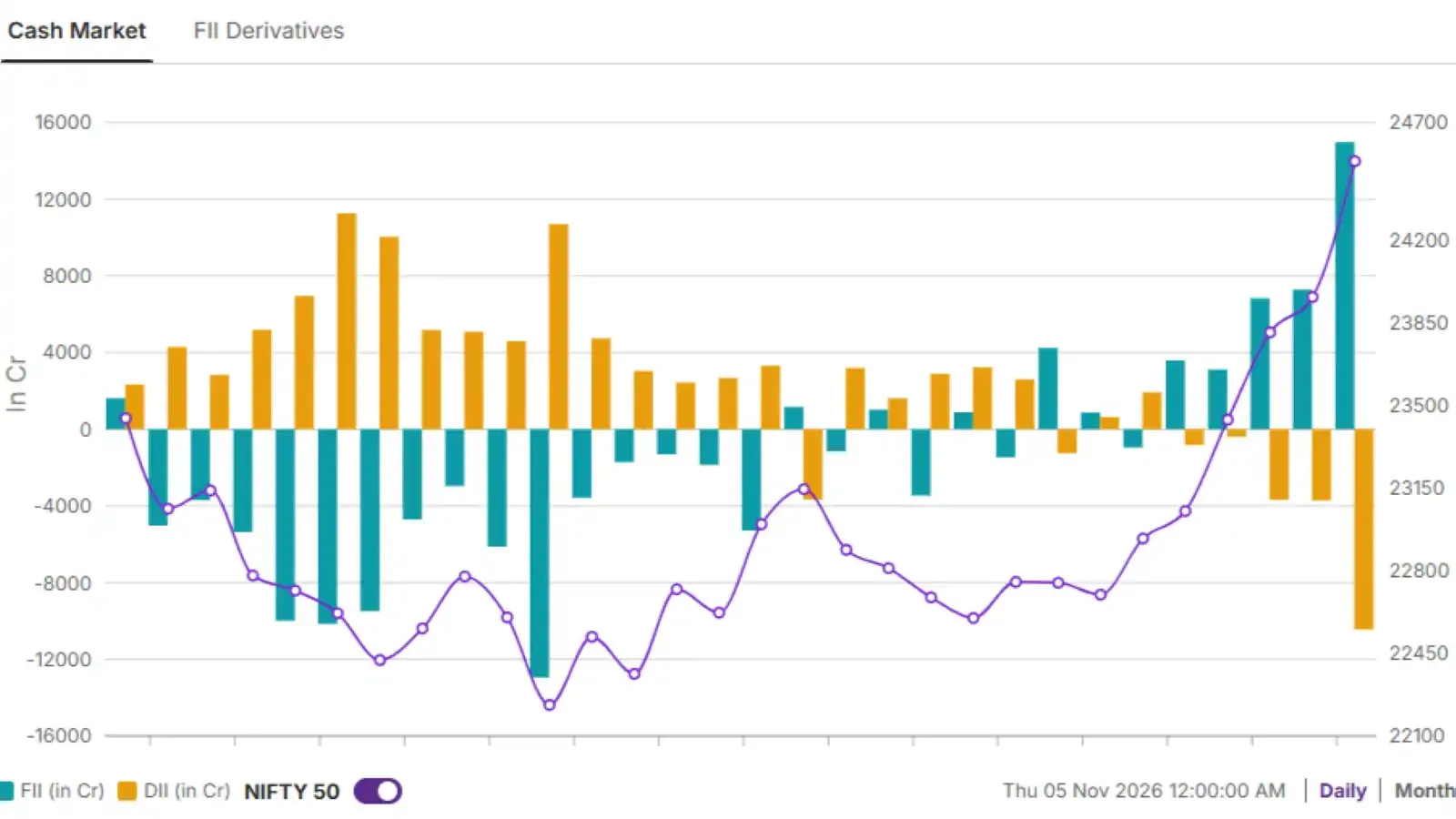
FIIs pumping money into Indian equities had to go somewhere, and the data shows that the inflows are likely to have been directed towards the large-cap stocks listed on the benchmark exchanges, rather than the higher-risk mid-cap or small-cap stocks in the last five days.
The following FII and DII chart, paired with the NIFTY50 index inflows, shows how the funds are likely flowing into large-cap stocks in the last five sessions, where foreign investors have powered their buying streak in the market.
The broader benchmark large-cap indices have relatively outperformed the mid-cap and small-cap peers with NIFTY50’s price-to-earnings (PE) ratio touching 19x, marking a four-year low compared to the median of 21.9x levels.
In comparison the PE ratio for NIFTY smallcap 100 was at 34.5x, trading at a significant premium of the five-year media of 29.1x, offering a much expensive bet for investors.
Similarly, the NIFTY Midcap 100 traded at 27.3x PE, slightly higher than the five-year median of 26x.
However, concerns still remain regarding the sustainability factor for the FII influx momentum in Indian equities as if the AI trade reversal stops in the global market the fund flows can potentially be impacted amid the dynamic geopolitical environment.
India has to offer foreign investors a combination of several factors like corporate earnings growth, reasonable valuations, currency stability and friendly policy environment to keep drawing global investment into the country.
Related News


About The Author
Next Story

