
Market News
RBI monetary policy: Interest rates on hold, inflation risk at 5.9% in Q3 FY27 amid energy crisis; check key takeaways

7 min read | Updated on June 05, 2026, 12:35 IST


SUMMARY
Reserve Bank of India kept its interest rates unchanged with a neutral stance as inflation risks appear for the third quarter of the current fiscal year amid the energy and supply crisis. Check key takeaways here.
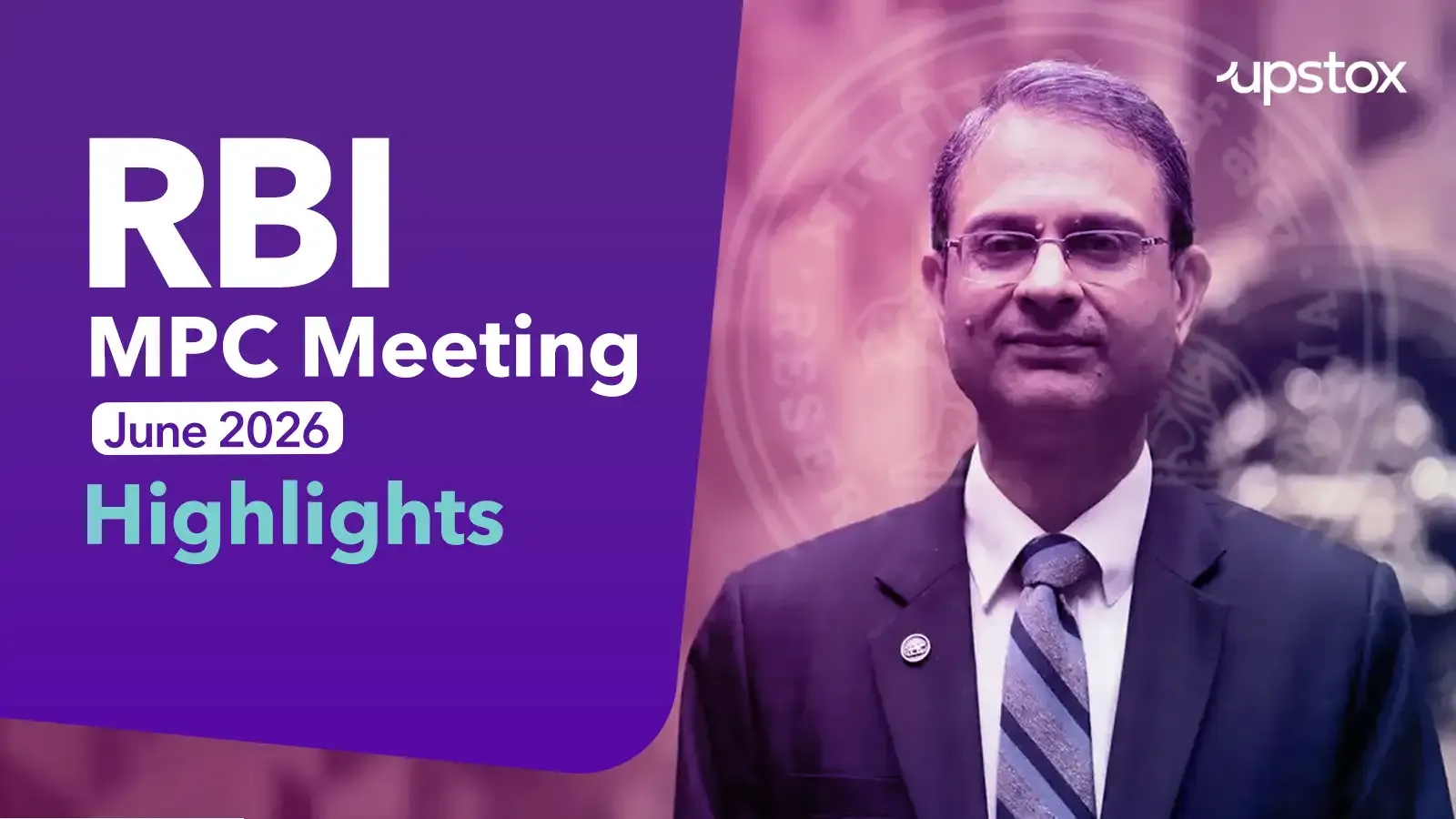
RBI decided to keep the key interest rate of the Indian economy unchanged at 5.25% on Friday, June 5.
RBI’s decision to keep the interest rates on hold comes for the third consecutive time since the February policy meeting, as the central bank maintains its stance of a ‘wait and watch’ approach amid the volatile market environment and supply chain dynamics.
The last rate cut from the central bank was carried out in December 2025, when the RBI cut the repo rates by 25 basis points to 5.25%, from an earlier 5.5% level. With a stance change from “accommodative” in December to ‘neutral’ since February, RBI now aims to analyse upcoming data to evaluate the interest rate trajectory in the financial year.
Experts predict that the RBI’s June 2026 policy decision to keep the rates unchanged comes as the MPC committee does not plan to use interest rates as the first line of defence for the Indian rupee, hence marking a calibrated rate pause, rather than a passive one.
Key takeaways from RBI’s MPC outcome
RBI holds repo rate at 5.25%
Governor Sanjay Malhotra-led Reserve Bank of India’s monetary policy committee (MPC) decided to keep the benchmark policy repo rate unchanged at 5.25% in June 2026, while retaining its ‘neutral’ stance amid the escalating energy prices and global supply chain disruptions.
The MPC committee acknowledged that the global environment has deteriorated since the last policy meeting in April 2026, with the current situation of a fragile ceasefire agreement in West Asia.
On the backdrop of the heightened uncertainty, Sanjay Malhotra, Dr Nagesh Kumar, Saugata Bhattacharya, Prof. Ram Singh, Dr Poonam Gupta and Indranil Bhattacharyya unanimously decided Friday’s monetary policy action.
“The adverse implications of the extended disruption in supply chains and elevated energy prices are reflected in the moderation of growth and increase in inflation projections from the April policy,” said Governor Malhotra.
Is there inflation risk ahead?
Although the consumer price index (CPI) inflation rate remains under the RBI’s target level of 4% as of date, the central bank expects the retail inflation rate to rise to the upper tolerance band in the third quarter of the fiscal year ending 2026-27.
RBI predicts that the inflation rate is expected to reach 5.9% by the third quarter of FY2027 due to the underlying inflation pressures amid the risk of the El Niño effect and the elevated energy prices.
“International crude oil prices (Indian basket) have averaged around $110/barrel during April-May 2026, and indications are that average oil prices for 2026-27 would be substantially higher than what were assumed during the last policy statement,” said Malhotra in his policy address.
Earlier, the expectations were around crude oil hovering at an average of $85/barrel as of the April 2026 policy meeting.
“The issue is not whether inflation is contained today; it is whether crude, rupee weakness, higher freight costs, trade-route disruption and fuel-price pass-through create second-round effects. With petrol and diesel prices already seeing multiple hikes in May and the rupee under pressure, the inflation risk is no longer theoretical,” said Harshal Dasani, the business head of INVasset PMS.
RBI predicts that the CPI inflation rate in the Indian economy will rise to 4.1% in Q1, 5.1% in Q2, 5.9% in Q3, and 5.4% in Q4 FY2027.
RBI GDP growth forecast
RBI, in its June 2026 monetary policy, forecasted that the real GDP growth for the financial year ending 2026-27 is estimated to grow at the rate of 6.6% due to the rise in energy prices and other input costs, combined with supply chain disruptions.
The second advance estimates released by the National Statistical Office (NSO) showed that India’s real GDP growth was at a rate of 7.6% in the financial year 2025-26 due to strong private consumption and fixed investment expansion.
The early estimates show that the RBI anticipates the GDP growth to witness a weaker surge due to the geopolitical crisis. However, the central bank also remains observant to monitor the ultimate duration of the West Asia conflict, along with the monsoon this season, to chart the growth.
“Sustained momentum in services, continuing impact of GST rationalisation, and broadly stable employment conditions should continue to support urban consumption,” said RBI Governor Malhotra.
Prolonged global supply chain disruptions, volatility in global financial markets, and weather-related shocks will continue to pose downside risks for the overall outlook for domestic growth.
“Growth forecasts have been moderated amid the lingering energy crisis and the spillover effects of the geopolitical conflict, with future concerns highlighted to reflect evolving ground realities that may alter the next course of action,” said Lata Pillai, Senior Managing Director and Head of Capital Markets India at JLL.
FPI outflows surge to $13.7 billion
RBI, in its June policy announcement, disclosed that the net foreign portfolio investors (FPIs) have witnessed a $13.7 billion of outflows primarily due to investors pulling out money from the emerging markets like India amid the geopolitical uncertainties.
“During 2026-27 so far (till June 2), net FPI to India, however, witnessed outflows of US$ 13.7 billion, primarily in the equity segment,” said Governor Malhotra.
However, the central bank also said that the ‘buoyant’ gross foreign direct investment (FDI) and higher net FDI in 2025-26 will underscore the continued interest of global investors in India.
How does India plan to attract foreign capital?
In the monetary policy announcement, the Reserve Bank of India announced five measures to attract foreign capital in the domestic markets.
RBI has planned to expand the new issuances of G-Secs (15, 30, and 40 years) under the Fully Accessible Route (FAR). They also plan to remove the limits of short-term investment, concentration and individual securities on FPI investment under the general route.
RBI also raised the limit of NRI and OCI investment limits in Indian equities, while also providing a facility of concessional forex swap till September 30, 2026, to incentivise ECBs by PSUs.
The central bank also proposed a similar facility for bearing the full hedging cost till September 30 to allow banks to raise fresh three to five-year FCNR (B) deposits.
RBI also proposed to restore the time for realisation of export proceeds to nine months.
“While these measures are expected to strengthen our balance of payments, we will continue to make the right policy adjustments to further promote exports and attract and incentivise capital inflows,” said Governor Malhotra in his address.
RBI raises NRI, OCI investment limits in equities
RBI, in its June MPC announcement, also disclosed that they are increasing the investment limit of Non-Resident Indians (NRIs) and Overseas Citizenship of India (OCI) holders in the equity markets without registration from the capital markets regulator, the Securities and Exchange Board of India (Sebi).
“The limits for investment by NRIs and OCIs in equity instruments traded on the stock market without Sebi registration are being increased,” said Governor Sanjay Malhotra in his policy address.
Malhotra also said that the same facility of an increased investment limit will also be allowed for all individuals, persons, and residents outside India at par with what is available to NRIs and OCIs.
This move is expected to improve the overseas investors' access to the Indian stock market in order to boost the overall participation in equities amongst Indians residing outside the country.
Related News

About The Author
Next Story

