
Market News
TCS Q1FY27 results: Revenue likely to remain flat, net profit could decline; focus on AI business growth and dividend
.png)
4 min read | Updated on July 09, 2026, 09:53 IST


SUMMARY
Tata Consultancy Services (TCS) is set to announce its Q1 FY27 results on Thursday, 9 July 2026, marking the start of the first-quarter earnings season. Investors will be closely tracking new deal wins, management commentary on the demand outlook, the impact of the conflict in the Middle East, AI-led business disruption, AI revenue contribution and dividend announcements.
Stock list
TCS options outlook: Open interest data for the 28 July expiry indicates substantial call writing at the 2,100 strike.
IT major Tata Consultancy Services (TCS) will announce its Q1 results on Thursday, July 9, 2026, kickstarting the first-quarter earnings season of financial year 2027.
The Tata-group company is expected to report low single-digit revenue growth of 1% to 2% QoQ and 12% to 13% YoY during the June quarter. The revenue is expected to remain between ₹71,450 and ₹71,850 crore. The company’s revenue could be impacted on a sequential basis amid delays in new deal wins because of weak macro from the West Asia war. TCS reported revenue of ₹70,698 crore in the previous quarter and ₹63,437 crore in Q1FY26.
On the profitability front, the IT major may report a 2 to 3% decline in net profit sequentially and a 4% to 5% rise on a yearly basis. Net profit could remain in the range of ₹13,450 to ₹13,890 crore. The company reported a net profit of ₹12,819 crore in Q1FY26 and ₹13,784 crore in the previous quarter.
According to experts, TCS's new deal wins are expected to remain in the range of $9 to $10 billion. Meanwhile, EBIT margin may narrow by 120 to 130 basis points in the range of 24.1 to 24.3% sequentially.
Investors will closely watch new deal wins and management’s commentary on the business outlook during the first-quarter results. The impact of the ongoing Middle East conflict on IT business and the fear of AI advancement on business will also be key. Revenue from the artificial intelligence (AI) business and dividend announcement will also be closely watched.
Ahead of the Q1 result announcement, TCS shares closed 1.7% lower at ₹2,059 on Wednesday, July 8. So far this year, TCS shares are down over 35% and also hit a 52-week low of ₹1,976 earlier this month amid weak discretionary spendings by clients and fears of AI disruption.
Technical view
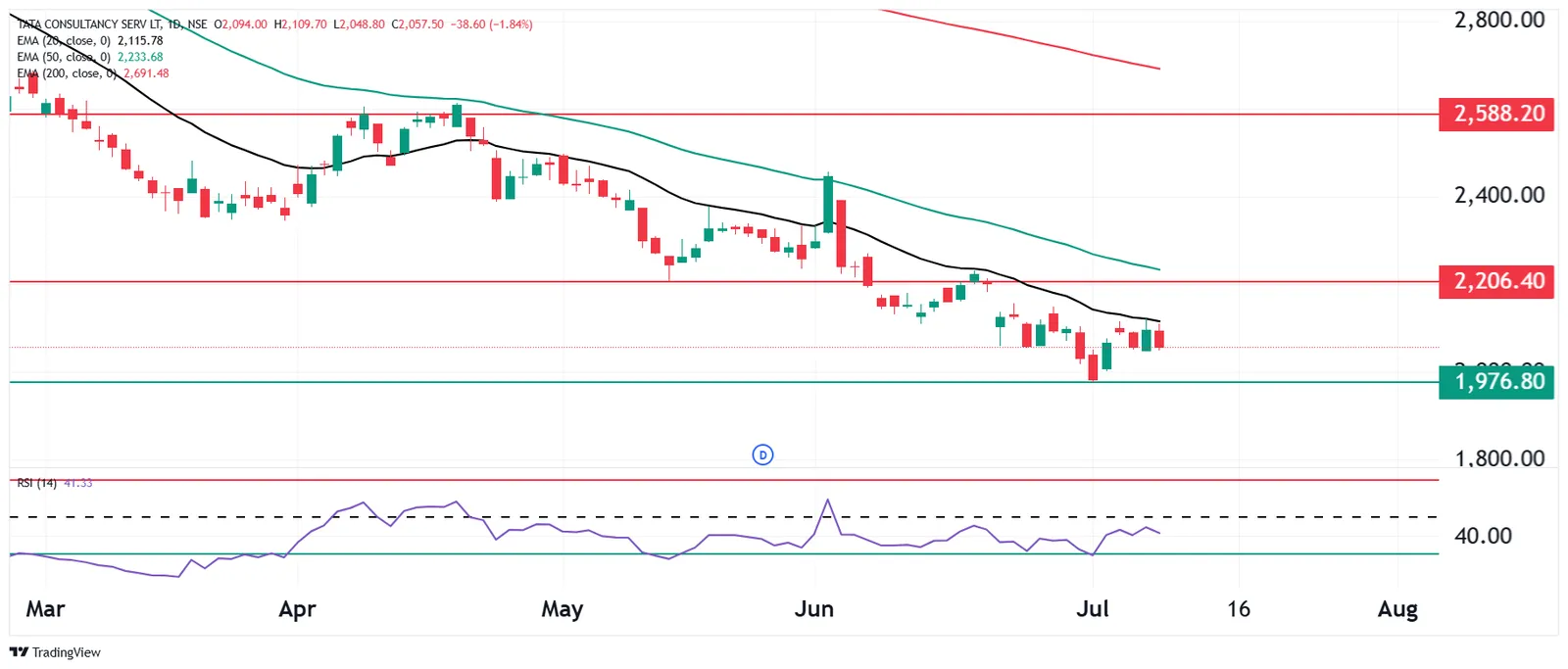
TCS remains in a weak structure on the daily chart. The stock is trading around ₹2,057, and the broader trend continues to be bearish as price remains below all key moving averages. This confirms that the short-term, medium-term, and long-term trend are still under pressure.
On the upside, ₹2,115–₹2,120 is the first resistance zone, where the 20-day EMA is placed. Above this, the next important resistance is around ₹2,206, followed by ₹2,230–₹2,235, near the 50-day EMA. A sustained close above ₹2,235 will be needed to show some improvement in momentum.
Options outlook
Open interest data for the 28 July expiry indicates substantial call writing at the 2,100 strike, suggesting resistance around this zone. Meanwhile, a minor put base was seen at 2,100 strike, signalling consolidation around this zone.
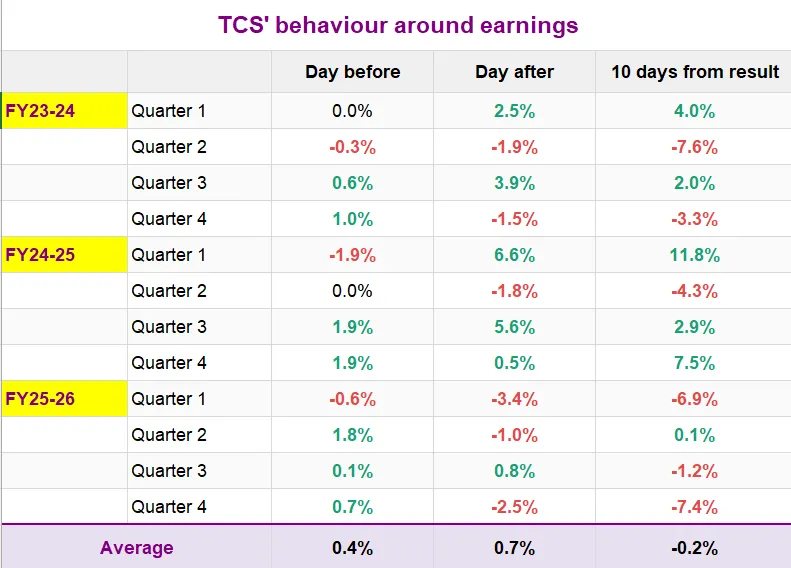
The at-the-money (ATM) strike on 8 July is at 2,040 strike and is priced at ₹130, implying an expected price movement of ±6.4% before the 28 July contracts expire. To judge this, let's examine how TCS has historically reacted to earnings announcements.
Options strategy and approach
The options market is currently factoring in a ±6.4% move in TCS for the July expiry, indicating scope for a volatility-driven trade on either side.
For traders expecting a sharp move, the long straddle remains a suitable strategy. It involves buying at-the-money call and put options with the same strike and expiry. The payoff comes if TCS moves beyond the implied ±6.4% range.
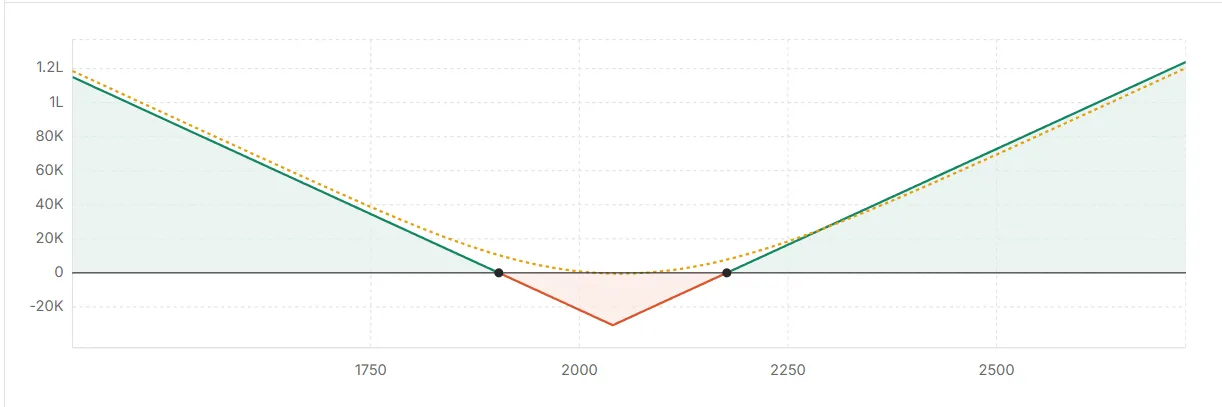
Conversely, if the view is for consolidation, a short straddle can be considered. This involves selling both the at-the-money call and put, benefiting if the stock stays within the ±6.4% band around the strike.
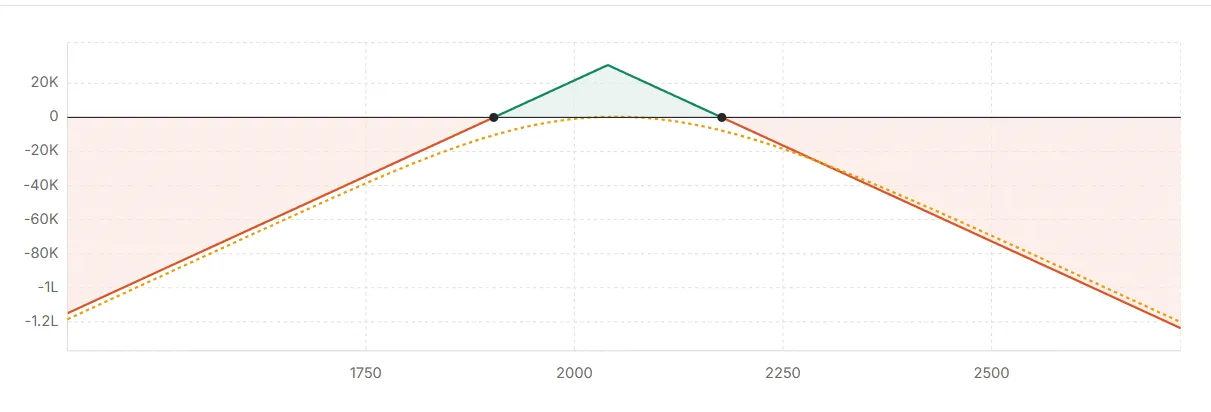
When it comes to positional setups, traders may consider defined-risk strategies such as a bull call spread or a bear put spread. Crucial levels to monitor are ₹2,150 on the upside and ₹1,950 on the downside, depending on whether the price breaks out or down from the current range.
Disclaimer:
Derivatives trading must be done only by traders who fully understand the risks associated with them and strictly apply risk mechanisms like stop-losses. We do not recommend any particular stock, securities, or trading strategies. The securities quoted are exemplary and not recommendatory. The stock names mentioned in this article are purely to show how to do an analysis.
About The Author
Next Story

